Korean Sunscreen Pilling or White Cast? Here’s What Causes It
Sunscreen that rolls into little gray threads the moment foundation touches it. A chalky film that only shows up in photos. That slow sting under the eyelids around 2 p.m. None of these mean you picked a bad bottle. Korean sunscreen pilling, white cast and eye sting are three unrelated mechanical failures, and each one points somewhere different — usually at a filter type or a layering habit rather than the brand on the tube.
In This Guide

- Match the symptom to the mechanism
- Why Korean sunscreen pilling happens
- The white cast is optics, not quality
- When it migrates into your eyes
- Shine, slip and the noon reapplication problem
- A five-minute diagnosis
- Sources and further reading
- FAQ
Match the Symptom to the Mechanism
The four formats below are the ones Korean brands actually sell in volume. Read the table as a troubleshooting chart, not a ranking. Every format fixes one complaint and creates another.
| Format | Which problem it solves | Where it still fails | Typical price |
|---|---|---|---|
| Chemical or hybrid fluid (Beauty of Joseon Rice, Round Lab Birch Juice) | White cast. Nothing sits on the surface to scatter light back at the camera. | High-alcohol versions can travel into the eyes and dry out cheeks by afternoon. | $14–$20 |
| Mineral, zinc oxide based | Stinging and reactivity. The filters stay put on the surface instead of drifting. | Visible cast on deeper tones. The thicker film is also the one most likely to pill. | $16–$24 |
| Cushion or stick | Reapplication over finished makeup — the only format that genuinely allows it. | Almost nobody applies enough. Sticks drag on dry patches. | $18–$28 |
| Gel-cream hybrid | Midday shine on oily and combination skin. | Silicone-rich versions pill hard against silicone primers. | $15–$22 |
Why Korean Sunscreen Pilling Happens
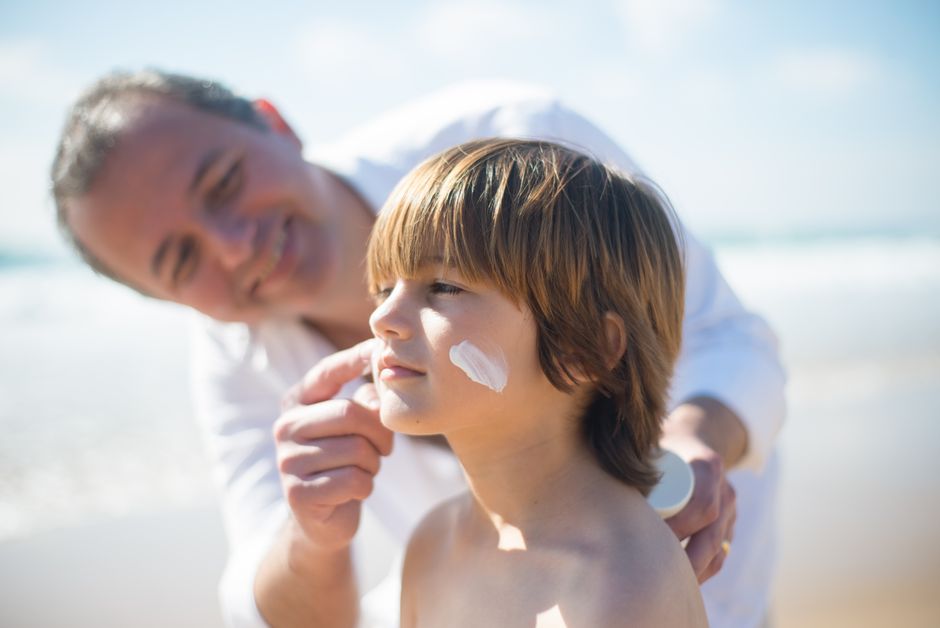
Pilling is not absorption failure. It is a film that never bonded, then got rubbed.
Sunscreen needs a continuous film to hit its labeled SPF. Formulators build that film with silicones, acrylate polymers and natural gums. Put a second gum-heavy or silicone-heavy product directly underneath and the two layers slide against each other instead of merging. One pass of a foundation brush shears them off together. Those gray threads are your serum and your sunscreen leaving as a unit.
When I lined up ingredient lists from a handful of popular Korean SPF fluids against the essences people layer beneath them, the overlap was obvious. Carbomer under carbomer. Dimethicone over dimethicone. The clash is the routine, not the sunscreen.
Three habits fix most cases.
- Wait properly. Give the layer beneath a full two to three minutes before sunscreen goes on. Rushing is the single most common cause dermatology clinics list.
- Press, do not buff. Pat the sunscreen down in sections. Circular rubbing is what physically rolls the film.
- Drop one product. If a hydrating toner, an essence and a gel moisturiser all sit under your SPF, remove the middle one for a week and watch what happens.
Still pilling after all three? Your primer is the likely culprit, not the sunscreen. Swap it before you swap the bottle.
The White Cast Is Optics, Not Quality
Zinc oxide and titanium dioxide protect by sitting on the skin surface and scattering ultraviolet light. Visible light gets scattered along with it. That is the cast — a physical property of the particle, not a sign the product was cheaply made. Titanium dioxide tends to read whiter than zinc oxide at comparable levels, which is why zinc-only mineral formulas are the friendlier starting point on medium and deep skin.
Melanin-rich skin shows it more because the contrast is greater. Nothing about the formula changed. Only the background did.
Korean brands attacked this from the chemistry side rather than the marketing side. Korea regulates sunscreen as a functional cosmetic, so newer organic filters entered the market there years before American shelves saw them. The United States went the opposite way, treating filters as over-the-counter drugs and leaving the approved list frozen for decades. That gap finally narrowed in June 2026, when the FDA published a final order amending Monograph M020 to permit bemotrizinol at concentrations up to 6 percent — the first new active in more than twenty years.
Practical upshot: if a cast is your only complaint, a modern organic-filter fluid removes it outright. There is nothing on the surface left to scatter light.
Tinted mineral formulas are the workaround if you need zinc for reactive skin. The pigment cancels the white optically. Match it the way you would match foundation, because a mismatched tint reads as a different problem entirely.
When It Migrates Into Your Eyes
Sunscreen rarely stings on contact. It stings later, and that timing is the clue. Sweat, sebum and ordinary facial movement carry the film downward across a couple of hours until it reaches the tear film. People report it most on hot commutes and after workouts, which fits the mechanism.
Skin reacts individually here, so treat the following as starting points rather than rules:
- Alcohol-heavy quick-dry fluids migrate faster than richer creams. The finish you like is doing the travelling.
- Fragrance is a common irritant near the eye. A fragrance-free version of the same product is the cheapest test you can run.
- A zinc-based stick around the orbital bone gives you protection with far less drift. Most people find it the practical fix.
One boundary worth naming. Redness, watering or burning that persists after rinsing is not a formula preference problem — stop the product and see a dermatologist or an eye doctor. Nothing in a skincare article substitutes for that.
Shine, Slip and the Noon Reapplication Problem
Oily skin does not break sunscreen. It dilutes the film and slides it around, which reads as shine by lunchtime and as patchy protection by mid-afternoon.
Gel-creams with silica handle this best. A light dusting of loose powder over a set sunscreen holds the film without dissolving it, which sounds fussy and takes about nine seconds.
The reapplication question is where most daily routines quietly fail. The American Academy of Dermatology guidance on applying sunscreen puts reapplication at every two hours of sun exposure. A lotion cannot do that over finished makeup. A cushion or a stick can, and that is the entire reason those formats exist — not because they protect better, but because they are the ones you will actually use at noon.
Applying too little is the other half of it. Laboratory SPF testing assumes a far thicker layer than most people apply, which means a labeled SPF 50 worn thinly performs nowhere near 50. Two passes beat one generous smear.
Patch testing catches the reactive formulas before they cost you a full bottle, and the same routine applies here — see how to patch test a new skincare product safely.
A Five-Minute Diagnosis
- ✅ Threads or crumbs under makeup → count the layers underneath and cut one. Then press instead of rubbing.
- ✅ Grey film in photographs → check the label for titanium dioxide. Move to a zinc-only or organic-filter fluid.
- ✅ Stinging after two hours → switch to a lower-alcohol texture and put a stick around the eye area.
- ✅ Shine by noon → silica gel-cream, plus powder over the top rather than a heavier base.
- ✅ Nothing improves after two weeks of one change at a time → book a dermatologist rather than buying a sixth bottle.
Change one variable per week. Changing three at once tells you nothing about which one worked.
Sources and Further Reading
- American Academy of Dermatology — How to select a sunscreen
- American Academy of Dermatology — How to apply sunscreen
- American Academy of Dermatology — Sunscreen FAQs
- Federal Register — Amending OTC Monograph M020 (bemotrizinol final order, 10 June 2026)
- INCIdecoder — Zinc oxide ingredient profile
FAQ
Does a white cast mean the sunscreen is working?
No. It means mineral particles are scattering visible light on the surface. Protection and appearance are separate properties, and an invisible organic filter can hit the same SPF.
Why does my sunscreen pill only on some days?
Usually the products underneath changed, or the wait time did. Humidity plays a part too — skin that is still damp holds a thicker film that shears more easily under a brush.
Are Korean formulas actually lighter than Western ones?
Often, yes, and the regulatory history explains why. Korea approved newer organic filters far earlier than the US did. Quality still varies enormously by brand, so read reviews from people with your skin type.
Can I fix stinging by using less product?
That trades one problem for a worse one. Thin application drops real-world SPF sharply. Change the texture or protect the eye area separately instead.
Does SPF in makeup count?
Not in practice. Foundation is never applied at the thickness its labeled SPF assumes, so it works as a bonus rather than a substitute.
If the formula side of your routine is what needs attention next, the 2026 Best K-Beauty Serums for Every Skin Type breakdown covers what belongs under sunscreen and what fights with it.