Thailand Cut Visa-Free Stays to 30 Days: How Digital Nomads Plan a 2-, 3-, or 6-Month Stay Now (2026)
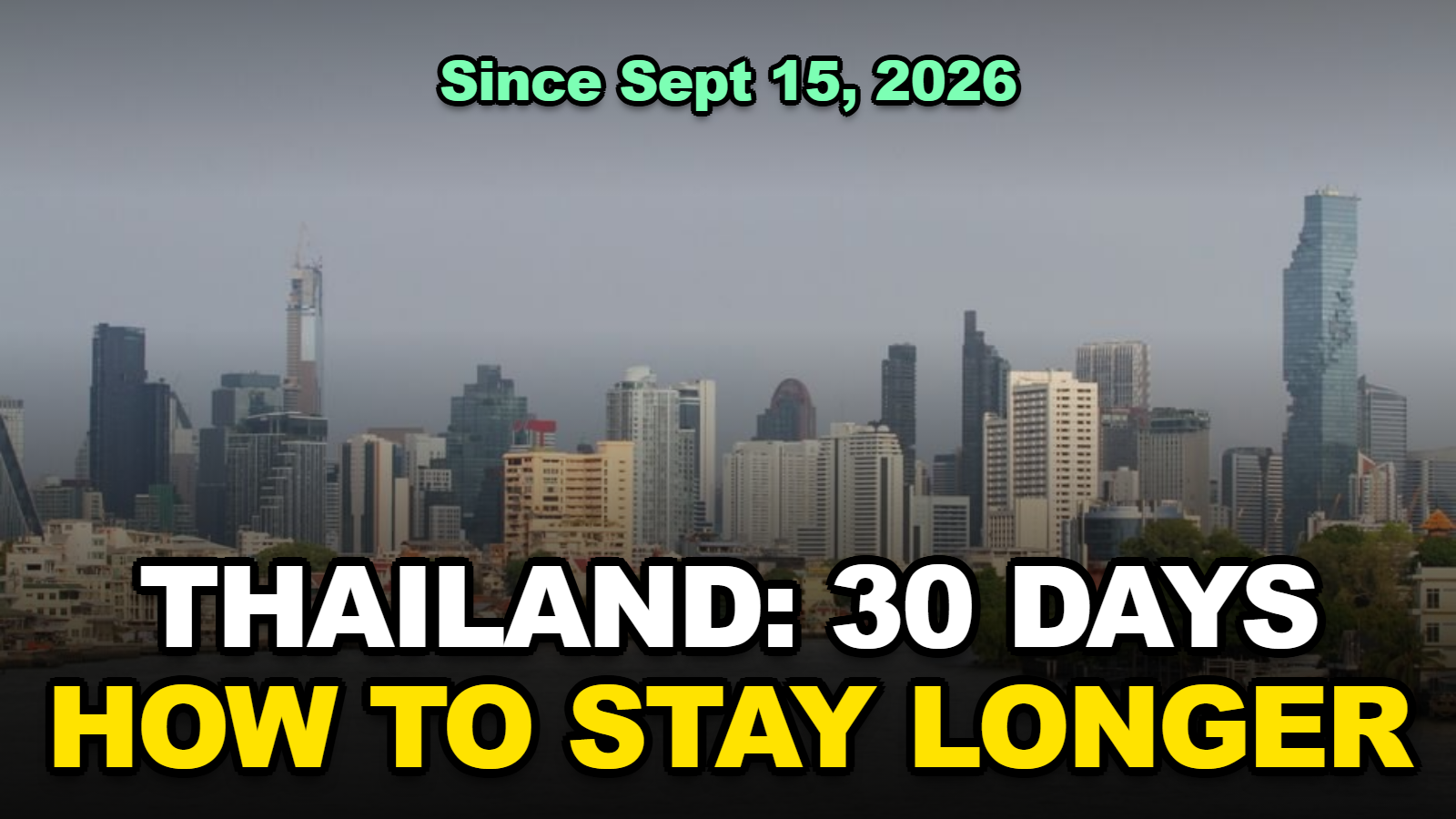
Short answer: Since September 15, 2026, US, UK, EU, Canadian, and Australian passport holders get 30 visa-free days in Thailand, down from 60. You can add one 30-day extension at an immigration office for 1,900 baht. The new exemption is for tourism only. For a two-month trip, the extension works. For three months, a tourist visa is simpler. If you’ll be working remotely for longer, the DTV is the route built for it.
Sixty days used to be the easy default. Land in Bangkok, work from a café in Chiang Mai for two months, fly out. That plan now breaks at day 30.
Here is what changed, what each longer-stay option costs, and which one fits a 6-week, 3-month, or 6-month stay — with the remote-work question most guides skip.
Jump to a Section
- What Changed in Thailand’s Visa Exemption on September 15, 2026?
- Can You Still Extend a 30-Day Visa-Free Stay in Thailand?
- Can You Work Remotely on Thailand’s Visa Exemption?
- Which Option Fits a 6-Week, 3-Month, or 6-Month Stay?
- Is the DTV Worth It for a Shorter Stay?
- Do Border Runs Still Work?
- Tips
- Warnings
- FAQ
- Sources
What Changed in Thailand’s Visa Exemption on September 15, 2026?
Thailand cut its visa-exempt stay from 60 days to 30 days on September 15, 2026, and shrank the list of eligible countries from 93 to 60, according to immigration law firm Fragomen. The 30-day group includes the United States, the United Kingdom, Canada, Australia, Japan, and most EU countries.
A few details matter for nomads:
- Mauritius and Seychelles nationals get 15 days instead of 30.
- Entries over land borders on the exemption are capped at two per calendar year. Air arrivals have no fixed cap but are up to the officer.
- Anyone who entered before September 15 on the old 60-day exemption keeps the full stay they were stamped for.
Thailand’s Ministry of Foreign Affairs keeps the official visa exemption list. Check your own passport there before booking.
Can You Still Extend a 30-Day Visa-Free Stay in Thailand?
A 30-day Thailand visa exemption can still be extended once, by up to 30 days, at any immigration office for a fee of 1,900 baht, as long as you apply before your stamped date runs out, according to VisasNews and DoVisa’s 2026 summary. That puts the practical maximum at about 60 days without a visa.
You’ll need form TM.7, a passport photo, and your passport. The extension is up to the immigration officer. It’s usually routine, but it’s not automatic.
And you can only do it once. There’s no second extension on the same entry.
Can You Work Remotely on Thailand’s Visa Exemption?
Thailand’s post-September 2026 visa exemption is described as being for tourism purposes only, which is narrower than the old 60-day scheme that also covered short-term business and urgent ad-hoc work, according to Thai law firm Dejudom Law’s analysis. The rule text doesn’t spell out whether answering emails for a foreign employer counts as “work.”
When I checked the 2026 guidance from Fragomen, Dejudom Law, and DoVisa, I found that none of them said remote work was clearly allowed on the new exemption. The only work carve-out Fragomen describes is an “Urgent Work Notification” for specific urgent tasks of up to 15 days. That’s not ongoing laptop work.
Here’s where people get tripped up. “Nobody checked” isn’t the same as “allowed.” If you’ll spend most of your trip working, the Destination Thailand Visa exists for exactly that.
Which Option Fits a 6-Week, 3-Month, or 6-Month Stay?
For a Thailand stay of up to about 60 days, the 30-day exemption plus one 1,900-baht extension is the cheapest option in 2026; for around three months, a 1,000-baht single-entry tourist visa (TR) is simpler; and for six months or more of remote work, the 10,000-baht Destination Thailand Visa is the option designed for it. Those fees come from DoVisa’s 2026 guide and the Thai e-Visa portal.
| Option | Stay per entry | Fee (THB) | Apply | Best for |
|---|---|---|---|---|
| Visa exemption | 30 days | Free | On arrival | Short holidays |
| Exemption + extension | Up to ~60 days | 1,900 | Immigration office in Thailand | 5–8 week trips |
| Tourist visa (TR), single entry | Up to 60 days | 1,000 | Thai e-Visa, before travel | Planned 2-month stays |
| Multiple-entry tourist visa (METV) | Up to 60 days per visit, 6-month validity | 5,000 | Thai e-Visa, before travel | Several trips in half a year |
| Destination Thailand Visa (DTV) | 180 days, extendable 180 | 10,000 | Thai e-Visa, before travel | Remote work, 3+ months |
Table: Thailand stay options for US/UK/EU passport holders after September 15, 2026, compiled from DoVisa, Fragomen, and the Thai e-Visa portal as of September 30, 2026. Fees can change and some embassies set extra requirements.
When I compared the costs for a 90-day stay, the visa route came out cheaper than you might expect. A TR visa is 1,000 baht. Doing two visa-exempt entries with an extension each means 3,800 baht in extension fees, plus a flight out, plus two rounds of border questions.
Is the DTV Worth It for a Shorter Stay?
The Destination Thailand Visa costs 10,000 baht, is valid for five years with multiple entries, and allows up to 180 days per entry. It also requires a bank balance of at least 500,000 baht, so it makes financial sense mainly for people who plan to return to Thailand more than once or stay longer than three months.
It’s also getting stricter at some embassies. Envoy Global reported that from August 31, 2026, the Royal Thai Embassy in London requires DTV applicants to show permanent residence in the UK, Ireland, or a British Overseas Territory, plus a police clearance certificate issued within six months.
Honestly, for a single six-week trip it’s overkill. For anyone planning two or three Thailand stretches over the next few years, it pays for itself fast in saved visa runs.
Do Border Runs Still Work?
Border runs are now limited: Thailand allows visa-exempt entries over land borders no more than twice per calendar year for most nationalities, while air arrivals are not capped but remain at the immigration officer’s discretion, according to Fragomen and Dejudom Law. Repeated short exits and re-entries draw questions.
A fly-out-and-back to Kuala Lumpur or Penang still resets you to a fresh 30 days if the officer lets you in. Officers can ask for an onward ticket, proof of funds, or your accommodation. Nomads with a passport full of back-to-back Thai stamps are the ones who get asked.
Most people skip this reality check and regret it. Plan your stay around a legal option instead of around how many times you can re-enter.
Tips
- Set a phone reminder for day 25 of your stamp. The extension must be filed before your permitted stay ends.
- Book accommodation that can issue you a TM30 address notification receipt, since immigration offices may ask for it when you apply for an extension.
- Keep screenshots of your e-Visa approval and onward flight offline in case airport Wi-Fi fails.
Warnings
- Overstaying in Thailand brings daily fines and, for longer overstays, entry bans. Don’t count on an extension being approved on your last day.
- Rules differ by nationality and embassy. Always check the Thai e-Visa site and your local Thai embassy before you book.
- This guide is general information as of September 30, 2026, not legal or immigration advice.
FAQ
I entered Thailand on September 10 with a 60-day stamp. Am I affected?
No. Travelers who entered before September 15, 2026 keep the full period stamped in their passport. The 30-day limit applies from your next entry onward.
Can I apply for the DTV while I’m already in Thailand?
DTV applications go through the Thai e-Visa system and Thai embassies or consulates outside Thailand. Some embassies, such as the Royal Thai Embassy in London, now also require proof of residence and a police clearance certificate.
Does the 30-day rule apply to Americans?
Yes. US passport holders are on the 60-country list that receives 30 visa-exempt days from September 15, 2026, with the option of one 30-day extension for 1,900 baht.
Sources
- Fragomen — Thailand: Reduction in Visa-Exempt Stay Duration
- Ministry of Foreign Affairs of Thailand — Visa exemption and visa on arrival
- Thai e-Visa — Destination Thailand Visa (DTV)
- DoVisa — Thailand 30-Day Visa-Free Limit: Longer-Stay Options
🔗 Related guides
- Korea’s F-1-D Visa Just Went Permanent With a 3-Year Stay — How It Compares to Thailand’s DTV and Malaysia’s DE Rantau (2026)
- Working Remotely on a Tourist Visa in Europe? Here Is the Real 2026 Crackdown Risk—and How to Convert to a Nomad Visa Before It Costs You
- ChatGPT Plus, Claude Pro, or Google AI Pro: Which $20 AI Plan Actually Fits You (September 2026)
Fact-checked based on Fragomen, Thailand’s Ministry of Foreign Affairs, the Thai e-Visa portal, and 2026 visa guides as of September 30, 2026. Not legal advice — immigration rules change and officers have discretion.