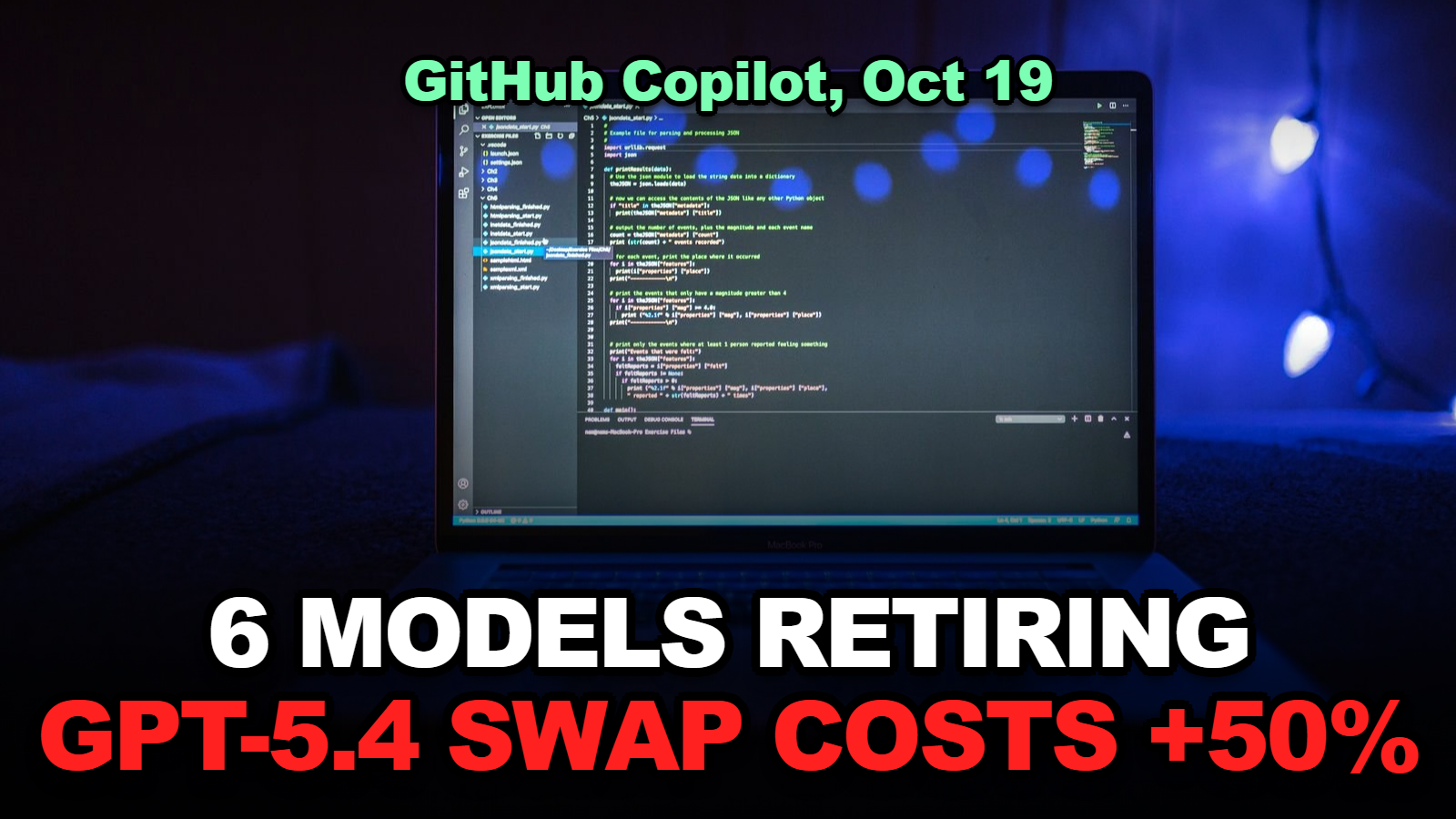
GitHub Copilot Retires GPT-5.4, GPT-5.5, and 4 More Models on October 19: Which Replacement Costs You More? (2026)
Short answer: GitHub Copilot retires six models on October 19, 2026. That includes GPT-5.5, GPT-5.4, GPT-5.4 mini, GPT-5 mini, Gemini 3.7 Flash, and Grok 4.5. GitHub’s suggested swaps are GPT-5.6 Sol, GPT-5.6 Luna, Gemini 3.8 Flash, and Grok 4.6. Most swaps cost the same or less. One doesn’t. Moving from GPT-5.4 to GPT-5.6 Sol raises the per-token price by 50% or more, so check that one before the deadline.
Six model names vanish from the Copilot picker on October 19. Nothing breaks loudly when that happens, which is the problem.
If you picked GPT-5.4 months ago because it was the sensible middle option, you’ve probably forgotten you picked it. After the cutoff you’ll land on something else, and your AI Credits will start draining at a different rate.
Here’s which model replaces which, what each swap does to your bill, and the places an old model name tends to hide.
What’s Covered
- Which GitHub Copilot Models Are Retiring on October 19, 2026?
- Will the Replacement Model Cost More in AI Credits?
- How Do You Switch Your Copilot Model Before the Deadline?
- Where Old Model Names Hide
- What Should Copilot Business and Enterprise Admins Do?
- Tips
- Warnings
- FAQ
- Sources
Which GitHub Copilot Models Are Retiring on October 19, 2026?
GitHub Copilot is deprecating Gemini 3.7 Flash, GPT-5.5, GPT-5.4, GPT-5.4 mini, GPT-5 mini, and Grok 4.5 on October 19, 2026, according to the GitHub Changelog post from September 18, 2026.
The retirement covers every Copilot surface: Chat, inline edits, ask and agent modes, and code completions. GitHub paired each retiring model with a suggested alternative.
| Retiring on Oct 19 | GitHub’s suggested replacement | Same family? |
|---|---|---|
| GPT-5.5 | GPT-5.6 Sol | Yes, newer flagship |
| GPT-5.4 | GPT-5.6 Sol | Moves up a tier |
| GPT-5.4 mini | GPT-5.6 Luna | Yes, small model |
| GPT-5 mini | GPT-5.6 Luna | Yes, small model |
| Gemini 3.7 Flash | Gemini 3.8 Flash | Yes |
| Grok 4.5 | Grok 4.6 | Yes |
Table: mapping from the GitHub Changelog deprecation notice, checked October 6, 2026.
Look at the second row. GPT-5.4 doesn’t get a same-tier successor. It gets bumped up to the flagship.
Will the Replacement Model Cost More in AI Credits?
For most GitHub Copilot users the October 2026 replacements cost the same or less per token, but anyone moving from GPT-5.4 to GPT-5.6 Sol pays $4.00 instead of $2.50 per million input tokens and $20 instead of $15 per million output tokens, based on GitHub’s published model pricing.
Copilot moved from premium-request multipliers to GitHub AI Credits on June 1, 2026. As of October 2026, the GitHub Docs models and pricing page sets 1 AI credit at $0.01 and bills each model at its own per-token rate. So a model swap is now a price change, not just a quality change.
When I compared the old and new rates line by line, I found that only one of the six swaps raises your cost. To make it concrete, here’s one typical agent-mode request (100,000 input tokens, 10,000 output tokens, no cache hits) priced at each model’s standard rate:
| Swap | Old input / output (per 1M) | New input / output (per 1M) | Sample request: old → new | Change |
|---|---|---|---|---|
| GPT-5.4 → GPT-5.6 Sol | $2.50 / $15.00 | $4.00 / $20.00 | 40 → 60 credits | +50% |
| GPT-5.5 → GPT-5.6 Sol | $5.00 / $30.00 | $4.00 / $20.00 | 80 → 60 credits | −25% |
| GPT-5.4 mini → GPT-5.6 Luna | $0.75 / $4.50 | $0.20 / $1.20 | 12 → 3.2 credits | about −73% |
| GPT-5 mini → GPT-5.6 Luna | $0.25 / $2.00 | $0.20 / $1.20 | 4.5 → 3.2 credits | about −29% |
| Gemini 3.7 Flash → 3.8 Flash | $0.75 / $3.75 | $0.75 / $3.75 | 11.25 → 11.25 credits | No change |
| Grok 4.5 → Grok 4.6 | $2.00 / $6.00 | $2.00 / $6.00 | 26 → 26 credits | No change |
Table: our own calculation using the default-tier per-token prices on GitHub’s models and pricing page (checked October 6, 2026). Sample request = 100K input + 10K output tokens, no cache. Real requests vary, and long-context tiers cost more.
So if you were on GPT-5.4 because it was cheaper than GPT-5.5, the “suggested alternative” quietly undoes that choice.
Is that 50% real money? For one person doing light chat, probably not. For a team running agent mode all day, it can be the difference between staying inside the plan allowance and paying overage. Our breakdown of why Copilot bills jumped under AI Credits explains how that overage shows up.
How Do You Switch Your Copilot Model Before the Deadline?
In VS Code and JetBrains IDEs, the GitHub Copilot Chat model is changed from the current-model dropdown at the bottom of the chat view, per GitHub’s guide to changing the Chat model.
- Open Copilot Chat in your editor. In VS Code that’s the chat icon in the title bar.
- Click the model name at the bottom of the chat panel. It shows whatever you’re using now.
- Pick a model that isn’t on the retirement list. If cost matters more than raw power, compare Luna, Gemini 3.8 Flash, and Grok 4.6 before jumping to Sol.
- Run one real task you do every day and compare the result with what you got last week.
- Check your usage page a few days later to see how fast credits are moving.
Honestly, step 4 is the one people skip. A cheaper model that needs two retries isn’t cheaper.
There’s also the Auto option. GitHub says Auto picks a model “based on availability and to help reduce rate limiting.” That’s convenient, but it also means you don’t control which per-token rate you’re paying.
Where Old Model Names Hide
The chat dropdown is the obvious place. It isn’t the only one.
- Prompt files and custom agent files. If your repo has
.prompt.mdor agent definition files with amodel:line naming GPT-5.4 or Gemini 3.7 Flash, update them. Shared files affect the whole team. - Scripts that call Copilot from the command line. Anything passing a model name as a flag will need the new name.
- Team docs and onboarding notes. “Use GPT-5 mini for completions” in a README will confuse new hires in November.
- Code review settings. If you set a specific model for Copilot code review, check that page too.
When I checked GitHub’s changelog wording, I noticed that it says “no action is required to remove the models,” but it also says existing settings that need adjustments should be updated before the deadline. Those two lines together mean: GitHub cleans up the picker, you clean up your own configs.
What Should Copilot Business and Enterprise Admins Do?
For Copilot Business and Copilot Enterprise organizations, GitHub automatically enables the suggested replacement models under default model enablement, unless an admin has turned off that global default or explicitly disabled a specific model.
That automatic step is where teams get surprised. If you locked down your model list months ago, the replacements won’t appear on their own. Developers will just find their favorite model missing on October 20.
- Open your organization’s Copilot model policies and confirm GPT-5.6 Sol, GPT-5.6 Luna, Gemini 3.8 Flash, and Grok 4.6 are allowed. GitHub’s organization policy guide covers where those switches live.
- Decide whether you even want Sol as the GPT-5.4 replacement. If budget is tight, enabling Luna and leaving Sol off is a legitimate choice.
- Tell your team before the 19th. A two-line message beats twenty “where did my model go?” tickets.
If you’re weighing other models while you’re in there, our look at Grok 4.7 arriving in GitHub Copilot covers the newest xAI option.
Tips
- Switch before October 19, not after. You get a week of side-by-side comparison while the old model still works.
- If you used GPT-5.4 mini for quick edits, Luna is the easy win. It’s about a quarter of the price per token.
- Keep Sol for the hard tasks: multi-file refactors, tricky debugging. Use a cheaper model for boilerplate.
- Search your repos for the six old model names. A quick text search finds most stray configs in a minute.
Warnings
- Don’t assume “suggested alternative” means “same price.” The GPT-5.4 swap is a price increase.
- Long prompts can push you into the long-context tier, where Sol costs $8 per million input tokens.
- If your org disabled default model enablement, nobody gets the replacements automatically. Check before the deadline.
- Third-party blog posts about this change sometimes list different replacements. Use GitHub’s own changelog as the source of truth.
FAQ
What happens if I’m still using GPT-5.4 in Copilot after October 19?
GPT-5.4 stops being available in GitHub Copilot after October 19, 2026, so you’ll need to pick another model. GitHub’s suggested replacement is GPT-5.6 Sol, which costs more per token.
Is GPT-5.6 Luna good enough to replace GPT-5 mini for code completions?
GitHub lists GPT-5.6 Luna as the suggested replacement for both GPT-5 mini and GPT-5.4 mini. It’s also cheaper per token than either. Test it on your own codebase for a few days to confirm the quality holds.
Do I have to remove the old models from my organization settings?
No. GitHub says no action is required to remove the models after they’re deprecated. You only need to update settings that point to a retiring model and make sure the replacements are enabled.
Sources
- GitHub Changelog — Upcoming deprecation of selected GitHub Copilot models in mid-October (September 18, 2026)
- GitHub Docs — Models and pricing for GitHub Copilot
- GitHub Docs — Changing the AI model for GitHub Copilot Chat
🔗 Related guides
Fact-checked against GitHub’s changelog and GitHub Docs pricing as of October 6, 2026. Per-token prices can change; credit figures in the sample-request table are our own calculation.