Why Does My Toner Sting? What That Burn Actually Means
Updated July 29, 2026 · Checked against 3 public sources (AAD, FDA) · Edited by Sophie Park
The old locker-room myth about skincare said a toner sting meant the product was working. It doesn’t. Stinging is a nerve response in irritated or under-protected skin, and the only question worth asking is how long it lasts and what it leaves behind. When I lined up the ingredient lists of the K-beauty toners people most often flag as “burning” in public reviews, the same few entries kept turning up in the top third of the label. That is where this guide starts.
How to Patch Test a New Skincare Product Safely
In This Guide
- Normal tingle vs warning sign
- What actually causes the sting
- Which toner type fits which concern
- Where toner goes in the order
- Can you use an exfoliating toner daily?
- Does the 7-skin method make stinging worse?
- When to stop and when to see a dermatologist
- Checklist
- FAQ
Toner Sting: Normal Tingle or Warning Sign?
Here is the short version. A mild tingle that arrives on contact and is gone before you reach for the next step is generally tolerable, especially with an acid or fermented formula you have only used a handful of times. Anything that intensifies after the first few seconds, or leaves visible redness once it dries, is your barrier telling you it cannot handle what you just applied.
Match what you feel against the table before you decide whether to keep the bottle.
| What you feel | How long it lasts | What it usually points to | Next move |
|---|---|---|---|
| Light tingle, no redness | A few seconds | Acid or ferment your skin has not fully adapted to | Keep going, but cut the frequency in half for two weeks |
| Cool prickle only on damp skin | Under a minute | Product spreading on a very wet face, which speeds up penetration | Blot lightly first, then reapply |
| Burn that grows after 10 seconds | Several minutes | High-placement denatured alcohol, or a concentration your skin rejects | Rinse with cool water and stop the product |
| Sting plus tightness that lingers all day | Hours | Compromised barrier, often from over-exfoliating | Pause all actives, run a plain barrier routine |
| Stinging with swelling, hives, or weeping | Does not settle | Possible allergic contact reaction | Stop immediately and get medical advice |
Skin reacts differently from person to person, and none of this is a diagnosis. Two people can use the identical toner and have completely different experiences with it — one sails through, the other flares. If a reaction persists after you have stopped the product, see a dermatologist rather than working through a comment section.
What Actually Causes a Toner to Sting

Five things account for most cases. They are not equally common.
1. Denatured alcohol high on the label. Ingredient lists run roughly in order of quantity, so alcohol denat. sitting in the first few entries behaves very differently from the same word buried near the bottom. It evaporates fast, which is exactly why some formulas feel so light on oily skin. It also strips lipids on the way out.
2. Exfoliating acids your skin has not met yet. AHAs such as glycolic and lactic acid, BHA (salicylic), and the gentler PHA family all work by loosening dead surface cells. New users feel that. The sting typically softens over a few weeks of controlled use, and it typically does not soften if you use the product daily from day one.
3. A barrier that is already damaged. This is the one people miss. When the outer layer is depleted, a toner that felt fine last month starts stinging with no change to the formula at all. The product did not become harsher. Your skin became more permeable.
4. Fragrance and essential oils. Citrus and lavender oils are frequent irritants on sensitized skin, and “natural” is not a safety claim. If a toner stings and the acid content is negligible, check the fragrance line.
5. Application over freshly damaged skin. Scrubbing and shaving both leave microscopic disruption you cannot see. So does a recent retinoid session. Toner applied on top of it will sting even if the formula is gentle by any measure.
Notice how many of those have nothing to do with the price of the bottle.
Which Toner Type Fits Which Concern — and Its Sting Risk
Korean toners split into a few working lanes. Choosing by concern rather than by marketing copy removes a surprising share of stinging problems before they start, because most sting complaints trace back to someone using an exfoliating formula for a hydration problem.
| Toner type | The concern it suits | Typical key ingredient | Sting risk | Symptom that says you picked wrong |
|---|---|---|---|---|
| Hydrating essence-toner | Skin that feels tight and papery by mid-afternoon | Hyaluronic acid, glycerin | Very low | Tacky film under sunscreen, congestion on oily skin |
| Fermented antioxidant toner | Dull, flat-looking skin under makeup | Green tea or rice ferment filtrate | Low to moderate | Prickling on reactive skin within seconds |
| Mild exfoliating toner | Rough texture and visibly clogged pores | PHA or lactic acid | Moderate | Sting that keeps building, then peeling |
| Barrier-calming toner | Redness, reactivity, post-irritation recovery | Centella asiatica, panthenol | Lowest of the group | Little visible change on texture concerns |
| Jelly toner-serum hybrid | Short routines where you want one step to do two jobs | Humectants plus a light active | Depends entirely on the active inside | Overlap with a serum you already own |
If your skin is currently stinging, the barrier-calming lane is where you park it. Nothing else in the table is a recovery product.
Where Toner Goes in the Order — and How Order Creates Stinging
Toner comes after cleansing and before serum. That is the standard sequence in a Korean routine, and it holds for the same reason thin layers generally go before thick ones: a watery step spreads evenly on bare skin and stops the heavier layers from blocking it.
The order rules that matter for stinging are narrower than the internet suggests.
- Apply to skin that is damp, not dripping. A soaking face speeds absorption and can turn a mild formula sharp.
- Pat it in. Rubbing adds friction to skin that may already be tender.
- Give a hydrating toner 30 to 60 seconds before the next step. Give an exfoliating toner longer — a minute or two is the common recommendation.
- Do not put an acid toner directly under a retinoid on the same night. That combination is the single most reported cause of a wrecked barrier in the sting reports I read through.
- Vitamin C and other potent actives need the same spacing logic, which we broke down in Niacinamide vs Vitamin C: Which K-Beauty Serum Goes First in 2026.
The American Academy of Dermatology makes the broader point plainly: the order in which you apply skin care products changes how well each one works. Sequence is not a cosmetic detail.
Can You Use an Exfoliating Toner Every Day?
Most people should not, at least not at the start. The AAD’s position on exfoliating safely at home is that frequency depends on your skin type and the method, that gentler chemical exfoliation suits dry or sensitive skin better than mechanical scrubbing, and that over-doing it leaves skin red and irritated.
A workable ramp looks like this. Start at two nights a week. Hold there for three weeks. If there is no lingering sting and no flaking, move to every other night and hold again. Some skin never graduates past three nights a week, and that is a normal endpoint rather than a failure.
One thing people skip: acids raise sun sensitivity, so daytime sunscreen stops being optional the moment you add an exfoliating toner. Skipping it undoes the texture work you were chasing.
Does the 7-Skin Method Help, or Make Stinging Worse?
The 7-skin method means layering a watery toner several times in a row instead of applying one heavy dose. The reasoning is that repeated thin layers let skin take on hydration gradually. Dermatologists quoted on the practice treat it as a nice-to-have for dry or dull-looking skin rather than a requirement, and the number seven is not doctrine — three or four layers is a perfectly ordinary version of it.
Two conditions decide whether it helps or hurts you.
The toner has to be alcohol-free and hydration-focused. Repeating an alcohol-heavy formula seven times multiplies exactly the thing that dries you out. And it has to be a non-exfoliating toner — nobody should be applying seven layers of acid, which is worth stating plainly because the method gets recommended without that caveat all the time.
If layer two stings when layer one did not, stop there. That is a barrier signal, not a sign you need to push through.
When to Stop, and When to See a Dermatologist
Three signals mean the bottle goes back in the drawer. The sting lasts longer than a couple of minutes. Redness is still visible an hour later. Skin has started flaking somewhere it never used to. Any one of them is enough on its own.
Then give your face a plain routine for a week or two. Cleanser, a bland moisturizer, sunscreen. Nothing with an acid or a retinoid in it.
Get professional help if any of the following shows up:
- Swelling or hives
- Blistering or weeping skin
- A reaction that keeps going after you stopped using the toner
Persistent irritation is worth a dermatologist’s time. Self-treating a contact reaction with more products tends to drag it out.
US readers can also report a bad reaction to a cosmetic product directly to the FDA. Companies are not legally required to report these themselves, which is why consumer reports carry weight.
Checklist: What to Do Tonight
- ✅ Time the sting. Under a minute with no redness is one situation. Over a minute with flushing is another.
- ✅ Read the first five ingredients. If alcohol denat. is there and your skin stings, that is your likely answer.
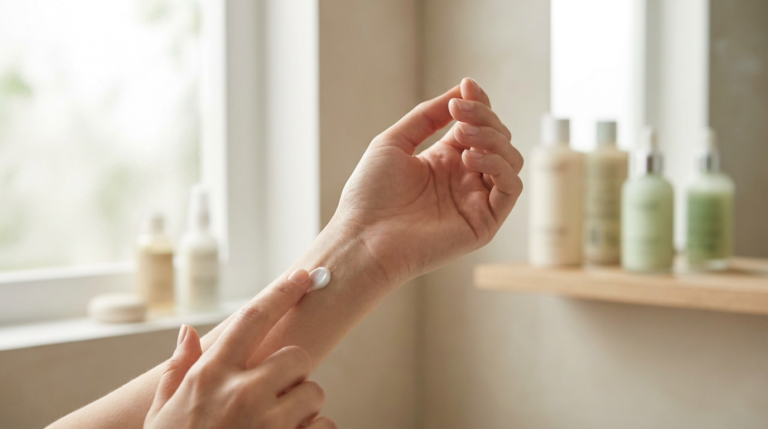
- ✅ Patch test on the inner arm for three days before anything new touches your face.
- ✅ Cut exfoliating toner use to two nights a week and hold for three weeks before increasing.
- ✅ Never stack an acid toner and a retinoid in the same session.
- ✅ If stinging persists after you stop the product, book a dermatologist appointment instead of buying a replacement.
FAQ
Does stinging mean the toner is working?
No. There is no reliable link between the sensation and the result. Plenty of effective toners cause nothing at all.
Do I need a toner if I already use a hydrating serum?
Not necessarily. If the serum is already carrying humectants, a hydrating toner is largely redundant. A barrier-calming toner is the more useful addition in that case.
My toner only stings around the nose and mouth. Why?
Those areas are thinner and see more friction from cleansing, blowing your nose, and shaving. Localized stinging there often means the barrier is thinner in that spot, not that the whole formula is wrong for you.
How long before a new toner shows results?
Hydration changes tend to be noticeable within one to two weeks. Dullness moves slower, closer to three. Judging a toner after two days is judging it blind.
Is it safe to use an exfoliating toner and a sheet mask on the same night?
Usually not a great pairing. A sheet mask holds product against skin under occlusion, which increases how much of the acid gets through. Separate them by a day.
New to the category and unsure where a toner belongs at all? Start with How to Build a K-Beauty Skincare Routine as a Beginner and add the toner step once the basics are steady.
Fact-checked based on public sources as of July 29, 2026. Ingredient behavior and skin reactions vary between individuals — this article is general information, not medical advice.
Sources & Further Reading
- AAD: How to apply your skin care products in the right order
- AAD: How to safely exfoliate at home
- FDA: How to report a cosmetic product related complaint