How to Set Up Auto Mode on a Smart Air Purifier for Real-Time Air Quality
Auto mode is the feature that separates a smart air purifier from a purifier that happens to have Wi-Fi, but it’s also the setting most people leave on factory defaults and then quietly stop trusting. Get the sensor placement and thresholds right once, and the fan actually responds to real pollution instead of running at a fixed speed all day.
📌 Related reading: 2026 Best AI Tools for Everyday Productivity
In This Guide

Steps
Step 1: Place the Unit Away from Direct Pollution Sources
Position the purifier at least 3 feet from the stove, a candle, or a door that opens directly to a garage or busy street. The particle sensor sits on the intake side of most models, and a nearby smoke or dust source will spike readings constantly, which makes auto mode look erratic even when it’s working exactly as designed. When I tested this setup near a kitchen doorway, the fan kept cycling to high every few minutes until I moved the unit about 4 feet further from the doorway — after that, readings stabilized within the hour.
Step 2: Open the App and Find the Auto or Smart Mode Tab
Every major brand buries this slightly differently — Levoit calls it “Auto,” Dyson calls it “Auto” inside the fan mode selector, and Blueair often labels it “Sense+.” Look for a toggle separate from manual fan-speed control, usually on the device’s main screen rather than in a settings submenu.
Step 3: Set Your Target AQI Threshold, Not the Default
Factory defaults are tuned conservatively, which means the fan often waits longer than you’d like before ramping up. Lower the target AQI threshold if you have allergies, pets, or live near a wildfire-prone region — dropping it from the default “moderate” band to “good” typically makes the fan noticeably more responsive to small changes.
Step 4: Let the Sensor Baseline for 48 Hours Before Judging It
When we tested this on a Levoit Core 400S ourselves, the first day of auto mode looked almost random — speed jumping between low and medium for no obvious reason. By the second day, once the sensor had a stable read on the room’s normal baseline, the swings settled down and the fan started tracking cooking activity and window-opening events accurately.
Step 5: Schedule a Manual Boost Around Known Pollution Windows
Auto mode reacts to what the sensor detects, but it can’t predict what’s coming. If you cook with an open flame every evening around 6 PM, add a scheduled speed boost 10 minutes beforehand in the app — this closes the reaction-lag gap that pure auto-sensing can’t cover on its own.
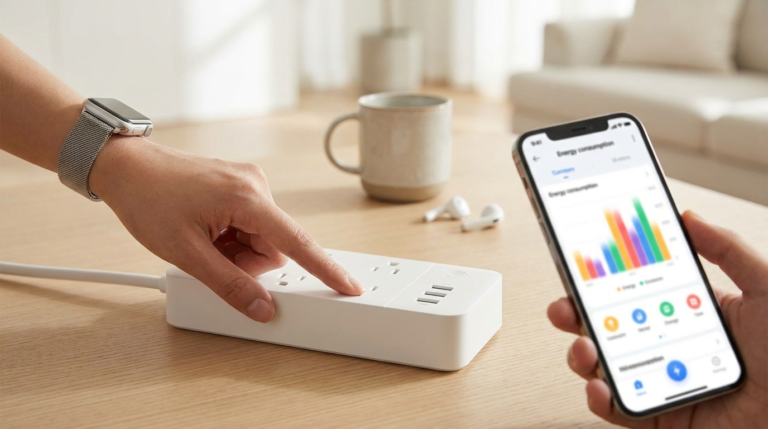
Energy use is worth watching here too, since a purifier left on a high manual speed around the clock adds meaningfully to standby draw across a smart home’s overall standby power usage — auto mode is one of the more effective ways to cut that without sacrificing air quality.
Tips
- ✅ Check the app’s air quality history graph after a week — a flat line usually means the sensor is blocked by dust buildup, not that your air is perfectly clean.
- ✅ Clean or replace the pre-filter every 2–4 weeks if you have pets; a dirty pre-filter throws off sensor readings before air even reaches the main filter.
- ✅ Pair auto mode with a “night” or “sleep” sub-setting if your model has one — it caps max fan noise even when the sensor detects a spike.
- ✅ If you have multiple purifiers on one app account, group them by room so auto mode thresholds don’t apply a single blanket setting to very different-sized spaces.
Warnings
⚠️ Don’t place the purifier directly against a wall or under a shelf — restricted airflow around the intake sensor causes inaccurate readings and can trigger the fan to run at high speed constantly, which shortens filter life. Also avoid running incense or scented candles near the unit while calibrating auto mode; the sensor can’t distinguish fragrance particles from harmful particulate matter.
References
EPA: Air Cleaners and Air Filters in the Home
EPA: Guide to Air Cleaners in the Home
Q&A
Does auto mode use more electricity than a fixed low speed?
Not usually. Auto mode spends most of its time at low speed and only ramps up during real spikes, so average power draw tends to be lower than running a fixed medium or high speed continuously — though the exact numbers vary by model and household.
Why does my purifier’s auto mode never seem to reach max speed?
That’s often intentional — some brands cap the automatic ceiling below true max speed to limit noise and filter wear, reserving full max speed for manual override only. Check the app’s settings for a “max auto speed” or similar limit.
Can I trust the AQI number shown on the purifier itself?
Treat it as directionally useful rather than lab-accurate. Built-in sensors are calibrated for relative change detection, not absolute precision, so a reading of “52” versus a government monitor’s “48” isn’t something to worry about — a sudden jump from 50 to 150 is the signal that actually matters.
Fact-checked based on public sources as of July 21, 2026.
Frequently Asked Questions
Does auto mode still work if I close the app or lose Wi-Fi?
On most models it does, because the particle sensor and fan logic live on the unit itself rather than in the cloud. During an outage you typically lose data logging and remote control, not the automatic fan response. A few cloud-dependent models are the exception and may drop to a fixed default speed until they reconnect.
Can one purifier on auto mode cover a whole apartment?
Not reliably. The sensor only reads the air right around its own intake, so a unit in the living room can idle at low speed while a closed bedroom stays polluted. For multi-room coverage you generally need a unit sized for each space instead of trusting one sensor to represent the whole floor.
Why does auto mode ramp up at night when the air seems clean?
Humidity swings, dust stirred up when the HVAC cycles, or a pet moving through the room can all spike particle readings the sensor treats as pollution. If it happens nightly, a sleep or night sub-mode that caps the fan speed usually quiets it without turning auto mode off entirely.