
Chargeback vs. Refund Request: Which Gets Your Money Back Faster in 2026?
Quick answer: A direct refund request beats a chargeback almost every time. It typically lands in 3 to 7 business days once approved. A chargeback can take 30 days for a simple case and stretch past 180 days if the merchant pushes back. Chargebacks still matter, though — for unauthorized charges, a seller who’s gone silent, or a merchant flatly refusing to help. Visa and Mastercard both give you up to 120 days to file one.
Something got charged wrong, or an order never showed up, and now there are two buttons in front of you: “Contact seller” or “Dispute this charge” with the bank. They are not the same process, and they don’t move at the same speed.
Refund requests go through the seller. Chargebacks go around the seller, straight to the bank that issued your card. That difference is why the timelines, the paperwork, and the risk to your account with that merchant end up so far apart.
Most guides on this topic are written for the business on the receiving end of a dispute. This one isn’t — it’s the shopper-side version, with real day counts and the point where asking nicely stops working.
What This Comparison Covers
- Which Gets Your Money Back Faster: A Refund Request or a Chargeback?
- When Should You Ask the Seller Before Filing a Chargeback?
- How Long Do You Have to File a Chargeback With Visa or Mastercard?
- What Happens on PayPal: Dispute, Claim, or Chargeback?
- The Real Cost of Skipping Straight to a Chargeback
- A Three-Question Way to Pick the Right Route
Which Gets Your Money Back Faster: A Refund Request or a Chargeback?
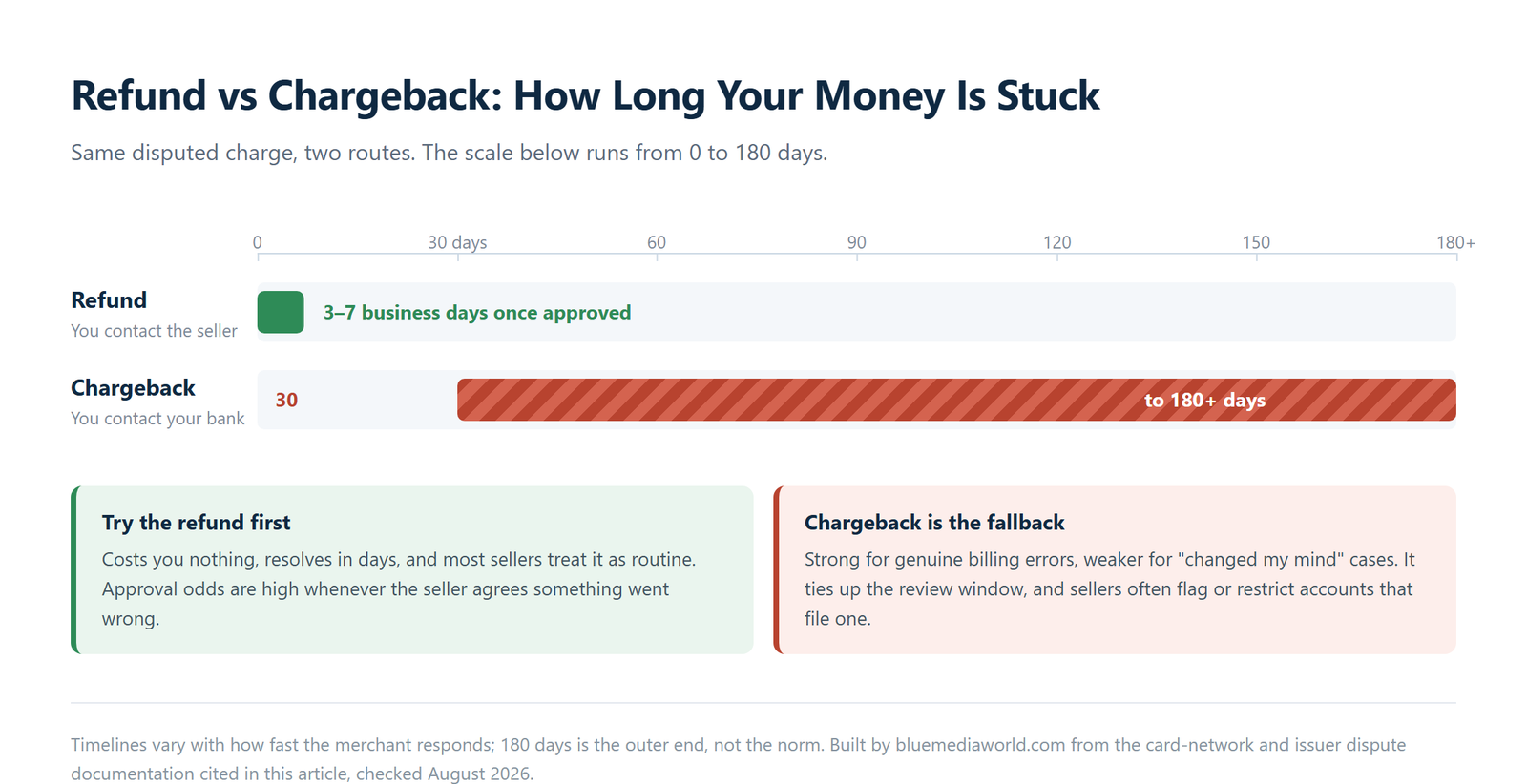
A direct refund request from the seller is faster in almost every case — most merchants process an approved refund in 3 to 7 business days, while a chargeback can take 30 days for a simple case and stretch past 180 days if the merchant disputes it.
The gap exists because a refund only involves two parties: you and the seller. A chargeback pulls in your card issuer, the merchant’s bank, and the card network’s own rulebook, and each one has its own review window before money actually moves.
When I checked how card issuers describe their own chargeback timelines against what merchants publish for direct refunds, the pattern held across every case I looked at — the issuer side is consistently the slower half of the process, not the merchant side.
| Factor | Refund Request | Chargeback |
|---|---|---|
| Who you contact | The seller directly | Your card issuer or bank |
| Typical timeline | 3–7 business days once approved | 30–180+ days depending on merchant response |
| Cost to you | None | Usually none, but ties up the review window |
| Odds of approval | High if the seller agrees there’s a problem | High for genuine billing errors, lower for “changed my mind” cases |
| Effect on the seller relationship | Minimal — most sellers treat it as routine | Sellers often flag or restrict accounts that chargeback |
Short version: if the seller is responsive, ask first.
When Should You Ask the Seller Before Filing a Chargeback?
Ask the seller for a refund first whenever the company is reachable, has a working return policy, and hasn’t already refused in writing — that covers most online purchases, including the bulk of marketplace and app-store orders.
A seller-first approach works because merchants would rather eat the cost of a normal refund than a chargeback. A refund costs them the price of the item. A chargeback costs that same amount plus a processing fee, and enough chargebacks can get a merchant’s payment processing account flagged or shut down. That gives them a real incentive to just say yes.
There’s one clear exception. If you’ve heard nothing back after a reasonable wait, that silence is itself grounds to escalate. The same goes for a storefront that turns out to be a fake or copycat site rather than a real retailer — there’s no seller to negotiate with, so a chargeback is the only real option from the start.
This part trips a lot of people up: contacting the seller doesn’t reset or shorten your chargeback filing window. You can try the polite route first and still escalate later if it goes nowhere.
How Long Do You Have to File a Chargeback With Visa or Mastercard?
Visa and Mastercard both give cardholders up to 120 days from the transaction date or the expected delivery date to file a chargeback, though the exact window can shift depending on the reason code behind the dispute.
Federal law works on a tighter, separate schedule. Under the Fair Credit Billing Act, you have 60 days from the first statement showing the disputed charge to send your card issuer a written dispute — after that, the FCBA’s specific billing-error protections no longer apply, even if the card network’s own 120-day window is still open.
According to the FTC’s consumer guidance on disputing charges, once your issuer receives a valid dispute it has 30 days to acknowledge it and 90 days to resolve it, and you can withhold payment on the disputed amount while that investigation is open.
Debit cards run on a less forgiving clock. Reporting a debit issue quickly matters more than with a credit card, since your liability protection narrows the longer you wait to report it.
What Happens on PayPal: Dispute, Claim, or Chargeback?
On PayPal specifically, there are three separate escalation levels — a Dispute, a Claim, and a Chargeback — and each one hands control to a different party.
A Dispute opens in PayPal’s Resolution Center and gives you and the seller 20 days to work it out directly, with PayPal acting as messenger rather than judge. If nothing gets resolved, either side can escalate it to a Claim, where PayPal reviews the evidence and makes a binding call. A Chargeback skips PayPal’s process entirely — it goes straight to your card issuer, and PayPal treats it as a serious event, charging the seller a $20 fee even if the seller ultimately wins.
| Route | Who decides | Typical timeline | Cost to seller |
|---|---|---|---|
| PayPal Dispute | You and the seller, together | Up to 20 days | None |
| PayPal Claim | PayPal | Days to a few weeks after escalation | None beyond the refund itself |
| Chargeback (via card issuer) | Your bank, under card network rules | 30–180+ days | Refund amount + $20 PayPal fee |
I found that this changes the math specifically for anyone who funded a PayPal payment straight from a bank account rather than a linked credit card. Without a card issuer sitting behind the transaction, PayPal’s own Resolution Center is often the only real escalation path available.

The same logic applies if a refund was already approved but the money just hasn’t posted yet — that’s a processing delay, not a dispute, and filing a chargeback on top of an already-approved refund usually just confuses both timelines at once.
The Real Cost of Skipping Straight to a Chargeback
Filing a chargeback the moment something goes wrong feels like the strong move. It isn’t free, and the cost doesn’t show up on your statement.
Sellers track chargeback rates closely because processors penalize them for it — too many in a short window and a merchant can lose the ability to accept cards at all. That’s why plenty of marketplaces and app stores quietly restrict or ban an account that files one, even when the chargeback itself was justified, with rarely any formal appeal for it. A refund request doesn’t carry that risk — sellers expect a normal volume of them and rarely treat one as a red flag.
None of this makes chargebacks the wrong move when they’re actually warranted. Fraud, an unresponsive seller, or a flatly refused legitimate refund are exactly what the process exists for. It just means the “instant nuclear option” reputation chargebacks have online isn’t quite accurate — they’re slower and carry more account risk than most people assume going in.
A Three-Question Way to Pick the Right Route
Three questions cover almost every situation.
Has the seller responded at all? If yes, ask for a refund first — even a slow response beats the chargeback timeline. Is the charge itself wrong, duplicated, or unauthorized? That’s squarely FCBA and card-network territory, and a chargeback is the correct tool, not an overreaction. Do you plan to buy from this seller again? A refund request preserves that relationship; a chargeback usually doesn’t.
Honestly, most disputes resolve at question one. It’s the unresponsive-seller and outright-fraud cases where a chargeback earns its reputation.
Tips
- ✅ Screenshot the order, the charge, and every message with the seller before escalating — issuers ask for this evidence during a chargeback review.
- ✅ Call the number printed on the back of your card, not one from a search result or email — scam calls impersonate this exact step.
- ✅ Paid through a marketplace like Amazon or Etsy? Try its own refund process first — usually faster and won’t affect your account standing.
- ✅ Note the date the seller marked the order “delivered” or “refunded” — that’s often what starts the issuer’s filing clock, not today’s date.
- ✅ Keep the filing window in your back pocket even while trying the seller-first route — contacting the seller doesn’t shorten it.
Warnings
- ⚠ Filing a chargeback while a refund is already processing can freeze both — some issuers auto-decline a dispute once they see a refund in progress, which then delays the refund too.
- ⚠ “Friendly fraud” — disputing something you actually received but are simply unhappy with — can get flagged by your own issuer, not just the seller, if it happens repeatedly.
- ⚠ A won chargeback doesn’t erase a merchant’s memory of it. Expect stricter scrutiny, order holds, or an outright ban on that platform going forward.
- ⚠ International purchases sometimes fall outside your issuer’s standard rules — check before assuming the same 120-day window applies.
FAQ
Does filing a chargeback hurt the seller even if I’m right?
Yes, somewhat, even when the chargeback is justified. The seller’s payment processor logs the chargeback against their account, and too many of them — regardless of fault — can raise the seller’s processing fees or put their merchant account at risk. That’s separate from whether you were right to file it.
Can a seller refuse a refund and force you into a chargeback?
Yes, a seller can legally refuse a refund outside their stated return policy, though exceptions exist for defective goods, undelivered orders, and unauthorized charges. If a seller refuses a refund you’re clearly entitled to, a chargeback through your card issuer becomes the practical next step.
Is it faster to dispute a charge with a credit card or a debit card?
Credit card disputes are generally faster and safer to start, since the disputed amount doesn’t have to be paid while the issuer investigates. Debit card disputes work differently — the money leaves your account first and gets investigated after, so reporting a debit issue quickly matters more than it does with a credit card.
Sources
- FTC Consumer Advice — Using Credit Cards and Disputing Charges
- PayPal — Understanding Disputes, Claims, and Chargebacks
- Visa — Dispute Resolution Process
Fact-checked based on 3 public sources as of August 8, 2026. Chargeback windows and issuer policies can change — confirm current terms with your card issuer before filing.