Loose vs CIB vs Sealed: Which Vintage Video Games Are Worth Flipping in 2026?
Condition is the entire game when flipping vintage video games. A loose cartridge, its complete-in-box version, and a factory-sealed copy of the exact same title can sell for wildly different prices — sometimes 10x apart. This piece breaks down what each condition tier actually commands, where the margins really are for a flipper (not a long-term collector), and which tier is worth your time to source. Prices below reflect market data as of this article’s publish date and shift with demand.
A loose copy of Nintendo’s Earthbound sells for roughly $150 on the secondary market. The same cartridge complete in its box climbs past $700. Factory sealed, it’s a four-figure item. Same game, same publisher, same year — the only variable is condition, and that gap is where flippers make or lose money.
This is not investment or financial advice. Collectible resale values are volatile and driven by collector demand, not fundamentals — treat this as a hobby with upside, not a guaranteed return.
What This Guide Covers
- Loose vs CIB vs Sealed: What’s the Real Price Gap?
- Which Condition Tier Actually Makes Sense for a Flipper?
- Where to Find Underpriced Games
- How Do I Know a Sealed Game Isn’t Resealed?
- What Does It Actually Cost to Sell One?
- Do I Need to Report Flipping Income on My Taxes?
- Tips for Sourcing on a Budget
- The Traps First-Time Flippers Hit
Loose vs CIB vs Sealed: What’s the Real Price Gap?
Reading through PriceCharting’s aggregated sale data, the multiplier between condition tiers isn’t fixed — it varies by platform and title, but a rough pattern holds across most retro consoles.
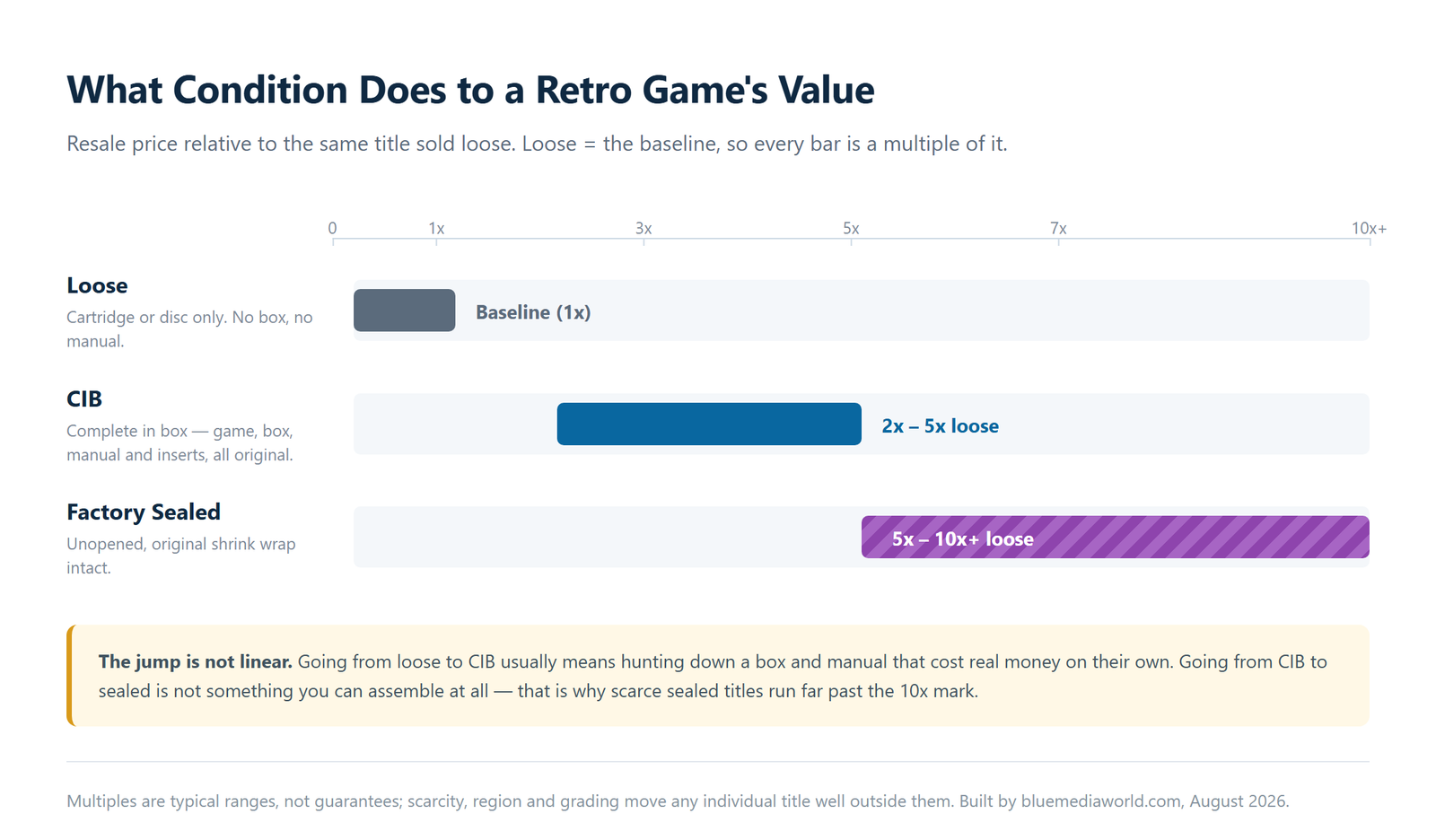
| Condition | What it means | Typical price relative to loose |
|---|---|---|
| Loose | Cartridge or disc only. No box or manual. | Baseline (1x) |
| CIB (Complete in Box) | Game, box, and manual/inserts all original | 2x–5x loose |
| Factory Sealed | Unopened, original shrink wrap intact | 5x–10x+ loose, sometimes much higher on scarce titles |
Nintendo first-party titles for the NES and SNES tend to sit at the high end of that range. Common third-party sports and licensed games from the same era barely move between tiers — a sealed copy of a mediocre licensed game can be worth almost the same as the loose cartridge, because nobody’s chasing it complete.
Which Condition Tier Actually Makes Sense for a Flipper?
Loose games are where the volume is. You’ll find them for a dollar or two at thrift stores and yard sales, and even modest titles resell for $15–$50 on eBay — the kind of margin that supports buying in bulk rather than hunting for one grail item.
CIB is where research pays off the most. A box or manual alone can be worth more than the cartridge, which means an incomplete lot at a garage sale — loose games plus a stack of empty boxes from different games — is often underpriced by sellers who don’t realize the box and cart need to match to command CIB pricing.
Sealed is a different game entirely. Here’s where people get tripped up — sealed inventory needs real capital upfront, storage that protects the seal, and patience, because buyers for four-figure sealed items are a much smaller pool than buyers for a $20 loose cartridge. It’s not a beginner’s starting tier.
Where to Find Underpriced Games
- Thrift stores and Goodwill outlets. Pricing is inconsistent store to store — the same title can be $2 at one location and $15 at another, so checking multiple locations pays off.
- Estate sales. Sellers are often pricing to clear a house fast, not to match secondary-market rates.
- Local marketplace apps. Search misspelled console names and generic listings like “old Nintendo games” — these get fewer views from competing buyers.
- Storage unit auctions. Higher risk, but complete collections sometimes surface at a fraction of itemized value.
When I checked how experienced flippers describe their sourcing routine, the common thread wasn’t a secret location — it was checking the same few spots on a schedule, since new inventory rotates in constantly and most of it gets picked over within days.
How Do I Know a Sealed Game Isn’t Resealed?
Resealing is the single biggest risk at the sealed tier, and it’s common enough that professional grading exists specifically to solve this problem. Third-party graders authenticate the seal, the cartridge’s manufacturing details, and other markers before certifying and encapsulating the game — a process that costs money but removes most of the resale risk for high-value titles.
Warning signs on an ungraded sealed game include shrink wrap that looks too glossy or too matte compared to verified reference photos, a seam that runs in an unusual direction for that era’s factory sealing method, and a price that’s noticeably below recent sold listings for the same graded title. None of these alone is proof, but two or more together are reason to walk away or demand a full-resolution photo set before paying.
What Does It Actually Cost to Sell One?
eBay is still where most vintage game sales happen, and its published seller fees apply the same way to games as to any other collectible category — a percentage of the total sale price plus a small per-order fee. Budget roughly 13–15% of your sale price for platform fees before you calculate profit, not after.
Shipping matters more for games than people expect. A loose cartridge ships cheap in a padded envelope. A CIB or sealed game needs a rigid mailer and enough padding to prevent box crushing — a $3 shipping mistake on a $20 loose game barely registers, but the same mistake on a $400 CIB game can mean a damage claim that erases the entire margin.
Do I Need to Report Flipping Income on My Taxes?
Yes, once flipping stops being an occasional garage-sale cleanup and starts looking like a regular activity with the intent to profit, the IRS treats it as business income rather than a hobby. In my experience checking how this gets classified, frequency and record-keeping matter more than dollar amount — someone selling three games a year is a different case from someone sourcing weekly and tracking cost basis in a spreadsheet.
Platforms including eBay are required to issue a 1099-K once your sales cross the federal reporting threshold, and that threshold has been phased in gradually — check the current year’s limit rather than assuming an old number still applies, since it’s changed more than once in recent years. Even below the 1099-K threshold, income is technically reportable; the form just isn’t generated automatically.
This part trips a lot of first-time flippers up. Keeping receipts for what you paid at the thrift store or estate sale is what lets you report profit — the difference between sale price and cost — instead of the full sale amount as taxable income.
Tips for Sourcing on a Budget
- Start with loose games from platforms you already know well — recognizing a rare title on sight beats looking everything up on your phone in the store.
- Photograph condition thoroughly before buying if the seller allows it, so you can compare against sold listings before committing.
- Track your cost basis per item from day one — margins look great until shipping supplies and platform fees eat into them, and a spreadsheet catches that early.
- Box protectors for CIB and sealed copies cost a fraction in multipacks on AliExpress — condition is the whole price gap in this hobby, so protect it from day one.
Disclosure: this post contains an affiliate link — if you buy through it, we may earn a commission at no extra cost to you.
The Traps First-Time Flippers Hit
- Buying “vintage” reproduction carts believing they’re originals — reproductions are legal to sell as reproductions but worthless as originals, and some sellers blur the line.
- Overpaying for CIB based on box condition alone without checking that the cartridge label matches the same print run and region.
- Tying up capital in sealed inventory before understanding how thin that buyer pool actually is compared to loose or CIB.
FAQ
Are graded video games worth more than raw sealed copies?
Usually yes for high-value titles, since grading removes the resealing risk buyers worry about. For common titles worth under $100, grading fees can exceed the value added.
Do modern sealed games (PS4, Switch era) hold value the way retro ones do?
Rarely, and not yet — most modern print runs are large enough that scarcity hasn’t developed. Limited print runs and early Nintendo Switch cartridges are the exception collectors are watching.
What’s the fastest-moving condition tier to resell?
Loose games in the $15–$50 range typically sell fastest because the buyer pool is largest — casual collectors and players outnumber high-end CIB and sealed buyers by a wide margin.
Sources
- PriceCharting: Video game price guide and value tracker
- eBay: Selling fees for sellers
- IRS: Gig Economy Tax Center