

Upwork vs Fiverr: Which Platform Keeps More of Your Money in 2026?
Upwork and Fiverr split freelance income differently enough that picking the wrong one costs money over a full year of side-hustle work. Upwork’s freelancer fee moves between 0% and 15% depending on the specific contract, set and disclosed before you accept. Fiverr keeps a flat 20% of every order regardless of size or client history.
Neither number tells the whole story. Client-side costs, refund rules, and how disputes actually get resolved shift the real math once you look past the headline percentage.
What This Page Compares
- How Do Upwork and Fiverr Fees Actually Work in 2026?
- Which Platform Keeps More of a $500 Project?
- What Do Clients Pay to Hire on Each Platform?
- Has Upwork’s Old Sliding-Scale Fee Really Disappeared?
- Canceling, Disputing, and Getting Refunded on Either Platform
- Matching the Platform to Your Side Hustle
- Can You Run Both Platforms at the Same Time?
How Do Upwork and Fiverr Fees Actually Work in 2026?
Fiverr charges every seller a flat 20% commission on each completed order, including tips and gig extras, according to Fiverr’s Help Center documentation on paying for orders. Upwork works differently. Its Freelancer Service Fee ranges from 0% to 15% per contract, and the exact number is shown to you before you accept an offer or send a proposal, not deducted as a surprise later, based on Upwork’s own Freelancer Service Fee page.
That fee stays fixed for the life of the contract once work begins. Freelancers working with Upwork Enterprise clients typically see a 10% fee, though the exact rate depends on the terms that client negotiated when they joined the program.
Fiverr’s flat rate is easier to predict. Upwork’s variable rate can beat it, or not, depending entirely on the contract you’re offered.
Which Platform Keeps More of a $500 Project?
A freelancer who lands a $500 fixed-price project keeps $400 on Fiverr after the flat 20% cut, and anywhere from $425 to $500 on Upwork depending on the fee that specific contract carries.
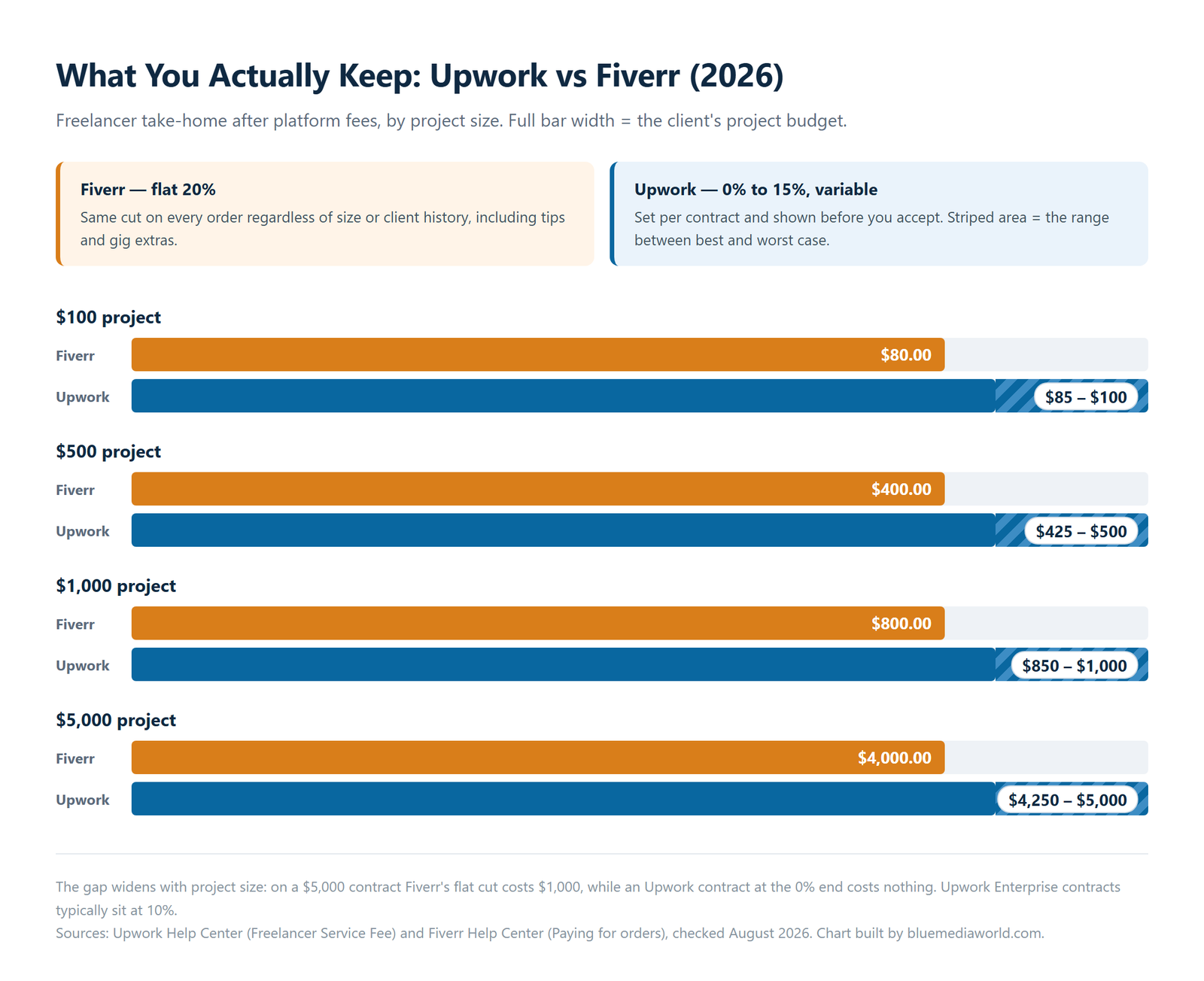
| Project Size | Fiverr Take-Home (flat 20%) | Upwork Take-Home (0-15% range) |
|---|---|---|
| $100 | $80.00 | $85.00 – $100.00 |
| $250 | $200.00 | $212.50 – $250.00 |
| $500 | $400.00 | $425.00 – $500.00 |
| $1,000 | $800.00 | $850.00 – $1,000.00 |
| $5,000 | $4,000.00 | $4,250.00 – $5,000.00 |
The wider the fee gap, the more it pays to check the rate before accepting an Upwork offer. A 15% contract barely beats Fiverr’s cut, while a 0% or 5% contract leaves noticeably more in your account. I found that the actual figure varies contract to contract, so it’s worth checking the offer screen rather than assuming Upwork is automatically cheaper.
There’s no universal winner here. It depends on the specific fee your contract lands.

Enter a project value and the Upwork freelancer fee shown on your contract. Fiverr’s cut is fixed at 20 percent, so the only variable that moves is Upwork’s.
What Do Clients Pay to Hire on Each Platform?
Upwork’s Basic-plan clients pay a marketplace fee of about 5% (or 3% for U.S. clients paying by bank transfer), while Business Plus clients pay closer to 10% (8% with the same bank-transfer discount), plus a one-time contract initiation fee of roughly $0.99 to $14.99 per new hire, according to Upwork’s client pricing page.
Fiverr charges buyers separately too. Fiverr’s own help documentation puts the buyer service fee at 5.5% of the order, plus a flat $3.50 add-on for orders under $200.
| Platform / Plan | What the Client Pays | Extra Fees |
|---|---|---|
| Upwork Basic | ~5% (3% via US bank transfer) | $0.99-$14.99 per new contract |
| Upwork Business Plus | ~10% (8% via US bank transfer) | Same contract initiation fee |
| Fiverr | ~5.5% buyer service fee | Flat $3.50 on orders under $200 |
A lower client-side fee doesn’t automatically mean more clients hire you there. It just means the client keeps more of their budget to spend on your rate instead of the platform’s cut.
Has Upwork’s Old Sliding-Scale Fee Really Disappeared?
Yes. The tiered structure that charged freelancers 20% on the first $500 billed to a client, 10% up to $10,000, and 5% beyond that has been retired, and Upwork’s current fee page describes a flat per-contract rate instead.
A lot of comparison articles still floating around online repeat those old tier numbers as if they’re current. When I checked Upwork’s help center directly rather than relying on secondhand comparison posts, the sliding-scale language was gone, replaced by a single line: the fee ranges from 0% to 15% per contract, fixed once the contract starts.
That distinction matters if you’re comparing platforms based on an older blog post. The math those posts run isn’t wrong for the year they were written. It’s just not how Upwork charges freelancers anymore.
Canceling, Disputing, and Getting Refunded on Either Platform
Both platforms let you cancel an order before work starts, but the refund outcome depends on how far along the job is and which side initiates the cancellation.
On Fiverr, either the buyer or the seller can request a cancellation. Mutual cancellations typically don’t affect a seller’s completion rate, but a cancellation flagged as the seller’s fault can. Refunds route back to the buyer’s original payment method once the cancellation is confirmed.
On Upwork, fixed-price work is protected through milestone escrow. Funds sit in escrow until a milestone is approved, so a dispute contests the escrowed amount rather than future earnings. Hourly contracts are protected differently, through the Work Diary and Hourly Payment Protection, which verifies logged time before a client can dispute a bill.
Neither platform makes cancellations instant. Budget a few business days for a refund to actually land in your account.
Matching the Platform to Your Side Hustle
Upwork tends to fit ongoing or higher-ticket work, retainers, multi-week projects, consulting, where a lower percentage fee compounds into real savings. Fiverr fits packaged, fixed-scope gigs that buyers can purchase directly without back-and-forth negotiation.
Choose Upwork if:
- You want hourly or retainer relationships instead of one-off orders.
- You’re pitching higher-budget clients where a few percentage points matter.
- You don’t mind writing custom proposals for each job.
Choose Fiverr if:
- You sell a repeatable, clearly-scoped service buyers can purchase off the shelf.
- You want buyers to find and book you without a negotiation step.
- You’d rather set a fixed package price than quote every job individually.
If you’re still working out what to actually charge on either platform, our Freelance Rate Calculator makes the fee math easier to run before you set a price.
Can You Run Both Platforms at the Same Time?
Yes. Plenty of freelancers keep active profiles on both Upwork and Fiverr and route new clients to whichever platform is charging less on that specific deal size.
I noticed that freelancers who run both tend to price their Fiverr gigs slightly higher than their Upwork rate for the same work, to offset the flatter 20% cut. It’s a small adjustment, but it keeps take-home pay roughly consistent across both platforms.
Income from either platform counts as self-employment income for tax purposes, regardless of whether the platform sends you a 1099. The IRS Gig Economy Tax Center confirms this reporting requirement applies whether you’re paid through Upwork, Fiverr, or any other platform. This isn’t tax advice specific to your situation, so check with a tax professional once your side income adds up to real money.
FAQ
Does Upwork or Fiverr charge clients more to hire a freelancer?
It depends on the plan. Upwork’s Business Plus clients pay around 10% (8% via bank transfer), noticeably more than Fiverr’s roughly 5.5% buyer fee. But Upwork’s Basic-plan rate of 5% (3% via bank transfer) actually undercuts Fiverr for many clients.
Is there a project size where Fiverr’s fee actually beats Upwork’s?
Not on percentage alone. Upwork’s freelancer fee tops out at 15%, while Fiverr holds steady at 20%, so Upwork’s cut is equal to or lower at every contract size. Fiverr can still win in practice if its buyer traffic gets you booked faster or at a higher list price than an idle Upwork profile would.
Do I need a business license to sell services on Upwork or Fiverr?
Neither platform requires a business license to start. Most sellers operate as sole proprietors and report the income as self-employment earnings. Once your side income grows, check your state and city rules, since some local jurisdictions require a general business license regardless of which platform you use.
Sources
- Upwork Help Center – Learn About the Freelancer Service Fee
- Upwork – Pricing for Clients
- Fiverr Help Center – Paying for Orders, Extras, or Custom Offers
- IRS – Gig Economy Tax Center
🔗 Related guides
Written by Jordan Lee. Fact-checked based on public sources as of 2026-08-07.