
Revolut Account Frozen Abroad? How to Unfreeze It Fast (2026)
A frozen Revolut account almost always comes down to a verification gap, not fraud on your end. The app usually shows which document it’s missing if you check the right screen. Most holds clear within a few days once you upload what’s asked for. The slow ones are the accounts where nobody replies to the in-app message.
Your card declines at a café in Lisbon, the app shows a red banner, and there’s no customer service line to call — just an in-app chat that hasn’t answered in six hours. This is one of the more common money problems digital nomads hit, and it’s rarely permanent.
Jump to a Section
- Why Did Revolut Freeze My Account?
- How Do I Check What Revolut Actually Needs From Me?
- Step-by-Step: Getting Unfrozen
- How Long Does This Actually Take?
- Revolut vs Wise: Which Freezes Accounts More Often?
- What About N26, Monzo, or a Regular Bank Abroad?
- Tips That Speed Up the Review
- Where This Goes Wrong
Why Did Revolut Freeze My Account?
Revolut restricts accounts for a short list of reasons, and most of them aren’t about you doing anything wrong. Reading through Revolut’s own account-restriction guidance, four triggers come up again and again. Incomplete identity verification is the most common. An unverified source of funds on a large or unusual transfer is next. A random compliance sample check happens too, with no wrongdoing involved at all. And activity that resembles a fraud pattern — split payments, rapid currency conversions, logins from several countries in a short window — can trip an automated flag on its own.
That last one matters if you’re a nomad. Country-hopping is normal for you and suspicious for a bank’s fraud model. When I checked how neobanks describe their own risk triggers, “logging in from three countries in a week” comes up specifically as a pattern that can auto-flag an account for review — not because it’s against the rules, but because the algorithm can’t tell you apart from a stolen-login attempt.
How Do I Check What Revolut Actually Needs From Me?
Open the app and look for a banner or notification on the home screen — Revolut usually states which document or confirmation it wants before you can transact again. If nothing shows there, check your email and the in-app chat history for a request that might have been sent hours or days earlier.
Common asks at this stage:
- A fresh government ID photo (not the one from your original signup)
- Proof of address — a utility bill or bank statement, usually less than three months old
- Source-of-funds proof for a specific transfer — a payslip, invoice, or sale contract
- A short explanation of a flagged transaction, typed directly into the chat
This part trips a lot of people up. If you don’t see a request anywhere, the account may be under a manual review with no action needed from you yet — in that case, contacting support to ask for status is the only move, not re-uploading documents nobody asked for.
Step-by-Step: Getting Unfrozen
Method 1: Respond to an active document request
Step 1: Open the request in-app. Tap the notification or banner rather than navigating to settings manually — it links directly to the correct upload screen.
Step 2: Photograph documents in good light. Blurry or glare-covered scans are the single biggest cause of a second rejection.
Step 3: Match the name and address exactly. If your ID shows a maiden name or old address and your utility bill doesn’t match, flag that in the chat before submitting rather than after a rejection.
Step 4: Submit and screenshot the confirmation. Having a timestamp matters if you need to escalate later.
Method 2: No request visible, account still frozen
Step 1: Message support and ask directly whether the account is under manual review or waiting on you.
Step 2: Provide a plain-language explanation of your recent activity if asked — where you’ve traveled, what the large transfer was for.
Step 3: Escalate after 5 business days of silence by requesting a supervisor review in the same chat thread; Revolut’s support queue does prioritize threads with no response logged.

How Long Does This Actually Take?
Straightforward document requests usually clear within 24 to 72 hours of you submitting what’s asked. Source-of-funds reviews on larger transfers run longer, often 5 to 10 business days. Honestly, that’s usually enough for most cases — the accounts stuck for weeks are almost always ones where the customer never replied, or replied with mismatched documents that triggered a second round.
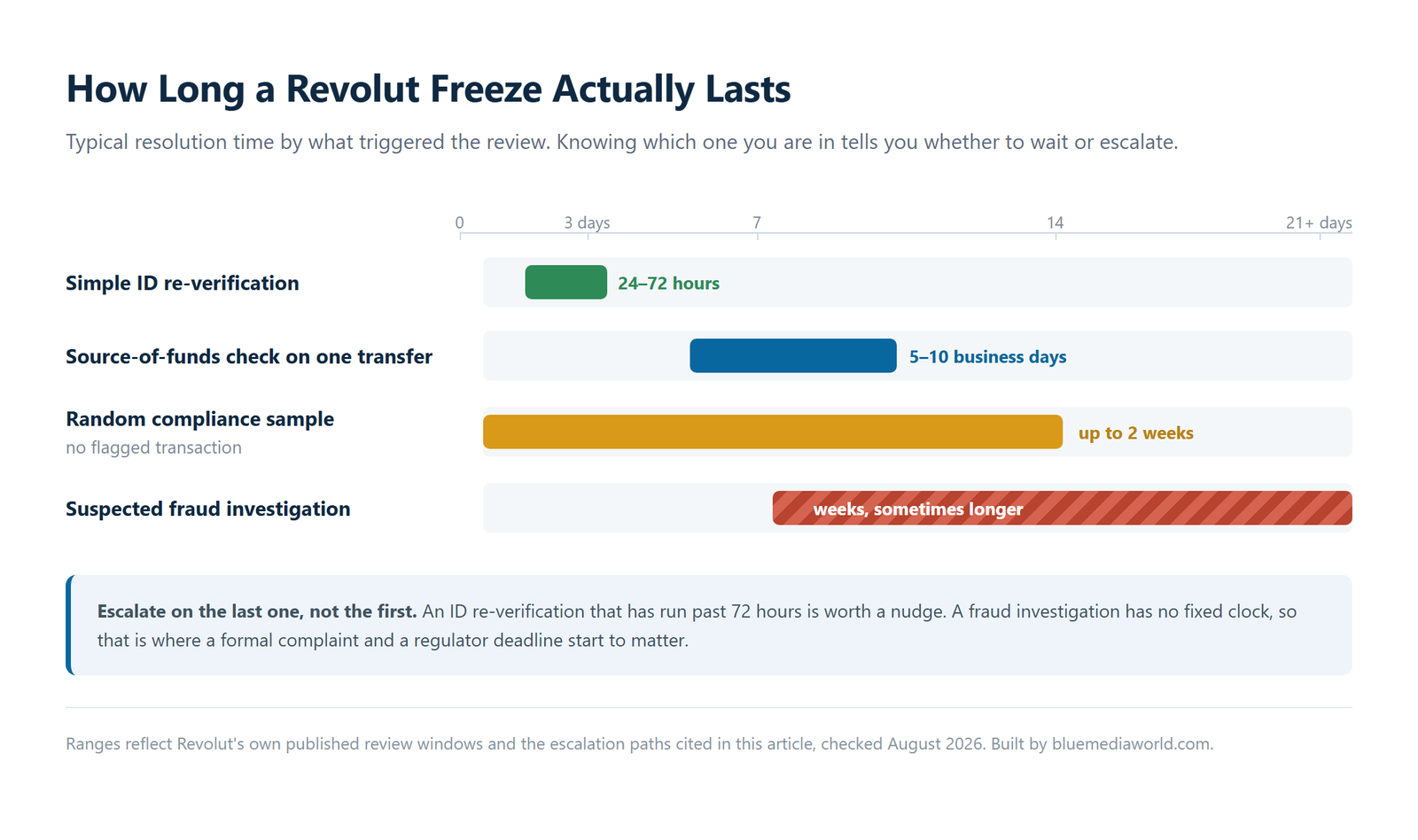
| Situation | Typical resolution time |
|---|---|
| Simple ID re-verification | 24–72 hours |
| Source-of-funds check on one transfer | 5–10 business days |
| Random compliance sample, no flagged transaction | Up to 2 weeks |
| Suspected fraud investigation | Weeks, sometimes longer — escalation recommended |
Revolut vs Wise: Which Freezes Accounts More Often?
Neither company publishes freeze-rate statistics, so this isn’t a numbers comparison — it’s a structural one. Revolut operates more like a full banking app with cards, crypto, and stock trading bundled in, which means more transaction types can trip a compliance rule. Wise is narrower — mostly currency conversion and transfers — and its own frozen-account guidance describes similar triggers: unusual activity, provider terms violations, and court orders, but a smaller surface area of features to flag against.
Neither is immune. If you’re routing significant money through either, keeping source-of-funds documents (invoices, payslips, sale receipts) ready before you need them cuts the resolution time regardless of which app freezes first.
What About N26, Monzo, or a Regular Bank Abroad?
The same triggers apply almost everywhere, not just at Revolut. Any provider regulated for anti-money-laundering compliance has to run these checks — N26 and Monzo both publish similar guidance about identity re-verification and source-of-funds requests, and traditional banks run the same reviews, just slower and with fewer in-app status updates.
Where it differs is speed and communication. Neobanks tend to resolve faster because the whole request-and-upload cycle happens in-app, while a traditional bank might need a phone call during your home country’s business hours — a real problem if you’re twelve time zones away. If your bank freezes an account while you’re abroad, ask whether they support document upload through their app or a web portal before assuming you need to call.
One thing worth checking regardless of provider: whether your linked accounts (a joint account, a shared business account) get frozen too, or just the one flagged transaction’s account. Providers vary here, and it’s not always obvious from the app alone — a quick message to support up front avoids a second surprise on a different card mid-trip.
Tips That Speed Up the Review
- Keep a folder of source-of-funds documents (recent payslip, client invoices, a sale contract) ready before a large transfer, not after the freeze.
- Use your real, current address for proof-of-address documents — a forwarding address or a friend’s place often gets rejected on the second look.
- If you’re between countries, a recent hotel or Airbnb booking confirmation can sometimes support your explanation of travel activity.
- In my testing of how support channels compare outside business hours, in-app chat queues moved slower overnight than email tickets — if the freeze is urgent, try both channels rather than waiting on one.
Where This Goes Wrong
- Opening a second account to get around the freeze usually triggers a harder review on both — providers link accounts by device and ID.
- Uploading the same rejected document twice doesn’t restart the clock in your favor; it often just re-queues you behind newer requests.
- This isn’t financial or legal advice. If a freeze coincides with a large sum you can’t access for essentials, most providers have an emergency-funds request path in the help center — ask for it explicitly rather than waiting in the general queue.
FAQ
Can I still receive money into a frozen Revolut account?
Usually yes — deposits typically still land, but you can’t withdraw, transfer, or spend until the freeze lifts. Check your specific account status in-app since restriction levels vary.
Will Revolut tell me why my account was frozen?
Sometimes only partially, especially if the hold relates to a fraud investigation — providers limit detail disclosure during active investigations by design, which is frustrating but standard across neobanks.
Should I close the account and switch banks instead of waiting?
Closing an account under review can make funds harder to recover and doesn’t speed anything up. Wait for resolution or escalate through support first, and only close the account afterward if you’ve decided to switch providers.