

CGC Comic Book Grading Turnaround Times in 2026: Tiers, Costs, and the Wait Nobody Budgets For
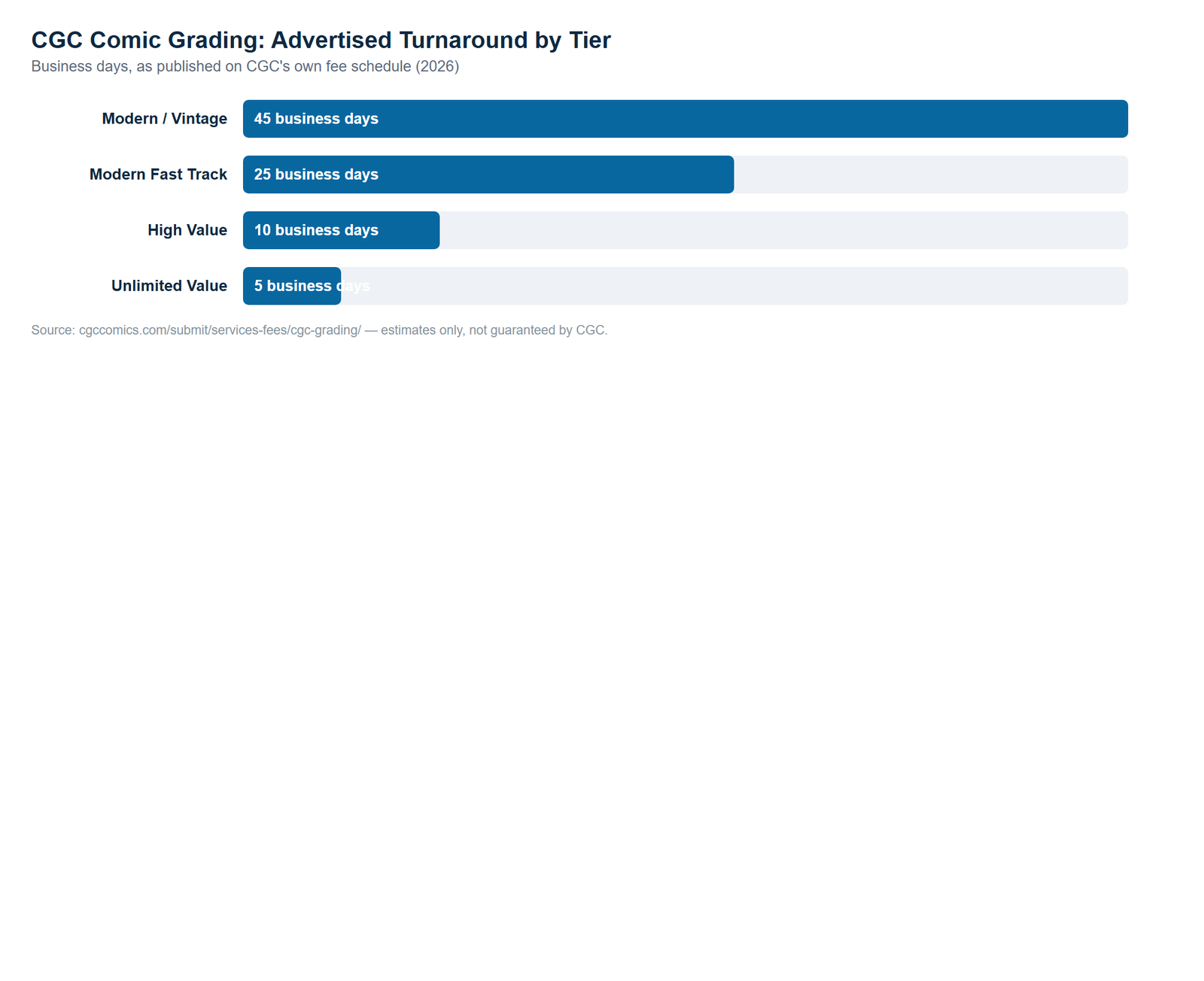
Quick answer: CGC’s Modern and Vintage comic grading tiers list a 45-business-day turnaround, and Fast Track cuts that to 25 business days for $15 more per book. High Value runs 10 business days, Unlimited Value runs 5. Those are CGC’s own published estimates, not guarantees — CGC’s FAQ says actual time depends on how many submissions are already ahead of yours. For a flip, every extra week is money sitting in a slab instead of a sale.
A 45-business-day estimate sounds like about nine weeks. It isn’t nine calendar weeks — business days skip weekends and holidays, and the clock only starts once CGC logs your package as received, not the day you drop it at the post office.
That distinction matters more in Collectibles & Flipping than almost anywhere else. A comic sitting in CGC’s queue is inventory you already paid for and can’t sell. The tier you pick decides whether that wait costs you six weeks or half a year, and this guide breaks down what each tier actually costs, when paying extra for speed pays for itself, and the fees that show up after the slab comes back.
What Does This Guide Actually Cover?
- How Long Does CGC Grading Actually Take in 2026?
- What CGC Itself Says About Delays
- What Does CGC Membership Actually Cost, and Is It Worth It?
- Does a Slow Grading Queue Actually Wreck a Flip’s Margin?
- The Fees That Show Up After the Slab Comes Back
- Is Fast Track or High Value Worth Paying Extra For?
- Matching the Tier to What You’re Actually Holding
- What Happens If a Book Comes Back Graded Lower Than You Expected?
How Long Does CGC Grading Actually Take in 2026?
CGC’s Modern and Vintage tiers carry a 45-business-day advertised turnaround, Fast Track cuts that to 25 business days for $15 more per book, High Value runs 10 business days, and Unlimited Value runs 5 business days for a fee based on the book’s declared value.
When I checked CGC’s current fee and turnaround page directly rather than relying on older blog posts still floating around with different tier names, the pricing broke down like this:
| Tier | Price per book | Advertised turnaround | Max declared value |
|---|---|---|---|
| Modern (1975–present) | $30 ($27 in a 25-book Bulk batch) | 45 business days | $400 |
| Modern Fast Track | +$15 per book | 25 business days | $400 |
| Vintage (pre-1975) | $45 ($42 in a 25-book Bulk batch) | 45 business days | $400 |
| High Value | $105 | 10 business days | $1,000 |
| Unlimited Value | 4% of fair market value, $135 minimum | 5 business days | No cap |
Bulk pricing only applies once you’re submitting 25 books or more at a time, which matters if you’re grading a small personal collection instead of sourcing in volume for resale.
What CGC Itself Says About Delays
CGC’s own submission FAQ states that turnaround depends primarily on submission volume and the tier you choose, and adds flatly that estimates are not guaranteed.
That’s a meaningful admission. It means the 45-day number on the fee page is a snapshot of current capacity, not a promise. A wave of submissions after a big convention or a viral back-issue story can push a tier’s real queue past its posted estimate, and CGC doesn’t publish a running “actual average” the way some price-tracking sites claim to.
Here’s where people get tripped up: they see 45 business days, count nine weeks forward on a calendar, and plan a sale around that date. Treat the posted number as a floor, not a target.
What Does CGC Membership Actually Cost, and Is It Worth It?
CGC requires paid membership to submit at all, and the tier you pick changes your grading discount — Associate is $25 a year with no discount, Premium is $150 a year with a matching credit, and Elite is $300 a year with 20% off every submission.
| Membership | Annual cost | What you get | Grading discount |
|---|---|---|---|
| Associate | $25/year | Right to submit | None |
| Premium | $150/year | $150 grading credit | 10% |
| Elite | $300/year | Priority handling perks | 20% |
I found that the math only favors Premium or Elite if you’re actually submitting enough books in a year for the discount to outrun the membership fee itself — a single occasional submitter usually comes out ahead on Associate, discount or not.
The trading-card side of this business runs a similar structure, and if PSA versus CGC versus BGS is the comparison you’re actually trying to make, our breakdown of grading trading cards in 2026 covers that side of the ledger.
Does a Slow Grading Queue Actually Wreck a Flip’s Margin?
A slower tier doesn’t shrink your percentage margin on paper, but it ties up cash you can’t touch, and that holding cost is real even though nobody puts a line item for it on a spreadsheet.
Picture two identical books bought for $40 each and expected to resell graded for $120. One goes in on the 45-business-day Modern tier, the other on 10-business-day High Value for an extra $75. The High Value book is liquid in about two months. The standard-tier book might still be sitting in a queue when a hype cycle for that title cools off, and the sale price you modeled at submission time isn’t guaranteed to still be there when the slab finally ships.
This part trips a lot of people up. They price the grading fee into their margin and stop there, without pricing in what that cash could have earned — or what the book could have sold for — if it had come back faster.
The Fees That Show Up After the Slab Comes Back
Getting a grade back is not the same as getting paid. Selling fees, shipping insurance, and payment processing routinely take 13% to 20% off your final sale price before storage or the original purchase cost even enter the picture.
eBay’s standard final value fee for most categories, collectibles included, runs about 13.6% of the total sale plus a small per-order fee, according to eBay’s own current seller fee schedule. Specialty consignment shops can run 30% or more. Facebook Marketplace and local pickup skip the platform fee entirely, but you lose buyer protection and the wider audience that pushes prices up in the first place.
Return shipping for a graded slab needs real insurance, not the cheapest tracked option available. A cracked case or a lost package after months of waiting is the kind of loss that erases an entire year’s worth of margin on one book.
Is Fast Track or High Value Worth Paying Extra For?
Fast Track and High Value are worth the extra cost when the book’s expected sale price is climbing right now, or when you’ve got capital tied up that you need back for the next purchase — not as a default upgrade on every submission.
You’ll probably notice the math flips depending on the book. A $40 back-issue with a flat, predictable resale value gains almost nothing from paying triple for speed — the standard tier’s 45 days barely costs you anything since the price isn’t moving. A key issue riding a trending storyline or a movie announcement is a different story: waiting 45 business days on that one risks missing the exact window that made it valuable.
Rough rule of thumb: if the book’s value depends on timing, pay for speed. If it doesn’t, the standard tier is free money you’re not leaving on the table.
Matching the Tier to What You’re Actually Holding
Run through this before you box anything up for submission:
- Is the book’s resale value trending right now, or has it been flat for over a year? Trending favors Fast Track or High Value.
- Do you have at least 25 similar-value books to hit Bulk pricing, or is this a one-off submission?
- Is your declared value under $400 (Modern/Vintage), under $1,000 (High Value), or genuinely uncapped (Unlimited Value)?
- Will you submit enough books this year that a Premium or Elite membership discount actually pays for itself?
- Can you afford to have this specific book’s cash tied up for two to three months if the standard tier runs long?
What Happens If a Book Comes Back Graded Lower Than You Expected?
A lower-than-expected grade doesn’t come with an automatic refund or a redo — CGC’s grade is final unless you pay again for a resubmission, and resubmission goes through the same queue and turnaround as a fresh book.
That’s the real risk sitting underneath every turnaround-time decision. Paying for Fast Track doesn’t just buy speed, it also shortens how long you’re exposed if a grade comes back lower than the comp prices you researched before submitting. A book stuck for 45 business days that grades lower than expected has cost you both the wait and the disappointment at once, with no faster path to fix it than starting the clock over.
If a submission situation goes sideways badly enough that you’re looking at cancellation instead, the process runs closer to what we covered in canceling a PSA grading submission for a refund — the general shape of grading-company cancellation policies tends to rhyme across companies, even though CGC and PSA aren’t identical.
What Should You Confirm Before You Ship a Book to CGC?
- ✅ Confirm your membership tier covers the discount you’re expecting — it doesn’t apply retroactively if you submit before upgrading.
- ✅ Photograph the book’s condition before it leaves your hands, corners and spine included, in case of shipping disputes.
- ✅ Check current sold comps for the graded version of your book, not just raw asking prices, before you decide a tier is worth paying for.
Where Do CGC Submissions Most Often Go Wrong?
- ⚠️ Treating the advertised turnaround as a hard deadline for a planned sale — CGC states plainly that estimates aren’t guaranteed.
- ⚠️ Skipping insurance on return shipping because the outbound leg felt safe enough. The return leg carries a graded, more valuable book.
- ⚠️ This article is for general information only and is not investment, financial, or legal advice. Collectibles are illiquid and can lose value.
FAQ
Does CGC’s turnaround clock start on the day I ship the book?
No. The advertised turnaround starts once CGC logs the package as received at its facility, not the day it leaves your hands, so shipping transit time is extra on top of the posted estimate.
Can I upgrade a submission to a faster tier after I’ve already sent it in?
Generally no once it’s logged into a specific tier’s queue. Tier selection happens at submission, so decide on speed before you box the book rather than trying to change it mid-process.
Does CGC Fast Track apply to every book in a mixed submission?
Fast Track is selected per book on the submission form, so you can mix standard and Fast Track books in the same package and only pay the extra fee on the ones you actually want expedited.
Sources
Fact-checked based on public sources as of August 18, 2026. Prices and turnaround estimates reflect CGC’s and eBay’s published fee schedules as of this publish date and are subject to change without notice. This article is for general information only and is not investment, tax, or legal advice.