

eBay vs Whatnot vs TCGplayer Seller Fees Compared (2026): Where You Actually Keep More Money
Quick answer: On a standard $100 card sale, Whatnot sellers keep about $88.80, TCGplayer sellers keep about $86.45, and eBay sellers keep about $86.35 after commission and payment processing. The gap between platforms is only about $2 to $3 per $100 sold. Buyer pool size and how fast an item actually sells usually matter more than the fee difference, so the “cheapest” platform is not automatically the one that nets you the most money.
Sellers moving cards between eBay, TCGplayer, and Whatnot almost always ask the fee question first, and almost always overestimate how much the answer actually matters. This is not financial or investment advice — treat it as a starting point for your own math, since your category, seller tier, and shipping method all move the real number.
When I checked each platform’s own fee schedule against seller-reported numbers from three different fee-calculator tools, the figures lined up closely enough to trust the published rates directly, rather than relying on rumor-level “eBay takes 20%” claims that circulate in seller groups.
What This Compares
- How Much Does Each Platform Actually Take?
- Why Did TCGplayer’s Fees Go Up in 2026?
- Does Whatnot’s Lower Fee Actually Mean More Money?
- Take-Home Per $100 Sale: The Real Numbers
- How Do You Pick Between Them for a Specific Card?
How Much Does Each Platform Actually Take?
eBay charges 13.25% on the sale price up to $7,500 for non-store and starter-store sellers, plus a flat $0.40 per order over $10, according to eBay’s own seller fee documentation.
TCGplayer charges a 10.75% marketplace commission as of its February 2026 increase, on top of a 2.5% plus $0.30 payment processing fee applied to every order — a combined rate that lands close to eBay’s despite looking lower at first glance.
Whatnot charges an 8% commission on most trading card and collectible categories, plus a 2.9% plus $0.30 payment processing fee, which comes out lowest of the three for a typical sale. A handful of categories run cheaper still — electronics sit at 5% and coins or currency at 4% — though most sports and TCG cards fall under the standard 8% rate.
eBay’s rate also is not fixed across every seller. Anyone with a Basic Store subscription or higher pays 12.35% instead of 13.25% on the first $2,500 per item, which narrows the gap with TCGplayer and Whatnot noticeably if you are already paying for a store tier anyway.
Why Did TCGplayer’s Fees Go Up in 2026?
TCGplayer raised its marketplace commission from 10.25% to 10.75% on February 10, 2026, and followed that with a rebuilt Direct fulfillment fee structure in June 2026.
Pro Seller accounts pay a lower 9.25% commission in exchange for tool access and a subscription cost, so the headline 10.75% rate only tells part of the story if you are running enough volume to justify a Pro upgrade.
Do the math before switching tiers. A 1.5-point commission savings only pays for a Pro subscription once your monthly sales cross the point where the percentage saved exceeds the flat subscription fee — for a seller moving a couple hundred dollars a month, standard Marketplace Seller status is usually still cheaper overall.
📌 Related reading: fee creep is not unique to card marketplaces — see how Where to Sell Collectibles in 2026: Whatnot, eBay, TCGplayer or StockX? breaks down platform choice beyond just the fee line.
Does Whatnot’s Lower Fee Actually Mean More Money?
Not automatically. Whatnot’s 8% commission is genuinely the lowest of the three, but it runs on a live-auction format that depends on you actually drawing an audience to your stream.
In my experience comparing seller reports across these platforms, a card that sells fast on eBay’s passive search traffic can sit unsold for weeks on Whatnot if the seller does not already have a following — at which point the lower fee rate does not matter because there is no sale to apply it to.
This part trips a lot of sellers up. They optimize for the smallest percentage instead of the platform where their specific card actually finds a buyer fastest.
Take-Home Per $100 Sale: The Real Numbers
Running the published rates against a flat $100 sale price makes the actual gap easy to see, and it is smaller than most fee debates suggest.
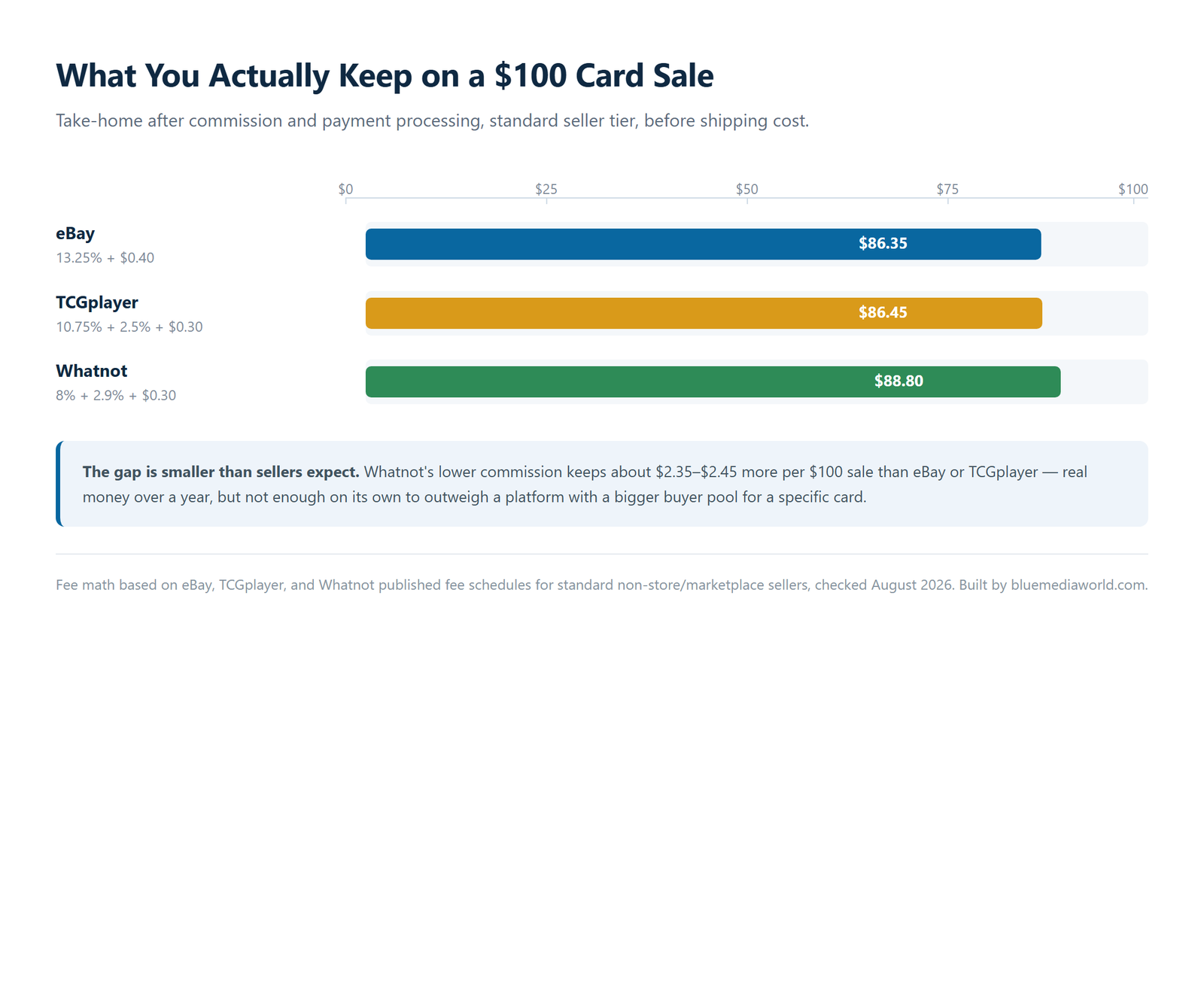
| Platform | Fee structure | Take-home on $100 sale |
|---|---|---|
| Whatnot | 8% + 2.9% + $0.30 | $88.80 |
| TCGplayer | 10.75% + 2.5% + $0.30 | $86.45 |
| eBay | 13.25% + $0.40 (non-store) | $86.35 |
✅ Quick gut-check: that is roughly $2 to $2.45 more per $100 sold on Whatnot compared to the other two. Sell $2,000 worth of cards a month and that gap is around $45 to $49 — real, but not usually enough to justify building an audience from zero on a new platform.
Scale that out further and the picture changes. A seller moving $10,000 a month keeps $225 to $245 more on Whatnot than on eBay or TCGplayer over that same period, which is where the fee gap stops being a rounding error and starts being worth the time it takes to build a following. Below that volume, sell-through speed almost always wins the decision.
How Do You Pick Between Them for a Specific Card?
Match the platform to the card, not the other way around. High-demand singles with deep buyer pools tend to move fastest on eBay or TCGplayer’s passive search traffic, where a motivated buyer is already searching for that exact card.
Lower-demand bulk lots, sealed product, and anything that benefits from a seller explaining condition or pulling cards live tend to do better on Whatnot, where the auction format and seller narration can push price above a flat listing.
A quick example: a $500 graded chase card with active buyers already searching for it by name usually sells faster on eBay or TCGplayer than it would waiting for the right live-stream audience. A $50 mixed bulk lot with soft, negotiable value often does better narrated live on Whatnot, where a seller can build interest in real time instead of hoping the right search query finds it.
You’ll probably notice the sellers doing best long-term are not loyal to one platform. They list the same inventory type in the place it moves fastest, and treat the fee difference as a tiebreaker, not the deciding factor.
Quick Checks Before You Pick a Platform
- ✅ Check whether you qualify for a lower store-tier or Pro-seller rate before assuming the base commission applies to you.
- ✅ Factor in shipping cost separately — none of these take-home numbers include it.
- ✅ Weigh sell-through speed against fee percentage, especially for time-sensitive inventory.
- ✅ Re-check current rates before a large sale — TCGplayer alone changed its fee structure twice in 2026.
- ✅ Treat promotional fee discounts (like eBay’s trading-card promos) as temporary, not a permanent rate.
Where Do Sellers Get the Fee Math Wrong?
The most common mistake is comparing only the headline commission percentage and ignoring the flat payment-processing fee stacked on top. That flat fee matters most on lower-priced items, where it eats a bigger share of the sale.
The second mistake is assuming a fee schedule checked six months ago is still accurate. TCGplayer’s commission changed twice in 2026 alone, and eBay has run temporary trading-card fee promotions that quietly expire.
A quieter mistake: ignoring seller-tier discounts. A basic-store eBay subscription can lower the effective rate enough to beat Whatnot on paper, but only if your sales volume justifies the subscription cost in the first place.
One more thing worth checking before you commit: none of these platforms guarantee a payout date. Processing times for payment methods vary, and a seller planning cash flow around a specific date should confirm the payout schedule directly on each platform rather than assuming it matches the sale date.
FAQ
Which platform has the lowest seller fees for trading cards in 2026?
Whatnot has the lowest combined fee at roughly 8% commission plus 2.9% and $0.30 payment processing, working out to about $88.80 kept per $100 sale on standard categories, ahead of TCGplayer and eBay.
Did TCGplayer raise its seller fees in 2026?
Yes. TCGplayer raised its marketplace commission from 10.25% to 10.75% on February 10, 2026, and rebuilt its Direct fulfillment fee structure again in June 2026.
Does a lower marketplace fee always mean more money for sellers?
Not necessarily. A lower fee only helps if the item actually sells. Platforms with smaller buyer pools, like Whatnot’s live-auction format, can leave inventory unsold longer than a passive-search marketplace like eBay or TCGplayer, which offsets the fee savings.
Sources
Fact-checked based on public sources as of August 20, 2026. Fees change periodically — confirm current rates on each platform before listing. This is not financial or investment advice.