

TAG Grading vs PSA: Is Computer-Vision Card Grading Actually Worth It in 2026?
Quick answer: PSA still wins on resale value. TAG wins on turnaround and transparency. PSA’s cheapest open tier right now is Regular at $79.99 a card. TAG only has two tiers open, Priority at $149 and Walkthrough at $299. If you’re grading to flip fast, that price gap matters less than the resale discount on the back end.
PSA’s backlog crossed 10 million cards this spring, and the company responded by shutting the door on its cheapest submission tiers. That single decision pushed a lot of collectors toward TAG Grading, the computer-vision challenger that’s been building a following since 2022 — and now a lot of people are asking whether TAG is a real alternative or just a stopgap until PSA reopens.
When I checked TAG’s official pricing page against PSA’s own backlog tracker, the numbers told two different stories: PSA is expensive to wait for right now, and TAG is fast but still resells at a real discount. Neither fact alone tells you what to do with your next submission.
How This Breaks Down
- What Makes TAG’s Grading Process Different From PSA’s?
- Why Is PSA Only Taking Regular-Tier Submissions Right Now?
- How Much Does Each Service Actually Cost Today?
- Does a Cheaper TAG Grade Still Pay Off at Resale?
- What Does the PSA Backlog Actually Cost a Flipper in Lost Time?
- Which One Should You Actually Submit To?
What Makes TAG’s Grading Process Different From PSA’s?
TAG grades a card with photometric stereo imaging and computer vision instead of a human grader working under a loupe, scoring centering, corners, edges, and surface separately on what it calls a 1,000-point TAG Score, on top of the familiar 1-10 scale (with a 10 Pristine at the top).
PSA, CGC, SGC, and BGS all still use trained human graders making a judgment call under magnification. That’s not automatically worse — it’s just a different kind of consistency, and it’s the standard the resale market has trusted for over three decades.
TAG backs every grade with a Digital Image Grading Plus report showing all 1,000-point subscores and a 360-degree slab video, so a buyer can inspect exactly why a card landed at, say, 9.4 instead of 9.7. Reading TAG’s own help-center documentation, that level of documentation is the whole pitch — transparency over tradition.
Why Is PSA Only Taking Regular-Tier Submissions Right Now?
PSA paused its Value, Value Bulk, Value Plus, and Value Max tiers on June 2, 2026, after a 20% spike in submissions pushed its backlog toward 10 million cards.
The company announced a $200 million investment to expand grading capacity and set a target of cutting the backlog to 5 million within about four months. When I checked PSA’s own public tracker, I found that the backlog was still sitting at 12.4 million as of July 28, so that target is running behind schedule.
Regular ($79.99), Express, Super Express, and Walk-Through remain open, which means anyone who wanted PSA’s cheapest submission path is currently locked out of it. That’s the exact gap TAG has been stepping into.
Honestly, that’s usually the part people skip when they compare prices — the “cheap” PSA tier everyone quotes online isn’t actually available to submit to right now.

How Much Does Each Service Actually Cost Today?
A Wise-tier comparison isn’t quite right here since there’s no direct cheap-to-cheap match anymore. TAG’s Priority tier costs $149 per card with an estimated 5-business-day turnaround and insurance capped at $2,500 per card, according to TAG’s own pricing page.
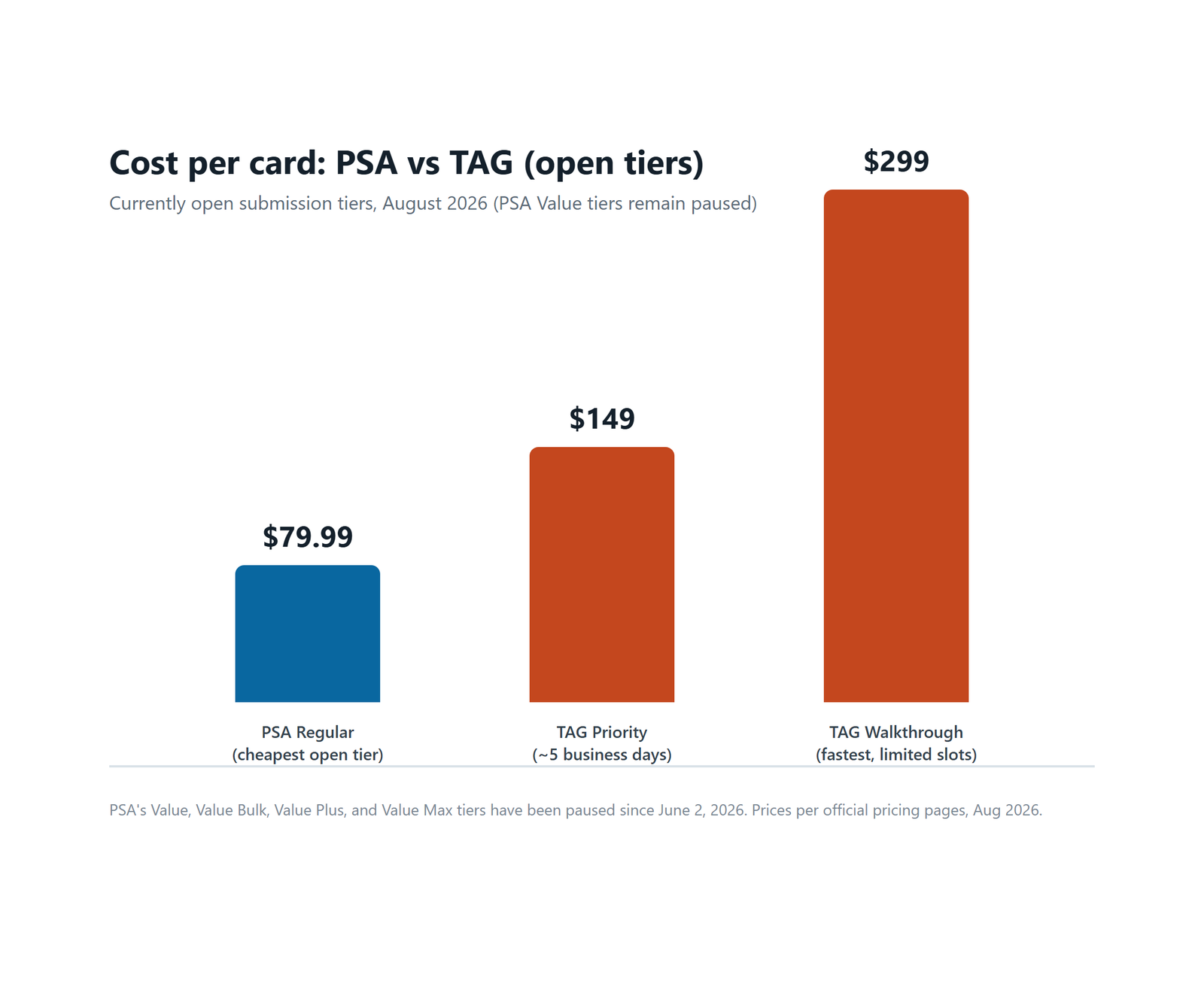
| Service | Cheapest open tier | Price | Turnaround |
|---|---|---|---|
| PSA | Regular | $79.99 | Weeks to months (backlog-dependent) |
| TAG | Priority | $149 | ~5 business days |
| TAG | Walkthrough | $299 | Fastest, limited slots |
TAG actually costs more per card than PSA’s cheapest open tier right now, which flips the usual “TAG is the budget option” assumption most collectors still repeat from 2023 and 2024.
Does a Cheaper TAG Grade Still Pay Off at Resale?
Not usually, and this is the number that should decide your submission more than the sticker price. PSA-graded cards typically resell for 35 to 60% more than an equivalent TAG-graded card, and that gap widens further on vintage and high-value cards.
You’ll probably notice this most on cards you actually plan to sell rather than keep. A $200 card graded a 9 by both services might net you close to $200 through PSA and closer to $90 to $130 through TAG once a buyer applies that resale discount.
This part trips a lot of newer flippers up. They chase TAG’s faster turnaround for a card headed straight to eBay, then discover the buyer pool paying full price for a TAG slab is a fraction of the size of PSA’s.
Market activity backs up why PSA still holds that premium. eBay’s sports card sales crossed $1.36 billion in the first half of 2026 alone, and the vast majority of high-dollar comps in that volume are still PSA slabs — buyers searching by grade default to a name they already trust.
What Does the PSA Backlog Actually Cost a Flipper in Lost Time?
A card sitting in PSA’s queue for weeks or months is capital a flipper cannot redeploy elsewhere, and that lockup period is the real cost most fee comparisons skip.
PSA’s own tracker put the backlog at 12.4 million cards as of July 28, 2026, well past its original 5-million target for that point in the timeline. For a submission filed under Regular tier today, a multi-month wait is a realistic outcome, not a worst case.
This is where TAG’s roughly 5-business-day Priority turnaround changes the math for time-sensitive flips. A card bought to flip inside a single price cycle, ahead of a set rotating out of print for example, can miss the window entirely if it is still sitting ungraded at PSA three months later.
You’ll probably notice the flippers doing this well treat turnaround time as a cost line item, not just an inconvenience. Money tied up in a slow grading queue is money that is not funding the next flip.
Which One Should You Actually Submit To?
Grade with PSA when the card is headed to resale and you can afford to wait, since the resale premium usually outweighs a few extra months in the queue.
Grade with TAG when you need documentation fast — insurance appraisals, a personal collection you’re not selling, or a card you want protected and dated before a price swing, where the 5-day Priority turnaround genuinely beats anything PSA offers right now.
A $2,000 vintage card is worth the PSA wait almost every time. A $40 modern parallel you’re grading mostly to protect the corners is a much easier case for TAG, since the resale discount barely registers on a card that cheap.
Most people skip doing this math and just default to whichever service they used last time.
Before You Submit a Card, Check This
- ✅ Confirm the tier you want is actually open — PSA’s Value tiers were paused for months, and availability can change again.
- ✅ Check TAG’s current slot availability before committing; Priority and Walkthrough have run limited capacity in 2026.
- ✅ Price out both services against the card’s realistic resale value, not its raw market price.
- ✅ Factor in insurance coverage limits — TAG’s Priority tier caps at $2,500 per card, which matters for high-value submissions.
- ✅ Re-check PSA’s public backlog tracker before assuming a turnaround estimate is current.
- ✅ Ship in a semi-rigid holder inside a sleeve, never a loose toploader — both graders can reject or downgrade cards that arrive scuffed. Bulk semi-rigids and sleeves are cheapest on AliExpress if you can wait a couple of weeks on shipping.
Disclosure: this post contains an affiliate link — if you buy through it, we may earn a commission at no extra cost to you.
The Mistakes That Cost Collectors Money
The biggest one is treating TAG as the automatic “budget” pick out of habit. With PSA’s Value tiers paused, TAG is no longer cheaper than PSA’s open tiers — it’s often more expensive per card.
The second is ignoring the resale discount until after the card is already slabbed. Once a card is graded, switching services means re-submitting from scratch, so that math needs to happen before you mail anything.
A quieter mistake: assuming PSA’s backlog will clear on the company’s original four-month timeline. The public tracker was already running behind that projection as of late July, so don’t plan a sale date around a Value-tier reopening that hasn’t happened yet.
FAQ
Is TAG grading as good as PSA in 2026?
TAG’s computer-vision process is more transparent, with 1,000-point subscores and slab video, but PSA still commands 35 to 60% higher resale value for comparable grades, so “as good” depends on whether you value documentation or resale liquidity more.
Why did PSA stop taking Value tier submissions?
PSA paused its Value, Value Bulk, Value Plus, and Value Max tiers on June 2, 2026, after a 20% submission spike pushed its backlog toward 10 million cards. Regular, Express, Super Express, and Walk-Through tiers stayed open.
Is TAG grading cheaper than PSA right now?
No, not currently. With PSA’s Value tiers paused, its cheapest open tier is Regular at $79.99. TAG’s only open tiers are Priority at $149 and Walkthrough at $299, both more expensive than PSA’s Regular tier.
Sources
- PSA: Service Level Update, May 2026
- TAG Grading: Official Pricing
- CardGrade.io: TAG vs PSA Grading, Prices & Resale (2026)
This is not investment or financial advice — grading and resale values fluctuate. Prices and tier availability reflect published rates as of August 26, 2026; confirm current pricing directly with PSA or TAG before submitting.