Gate Fee Payback at 70% (2026): Why the Highest Rate Ties With Bitget on Real Cost
Updated 8 October 2026. TetherBase revised its exchange rates on 28 September 2026. The OKX, Binance, Bybit and EdgeX figures in the comparison table below are recalculated against the new rates. Check tetherbase.io before you trade.
Quick answer
A 70% payback on Gate’s 0.05% taker fee leaves 0.015% — about $1.50 on a $10,000 market order, down from $5.00.
That is a tie with Bitget, not a win. Rank exchanges by effective fee after discounts, not by the payback percentage in the advertisement.
Anyone comparing crypto futures fee-payback programs starts at the top of the rate table, and on TetherBase that is Gate at 70%. Reading that number as “cheapest exchange” is the most common mistake in this corner of the market. What follows is what 70% returns in actual dollars, and why an exchange paying twenty percentage points less ends up costing exactly the same.
What this page covers
- What Does a 70% Payback Actually Return?
- Why Is the Highest Rate Not the Cheapest Exchange?
- All six exchanges, same yardstick
- Where Gate wins, and where it does not
- The order of operations that actually works
What Does a 70% Payback Actually Return?
Gate carries the highest payback rate of the six exchanges TetherBase currently supports. The listed taker fee on a standard (non-VIP) account is 0.05%. Route the account through the payback program and 70% of that fee comes back, leaving 0.015% as the real cost.
In dollars: a $10,000 market order costs $5.00 in fees before payback and $1.50 after. A full round trip — entry and exit — drops from $10.00 to $3.00. Someone opening and closing ten positions of that size a day is looking at roughly $2,100 a month in gross fees turning into about $630.
Limit orders follow the same arithmetic. The listed maker fee of 0.02% falls to 0.006%. Which of the two numbers matters more depends entirely on how your orders fill, so check your own order history before assuming either figure applies to you.
Why Is the Highest Rate Not the Cheapest Exchange?
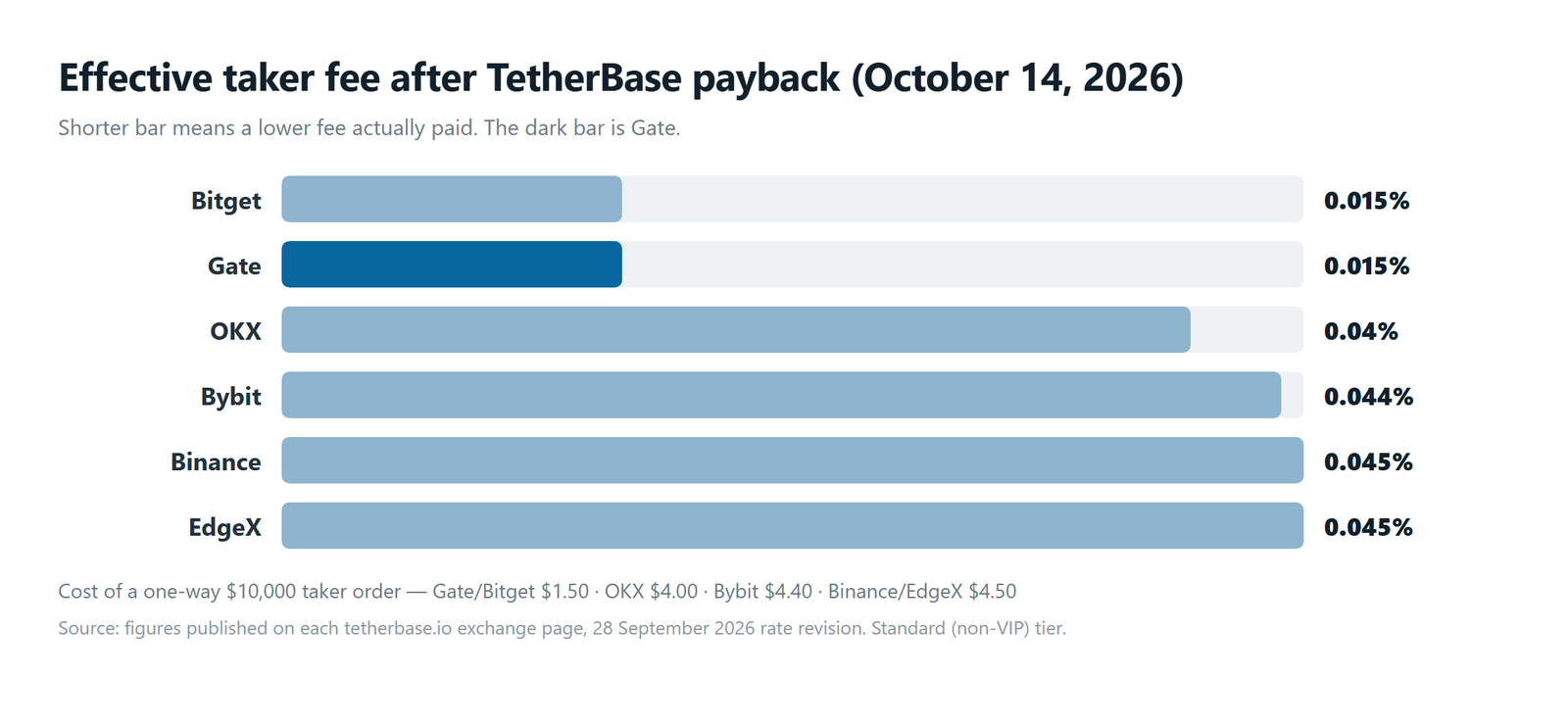
This is the part worth slowing down for. Gate pays back 70%. Bitget pays back 50% — twenty percentage points less. Yet the effective taker fee on both comes out to 0.015%.
The two programs are built differently. Gate charges its standard fee and returns a large share of it. Bitget discounts the fee itself by 50% first, then pays back 50% of the reduced amount. Different starting points, same destination. Comparing the headline percentages alone gets you the wrong answer.
Bybit shows the same effect in milder form: a 35% payback that reads as the weakest on the list, paired with a 20% fee discount that pulls the effective cost closer to the middle of the pack.
All six exchanges, same yardstick
These are the figures TetherBase publishes on each exchange page, checked on September 20, 2026. Every row assumes a standard non-VIP account.
| Exchange | Listed taker fee | TetherBase payback | Effective taker fee | Cost per $10,000 |
|---|---|---|---|---|
| Gate | 0.05% | 70% | 0.015% | $1.50 |
| Bitget | 0.06% | 50% + 50% fee discount | 0.015% | $1.50 |
| OKX | 0.05% | 20% | 0.04% | $4.00 |
| Binance | 0.05% | 10% | 0.045% | $4.50 |
| Bybit | 0.055% | 20% (no fee discount) | 0.044% | $4.40 |
| EdgeX (on-chain) | 0.045% | None | 0.045% | $4.50 |
Gate and Bitget tie at the top, then OKX and Bybit, and Binance ties with the on-chain venue EdgeX at the bottom. The spread from first to last is 0.015% against 0.045% — exactly 3x. That multiple lands directly on your monthly fee bill, so it matters more the more you trade.
Where Gate wins, and where it does not
If the effective cost is a tie, the decision has to come from somewhere else. Gate’s advantage is bookkeeping. Fees are charged in full and the rebate arrives separately, so your trade log and your rebate log stay cleanly apart. Anyone reconciling monthly costs or preparing tax records will find that easier to work with than a discounted-then-rebated structure.
The trade-off shows up when margin is tight. With a discount model, the reduced fee is all that ever leaves the account. With a payback model, the full fee leaves first and comes back later, so collateral drains marginally faster in the meantime. On a high-leverage position sitting near its liquidation price, that gap is not always negligible.
Listing coverage is the other check. A low fee on a pair Gate does not list is worth nothing, and a thin order book can hand back the savings through slippage on a single fill. Fees are one component of trading cost, not the whole of it.
The order of operations that actually works
- Open the TetherBase page for Gate and use its sign-up link to create a new Gate account.
- Complete Gate’s identity verification.
- Find your UID in the Gate app or web interface.
- Link that UID on TetherBase.
- Start trading only after the link is confirmed.
The sequence is not arbitrary. Payback exists because the exchange pays an affiliate commission on accounts attributed to that affiliate. No attribution, no commission, nothing to share. Attaching an existing Gate account after the fact is usually not possible, so if you already trade there, settle what happens to that account before you open a second one.
One closing note. Payback reduces what trading costs you. It does not improve whether the trade was right. A 70% cut in fees is not a reason to size up.
Frequently asked questions
Does a 70% payback mean 70% of my fees come back?
Yes — 70% of the fees you actually paid is credited back on the platform’s settlement cycle. Against Gate’s standard taker fee of 0.05%, that leaves 0.015% as your real cost. If your account already sits at a VIP tier with a different starting fee, recalculate from that number instead.
Can I attach an existing Gate account to a payback program?
Usually not. Payback depends on the account being attributed to the affiliate at sign-up, and most exchanges do not allow retroactive attribution. If you already trade on Gate, ask the platform’s support whether anything can be done before you open a second account.
Is Gate the cheapest exchange because it pays the highest rate?
No. On effective taker fee after payback, Gate and Bitget are tied at 0.015%. Bitget’s lower 50% rate applies to an already discounted fee, which is why the two converge. Ranking by headline payback percentage produces the wrong order.
Sources
- TetherBase — Gate payback and effective fee page (checked September 20, 2026)
- TetherBase — full list of partner exchanges and rates
- Gate — official contract trading fee calculation
🔗 Related guides
This article is general information about exchange fee structures, not investment advice or a recommendation to use any particular exchange. It contains affiliate links to TetherBase (tetherbase.io). Leveraged crypto futures can lose your entire deposit, and fee and payback rates change without notice — confirm current terms on each official page before trading.
Fact-checked based on public sources as of September 20, 2026.