How to Check a Crypto Exchange’s Funding Rate Before You Trade
A funding rate that looks tiny on paper can quietly eat a real chunk of a leveraged position’s return in just a few days. I check this before every futures trade. It’s also the step I see skipped more than any other. Skipped, that is, right up until the day it burns someone. Let me walk you through it. The whole thing takes under two minutes.
📌 Related reading: 2026 Best Crypto Futures Exchanges for Funding Rates · How to Set a Stop-Loss on a Crypto Futures Position
In This Guide

Steps
Step 1: Open the Futures Trading Interface for Your Pair
Go to the perpetual futures contract for the exact pair you want to trade. This matters. Funding rates vary by pair, not just by exchange. A well-known pair with balanced long/short interest can carry a very different rate than a smaller, more speculative one sitting on the same platform.
Step 2: Locate the Funding Rate Display
Most exchanges park the current funding rate right by the price ticker or in the contract details panel. Look for a label like “Funding Rate” or “Funding / Countdown.” It refreshes on a fixed schedule. Commonly every 8 hours, though a few platforms settle on different intervals, so don’t assume.
Step 3: Check the Funding Rate History, Not Just the Current Number
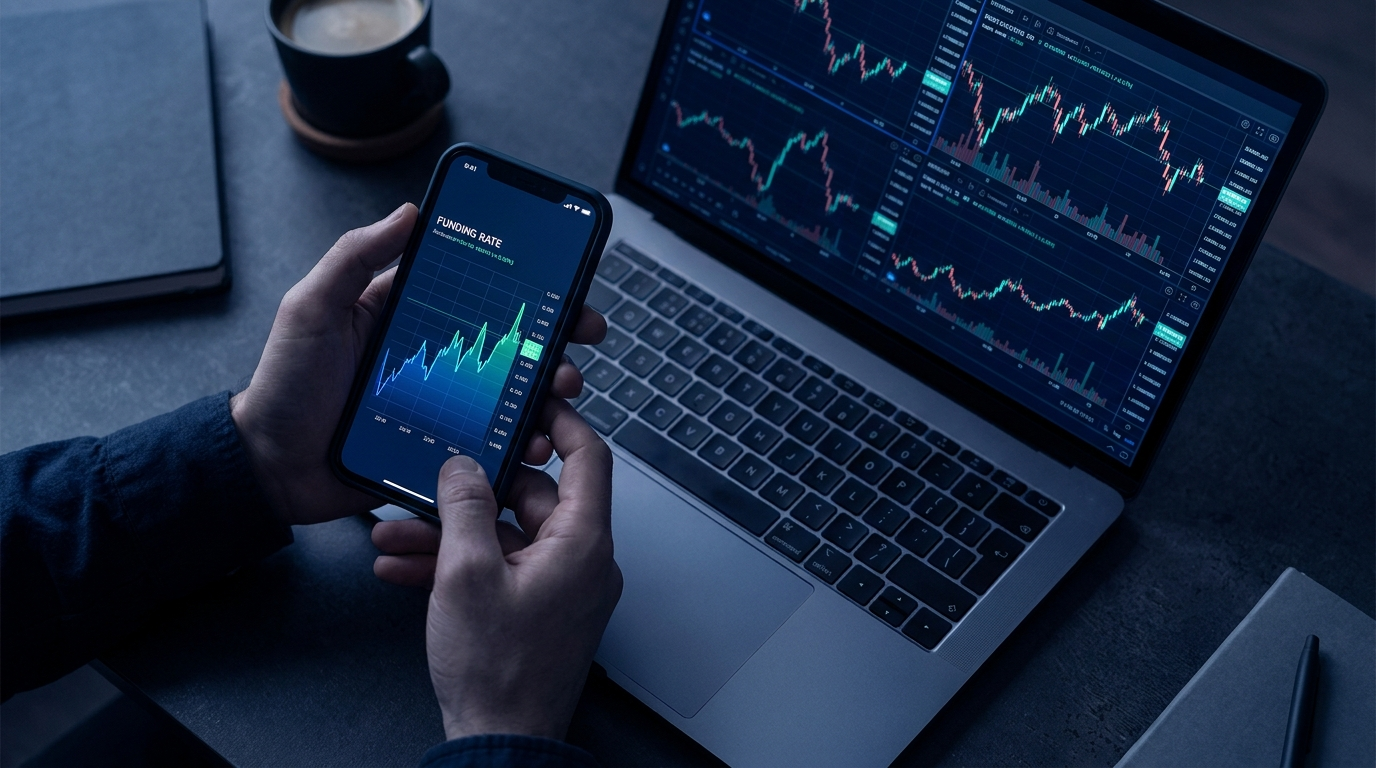
Click into the funding rate history chart if the exchange gives you one. A single snapshot lies by omission. A pair with wildly swinging funding is riskier to hold long-term than one with a stable, low rate. When I pulled the funding history on a handful of popular pairs, the calmest charts were consistently the cheapest to hold across multi-day windows. Even when the current snapshot looked nearly identical.
Step 4: Calculate Your Estimated Holding Cost
Take the funding rate and multiply it by the number of settlement periods you expect to hold. A 0.01% rate paid three times daily over a week works out to roughly 0.21%. Small per period. It piles up on leveraged positions held for days, though. On a 10x leveraged position, that 0.21% funding cost translates to roughly 2.1% of your margin. That is not trivial, and I’ve watched people ignore it right up to their liquidation.
Step 5: Compare Against at Least One Other Exchange
Got accounts on more than one exchange? Compare the same pair’s funding rate before you commit. The spread is sometimes wider than the trading fee difference. That’s especially true during stretches of strong directional sentiment, when one platform’s traders lean far more one-sided than another’s.
Tips

- ✅ Set a price/funding alert if your exchange supports it, so a settlement spike doesn’t catch you asleep.
- ✅ Funding flips direction. When sentiment reverses, you can end up getting paid instead of paying.
- ✅ Recheck funding rates before you add to an existing position, not only when you first open it.
- ✅ Fold funding cost into your break-even the same way you’d fold in trading fees. It’s easy to forget because it’s charged periodically rather than upfront.
- ✅ Tread carefully around major scheduled events like economic data releases or token unlocks. Funding tends to swing harder than usual then.
Warnings
⚠️ Funding rates can spike sharply during high volatility, especially around major news events. ⚠️ Extremely high funding on one side of the market can signal an overcrowded, one-directional trade that’s prone to a sharp reversal. ⚠️ Futures trading involves substantial risk of loss and is not suitable for all investors. This article is for informational purposes only and is not financial advice.
References
Q&A
How often do funding rates actually change?
Settlement itself usually lands every 8 hours. The rate underneath it, though, can drift continuously as market conditions shift between those settlements.
Do all exchanges use the same funding rate formula?
They don’t. The underlying calculation rests on the gap between the perpetual and spot price, and it varies a little from exchange to exchange. That’s part of why the same pair shows different rates across platforms.
Can a negative funding rate ever mean something is wrong with the exchange?
Usually not. Negative funding is a normal, expected state when short positions outweigh longs. It’s only worth worrying about if it turns extreme and stays that way with no clear market reason behind it.
Fact-checked based on public sources as of July 21, 2026.
Frequently Asked Questions
Does the funding rate apply if I only trade spot, not perpetual futures?
No. Funding rates exist only for perpetual futures contracts, as a mechanism to keep the contract price near spot. Spot trades do not incur funding payments. General information, not advice.
What if the funding rate changes right after I open a position?
Funding is charged at set intervals, often every eight hours but this varies by exchange, so a rate that shifts between intervals only affects the payment calculated at the next settlement, not continuously. Check your exchange’s funding schedule.
Can I be charged funding even while my position is at a loss?
Yes. Funding payments are based on position size and the current rate, independent of whether your trade is profitable, so holding through several intervals can add cost regardless of profit or loss. This is not financial advice.

Similar Posts
Crypto Futures Liquidated Before Stop-Loss Triggers: Why It Happens (2026)
TL;DR — Your stop-loss and your liquidation price are handled by two completely different systems. Liquidation is triggered by the mark price, not the last-traded price you’re watching. When markets whip fast enough, the mark price can jump straight past your stop and land on your liquidation price in the same tick. Quick answer: Your…
Where Are Crypto Futures Funding Rates Cheapest in 2026?
TL;DR — Hold a leveraged perpetual position for a few days and the funding payments — not the trading fees — usually end up being the bigger line item. Most exchange comparisons still lead with maker-taker fees anyway. This one doesn’t. Hold a leveraged perpetual position for a few days and the funding payments —…
How Much Leverage Is Too Much for Crypto Futures in 2026?
TL;DR — Choosing a leverage number looks like flipping a settings toggle. It isn’t. It’s a risk-tolerance decision wearing the costume of a slider. Ask “what leverage should I use” and there’s no single answer waiting for you. It hinges on your risk tolerance and how long you plan to hold. Choosing a leverage number…
Isolated Margin vs Cross Margin: The 2026 Liquidation Risk Comparison
TL;DR — By Marcus Han · Fact-checked based on public sources as of July 28, 2026 · 3 sources confirmed The short version Isolated margin caps your loss at whatever you put into that one position. Cross margin lets your whole futures wallet act as a backstop, so a single bad trade survives longer before…
Negative Funding Rate on Crypto Futures: Binance vs Bybit Short-Squeeze Risk (2026)
TL;DR — Quick answer Bitcoin’s funding rate flipped negative in early August 2026. Short sellers are now paying longs to hold their positions. That alone doesn’t guarantee a bounce. Binance and Bybit calculate funding differently. The same market can show two different numbers on two different apps at the same moment. Quick answer Bitcoin’s funding…
How to Set a Stop-Loss on a Crypto Futures Position
TL;DR — Pick your maximum acceptable loss first. Make it a percentage of your whole account, not the position. Most people I’ve seen stick to 1-2% per trade. Then work out the exact stop price from that number and your leverage. Set the stop in the same order flow that opens the trade. Quick answer:…