Maryland Banned Tips on Early Pay Apps October 1: What ‘Free’ Instant Pay Really Costs Gig Workers (2026)
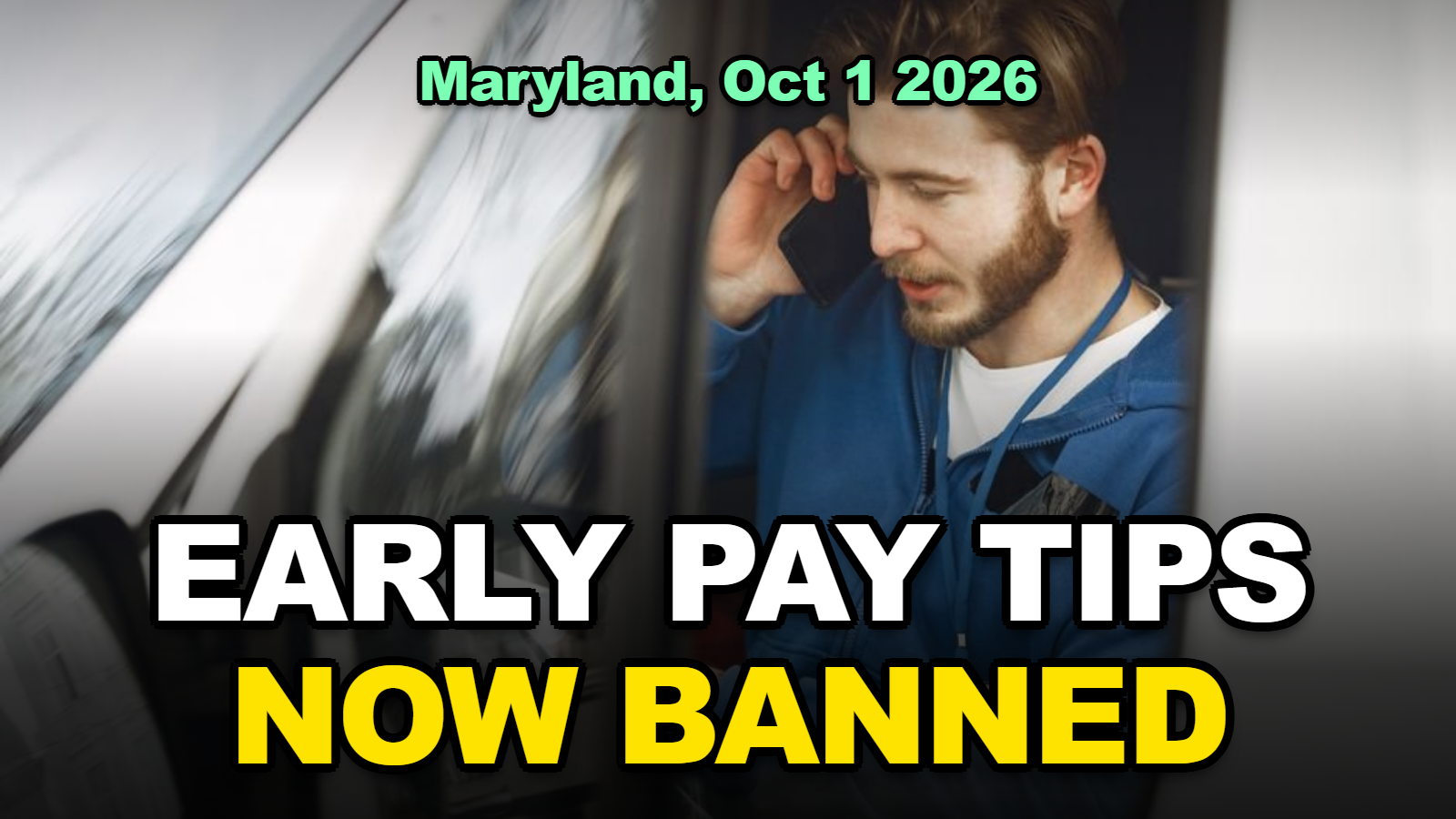
Short answer: Since October 1, 2026, earned wage access apps can’t ask Maryland users for tips. Fast-transfer fees were already capped there: $5 on $75 or less, $7.50 above that. Every app must also offer a free option. Outside Maryland, tips are often still allowed. A $5 fee on a one-week $75 advance works out to about 348% APR. Before you pay for speed, find the free option and check when your money actually lands.
Maryland just made “optional” tips on paycheck advance apps illegal.
That matters even if you don’t live there. The state’s own numbers show how much those small tips and fees add up, and they’re the clearest look yet at what early pay really costs people who live gig to gig.
Here’s what changed on October 1, how to work out the real cost of any instant-pay app wherever you live, and how to stop paying for speed you don’t need.
Inside This Guide
- What Changed in Maryland on October 1, 2026?
- How Much Does a “Free” Early Pay Advance Really Cost?
- Advance Fees Turned Into APR
- Does This Cover DoorDash, Uber, and Instacart Instant Pay?
- How Do You Stop Paying for Early Access?
- Tips
- Warnings
- FAQ
- Sources
What Changed in Maryland on October 1, 2026?
Maryland’s earned wage access bill, SB 94, signed by Gov. Wes Moore on April 28, 2026 and effective October 1, 2026, bans earned wage access providers and lenders from soliciting, charging, or accepting tips from consumers, according to the Maryland Department of Labor.
Before this, Maryland let apps ask for tips as long as the default was zero. That was the 2025 rule. Now the tip prompt is gone entirely, and providers have to say in their contracts that Maryland law prohibits tips or donations, per HR Morning’s summary of the change.
The rest of the 2025 framework still sets the baseline. According to Goodwin’s analysis of the 2025 law:
- Fast-delivery fees are capped at $5.00 for advances of $75 or less and $7.50 for advances over $75.
- A no-cost option is required whenever an app charges a fee. The app has to explain how to choose it.
- No late fees, interest, or penalties for failing to repay.
- No credit reports to qualify you, and unpaid amounts can’t be reported to credit bureaus or sent to collections.
Why the crackdown? The state’s 2024 market inquiry found Maryland consumers paid over $35 million in fees on 5.5 million transactions from 2019 to 2024. Tips alone averaged more than $280 per user, according to the Department of Labor.
Two hundred eighty dollars. In “optional” tips.
How Much Does a “Free” Early Pay Advance Really Cost?
An earned wage access advance that charges a $5 fast-transfer fee on $75 repaid in seven days costs the equivalent of about 348% APR, even though the app may call the standard transfer free.
The trick is that the fee looks tiny. Five dollars is a coffee. But you’re paying it to borrow $75 for a week, and many people do it every week.
When I checked the Maryland Department of Labor’s announcement, I noticed that it calls these “app-based payday loans” and describes the tip prompts as “dark-pattern pricing.” That’s a state regulator’s word choice, not a consumer blog’s.
Here’s where people get tripped up: the free option usually exists, but it’s slow. Standard transfers can take a day or more. The instant button is right there, and it’s the one that costs money.
Advance Fees Turned Into APR
When I compared common fee and tip amounts against how long the money is actually out, I found that short advances with flat fees cost far more than they look, while larger, longer advances shrink toward ordinary credit-card territory.
| Advance | Fee or tip | Days until repaid | APR equivalent | Allowed in Maryland now? |
|---|---|---|---|---|
| $75 | $5 fast fee | 7 | about 348% | Yes, at the cap |
| $100 | $3 tip | 10 | about 110% | No, tips banned |
| $200 | $7.50 fast fee | 7 | about 196% | Yes, at the cap |
| $500 | $7.50 fast fee | 14 | about 39% | Yes, at the cap |
| Any amount | Free standard transfer | Any | 0% | Required to be offered |
Table: our calculation (fee ÷ advance × 365 ÷ days) using Maryland’s fee caps as summarized by Goodwin and the October 1, 2026 tip ban, as of October 3, 2026. Earned wage access isn’t always legally a loan, so APR here is a comparison tool, not a legal disclosure.
So the cap helps on bigger advances. It does very little for the $50-to-$75 weekly top-ups people use most.
Does This Cover DoorDash, Uber, and Instacart Instant Pay?
Maryland’s earned wage access rules target providers that advance wages before payday, so gig platforms’ own cash-out features, such as instant pay of earnings already credited to a driver’s account, may be treated differently; check each platform’s terms rather than assuming the tip ban or fee caps apply.
This distinction matters for delivery and rideshare drivers. When you cash out from DoorDash or Uber, you’re usually withdrawing money already sitting in your earnings balance. That’s different from an app fronting you money against a paycheck that hasn’t arrived.
Where gig workers often do run into earned wage access is the separate app layer: standalone advance apps, or employer-linked services on a W-2 side job.
Honestly, the platform cash-out fee is usually the smaller problem. The bigger one is stacking a platform fee, an advance app’s fast fee, and sometimes a tip, all in the same week.
How Do You Stop Paying for Early Access?
The simplest way to stop paying earned wage access fees is to pick the free standard transfer, which Maryland law requires apps to offer when they charge a fee, and to time the request a day or two before you actually need the cash.
A practical routine:
- Look for the free option first. In Maryland it has to be there and explained. Elsewhere, it often still exists under a “standard” or “no-fee” label.
- Request a day earlier. Most fast fees buy you hours, not days.
- Track every fee for one month. Add up fast fees, tips, and subscriptions. People are routinely surprised by the total.
- Build a $100 buffer. Even a small cushion breaks the weekly advance cycle that the table above punishes most.
- Check for subscriptions. Some apps charge a monthly membership on top of transfer fees. That’s a cost even in months you don’t borrow.
Most people skip step 3 and regret it.
Tips
- If you’re in Maryland and an app still shows a tip prompt after October 1, 2026, take a screenshot. You can report it to the Maryland Office of Financial Regulation.
- Turn off auto-repeat or “auto-advance” features so you only borrow when you choose to.
- Compare against a credit union small-dollar loan. Over a full month, it can beat repeated weekly fast fees.
- Keep holiday income from seasonal gigs in a separate account so it can become your buffer.
Warnings
- This is general information, not financial or legal advice. State rules differ, and apps change their terms often.
- The APR figures above are illustrations from our own math. They’re not the APR any app is required to disclose.
- Tip bans don’t remove fast-transfer fees or subscriptions. Read the full fee screen every time.
- Be careful with apps that request access to your bank login. Check what they can see and how to revoke it.
FAQ
Does Maryland’s tip ban apply if I live in another state?
No. SB 94 covers Maryland consumers. In many other states, earned wage access apps can still request optional tips, so the fee-to-APR math above matters even more there.
Can an earned wage access app send me to collections in Maryland?
No. Under Maryland’s 2025 law, providers cannot report unpaid advances to credit bureaus, use collectors, sell the debt, or sue consumers over unpaid proceeds, fees, or tips.
Is a $5 fast-transfer fee still legal in Maryland?
Yes, for advances of $75 or less. Maryland caps fast-delivery fees at $5.00 up to $75 and $7.50 above $75, and apps must also offer a no-cost option.
Sources
- Maryland Department of Labor — Gov. Moore signs Earned Wage Access bill (SB 94)
- HR Morning — Earned Wage Access Alert: Maryland Law Changes Rules on Oct. 1
- Goodwin — Maryland Enacts Law Regulating Earned Wage Access Services
🔗 Related guides
- DoorDash’s $131.5M NYC Settlement: Who’s Owed, How Much, and How to Make Sure You Actually Get Paid (2026)
- Holiday Side Hustles That Actually Pay Before Christmas: Approval Times and Real Pay, Compared (2026)
- Amazon Auto Buy Before Prime Big Deal Days: The Coupon Catch and 5 Other Rules to Know (2026)
Fact-checked against the Maryland Department of Labor, HR Morning’s coverage of SB 94, and Goodwin’s analysis of Maryland’s 2025 earned wage access law as of October 3, 2026. Not financial or legal advice.