Fat Cat Card: How to Move Leftover USDT Off Your Card
Short answer: Check whether your card allows withdrawals at all before you top up. KAST does, for a flat network fee plus 0.1%. Jupiter cards issued by DCS, the issuer for Korean residents, can’t withdraw yet. On KAST, the network you pick matters more than the amount. Moving $40 costs $0.24 on Arbitrum and $6.04 on Ethereum.
Trips end with money left on the card. Sometimes it’s $30. Sometimes it’s $800 because a hotel refunded a deposit on the last day.
Getting it back out is a different process from topping up, with different fees, and on some cards it isn’t possible at all. Fat Cat Card compares USDT cards on top-up networks and fees. This page looks at the exit: what each route costs and which cards lock the balance in.
What This Works Out
- Can every USDT card send your balance back out?
- What does a KAST withdrawal cost on each network?
- Is a KRW bank payout cheaper than sending USDT?
- What if your card can’t withdraw?
- How do you withdraw without losing the transfer?
- Decide before the next top-up
Can every USDT card send your balance back out?
Not every USDT card lets you withdraw: KAST allows stablecoin withdrawals on four networks, while Jupiter’s DCS-issued cards, the ones Korean residents receive, do not support withdrawals at all as of October 2026.
| Card | Can you withdraw? | Routes | Source |
|---|---|---|---|
| KAST | Yes | Stablecoin to Solana, Arbitrum, Ethereum or Tron; fiat payout; free KAST Tag transfer | KAST fee page, October 22, 2026 |
| Jupiter (Rain issuer) | Yes | USDC or USDT to a Solana address, no fee shown, minimum 1.00; bank transfer for USDC deposits only | Jupiter Fees and Limits |
| Jupiter (DCS issuer: Korea, Japan, Australia and others) | No | Spend only; the app says withdrawals aren’t available in your region | Jupiter Fees and Limits |
When I checked Jupiter’s fees and limits page, I noticed that the warning sits on the deposit screen itself: card balances are for spending only, so deposit only what you plan to spend. Easy to scroll past. Expensive to miss.
The Jupiter Card docs list the DCS countries: Australia, Japan, Malaysia, the Philippines, Singapore, South Korea, Taiwan, Thailand and Vietnam. You can’t hold cards from both issuers.
What does a KAST withdrawal cost on each network?
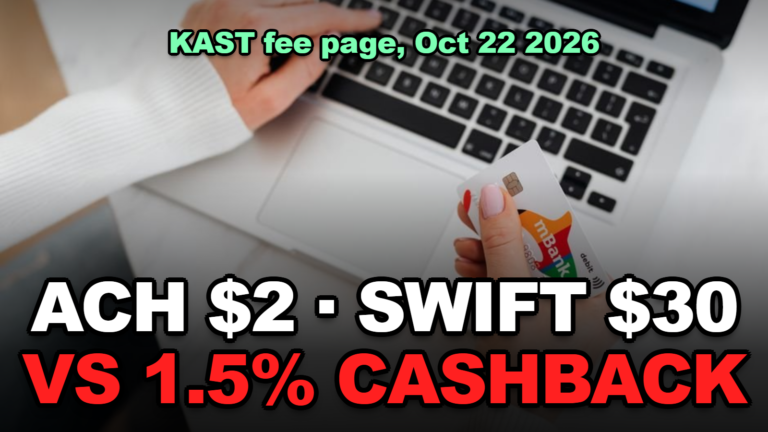
A KAST stablecoin withdrawal costs a flat network fee plus 0.1% of the amount: $1 on Solana, $0.20 on Arbitrum, $6 on Ethereum and $5 on Tron, according to KAST’s fee page updated October 22, 2026, with a $5 minimum.
I worked out three common leftover amounts from KAST’s published fee table:
| Network (assets) | $40 left | $300 left | $1,000 left | Fee on $40 as % |
|---|---|---|---|---|
| Arbitrum (USDC) | $0.24 | $0.50 | $1.20 | 0.6% |
| Solana (USDT, USDC) | $1.04 | $1.30 | $2.00 | 2.6% |
| Tron (USDT) | $5.04 | $5.30 | $6.00 | 12.6% |
| Ethereum ERC-20 (USDT, USDC) | $6.04 | $6.30 | $7.00 | 15.1% |
| KAST Tag to another KAST user | $0 | $0 | $0 | 0% |
When I compared the rows, I found that the flat part dominates small amounts. On $40, Tron costs 21 times what Arbitrum does. At $1,000 the gap shrinks to $4.80, because the 0.1% part is the same everywhere.
This part trips a lot of people up. Tron (TRC-20) is the USDT network Korean exchanges commonly use, as Fat Cat Card notes in its KAST listing, so it feels like the default. On a small leftover it’s one of the two worst choices.

The catch is the receiving side. A cheap network only helps if your exchange or wallet accepts that coin on that network. Check the deposit page of the receiving account first. Sending to an unsupported network can mean losing the transfer. Our guide to Fat Cat Card: Why Your USDT Top-Up Arrives Short covers the network fee on the way in, which is the mirror image of this.
Is a KRW bank payout cheaper than sending USDT?
A KAST payout to a Korean bank account in KRW costs $2 plus a 1% foreign exchange fee with a 20,000 KRW minimum, according to KAST’s fee page, so it beats a Tron USDT withdrawal on small amounts and loses on large ones.
| Leftover | KRW bank payout ($2 + 1%) | Tron USDT withdrawal ($5 + 0.1%) | Cheaper route |
|---|---|---|---|
| $40 | $2.40 | $5.04 | KRW payout, by $2.64 |
| $300 | $5.00 | $5.30 | KRW payout, by $0.30 |
| $1,000 | $12.00 | $6.00 | Tron, by $6.00 |
The break-even sits at about $333. Below that, the bank payout costs less. Above it, sending USDT to an exchange costs less in fees.
Fees aren’t the whole story, though. Sending USDT means you still have to sell it on the exchange, and the local price of USDT in Korea can sit above or below the dollar rate. The KRW payout skips that step. If you’ve ever sold USDT on a day the premium vanished, you know that gap can be bigger than either fee.
What if your card can’t withdraw?
A USDT card balance that can’t be withdrawn, such as a DCS-issued Jupiter card, can only leave the card through spending, so the practical plan is to spend it down on USD-priced purchases where Jupiter charges no FX fee.
Jupiter’s docs say there’s no fee on USD payments and 1.8% on non-USD payments for DCS cards. Spending $100 of leftover on a dollar-priced subscription or app purchase uses it at face value. Spending it in won costs $1.80.
- Use it for USD-billed subscriptions you’d pay anyway.
- Pay for the next trip’s bookings in USD where the site offers it.
- Stop topping up beyond what you’ll spend in the next few weeks.
Honestly, the last one is the real fix.
How do you withdraw without losing the transfer?
- Open the receiving exchange or wallet and copy a deposit address for the exact coin and network.
- In the card app, choose the same coin and network for the withdrawal.
- Send the $5 minimum first if the amount is large. Wait for it to arrive.
- Send the rest.
- Write down the amount sent, the fee shown, and the amount received.
If a transfer sits on pending for hours, our checklist for Crypto Card Top-Up Stuck on Pending? works the same way in reverse.
Decide before the next top-up
The cheapest withdrawal is the one you don’t need. Size top-ups to the trip, and pick a card that lets money out if you tend to over-fund. Our Fat Cat Card: Compare Crypto Card FX Fees on a Euro Trip helps estimate what a trip will actually use.
Tips
- On KAST, Arbitrum is the cheapest way out for USDC. Solana is next and takes both USDT and USDC.
- For leftovers under about $333, KAST’s KRW bank payout costs less than a Tron USDT withdrawal.
- A friend on KAST? KAST Tag transfers are free, up to $10,000 and 5 transfers a day.
- Keep the transfer record. You’ll want it if a balance ever looks short.
Warnings
- Jupiter DCS cards (Korea and eight other countries) can’t withdraw. Treat every top-up as money you’ll spend on the card.
- Sending a coin on a network the receiver doesn’t support can lose the transfer.
- Fees here come from KAST’s fee page updated October 22, 2026 and Jupiter’s docs read October 28, 2026. The app shows the current fee before you confirm.
FAQ
Can I withdraw USDT from a Jupiter card in South Korea?
Not at the moment. Jupiter’s fees and limits page says DCS-issued cards, which go to residents of South Korea and several other Asian countries, do not support withdrawals yet, and the deposit screen warns to deposit only what you plan to spend.
What is the minimum KAST stablecoin withdrawal?
KAST’s fee page, updated October 22, 2026, sets the minimum stablecoin withdrawal at $5 with no maximum. The fee is a flat amount per network plus 0.1% of the withdrawal.
Is it cheaper to send my leftover KAST balance to a friend?
If the friend also uses KAST, yes. KAST Tag transfers are free and instant, with a limit of $10,000 a day and up to 5 transfers a day, according to KAST’s fee page. They can pay you back another way.
Sources
- KAST: What Are the Fees and Conditions for KAST Cards and Accounts? (updated October 22, 2026)
- Jupiter docs: Fees and Limits (Withdrawals)
- Jupiter docs: Jupiter Card (Card Issuers)
Before your next top-up, open the card’s withdrawal screen once. If there isn’t one, top up less.
Fact-checked against KAST and Jupiter public pages as of October 28, 2026. Fees change; the card app shows the current figure. This is general information, not financial advice.
🔗 Related guides