Fat Cat Card: How to Choose ACH, Wire or SEPA for KAST
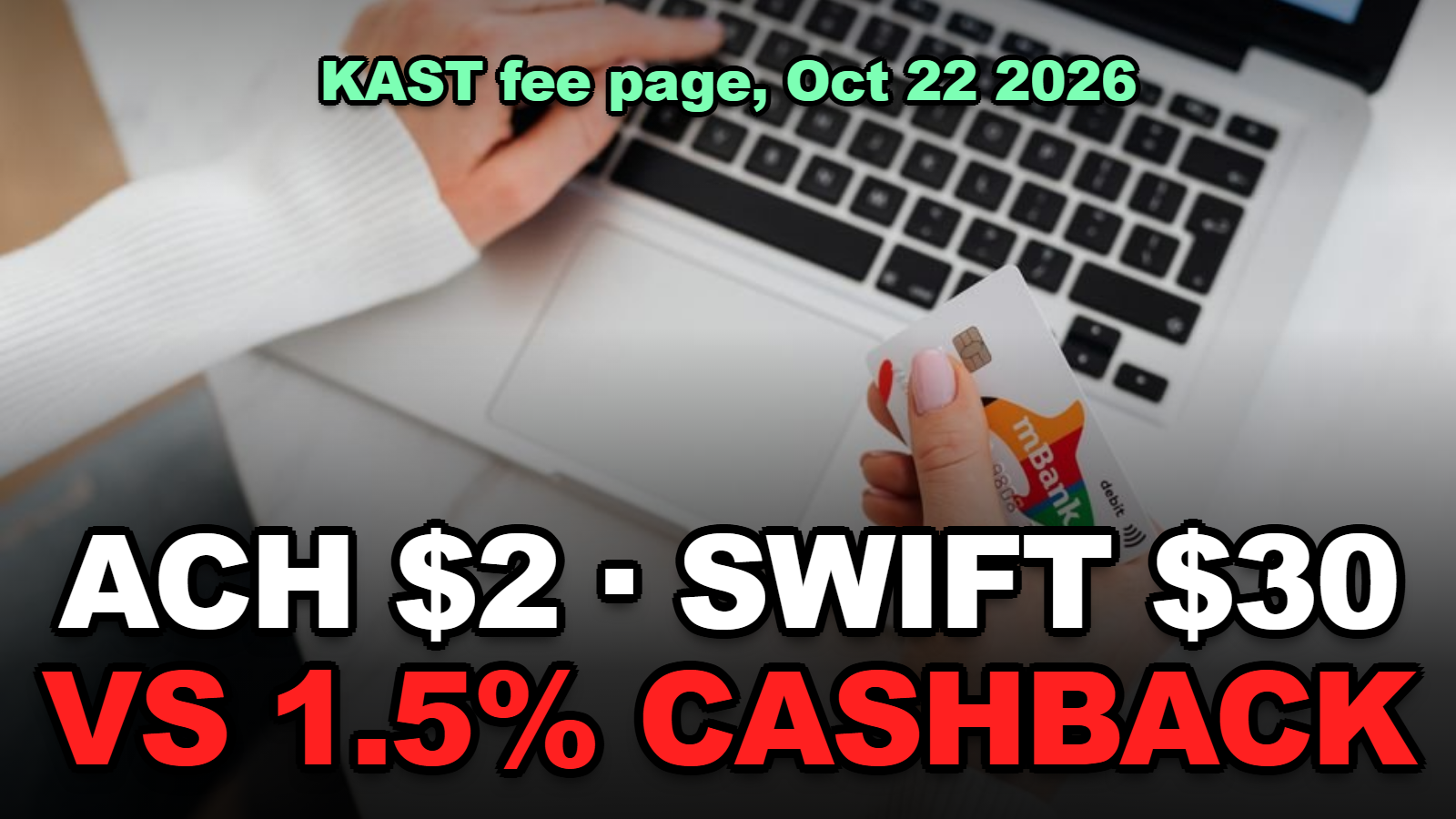
Short answer: ACH is the cheapest bank route into a KAST card at $2 flat. A Fedwire costs $15 and SWIFT costs $30. SEPA euro deposits cost 0.5%. Against the Standard tier’s 1.5% cashback, ACH breaks even at about $133 of spend. Fedwire needs $1,000. SWIFT needs $2,000, which is the whole monthly cashback cap.
Most people fund a crypto card with USDT. But KAST, one of the cards Fat Cat Card compares, also takes plain bank transfers in dollars and euros, and each rail has its own price tag.
The fee alone doesn’t tell you much. What matters is the fee against the cashback you’ll earn spending that money. That’s the calculation below, using KAST’s own fee schedule.
What This Works Out
- What does KAST charge for each deposit route?
- How much cashback pays back each deposit fee?
- What does a $500 or $2,000 deposit really cost?
- Why does SWIFT hit the cashback cap?
- Is USDT cheaper than a bank transfer?
- Pick your route in three questions
What does KAST charge for each deposit route?
KAST charges $2 for an ACH deposit, $15 for a Fedwire deposit, $30 for a SWIFT deposit and 0.5% for a SEPA euro deposit, according to its fee page updated October 22, 2026.
| Deposit route | KAST fee | Fee type | Typical arrival (KAST) |
|---|---|---|---|
| USD via ACH | $2 | Flat | Domestic: most within a day |
| USD via Fedwire | $15 | Flat | Domestic: most within a day |
| USD via SWIFT | $30 | Flat | International: up to 5 days |
| EUR via SEPA | 0.5% | Percentage | Depends on the sending bank |
| Supported stablecoins | 0% (network fee extra) | Network fee only | Depends on the chain |
ACH and Fedwire are both US domestic rails. Nacha’s ACH overview lists Direct Deposit and Same Day ACH among the payment types the ACH Network carries. The Federal Reserve’s Fedwire Funds Service page says banks use it to send payments for their own accounts or on behalf of corporate or individual clients. SEPA transfers follow the euro credit transfer scheme run by the European Payments Council.
Your own bank may charge to send, too. Those fees aren’t in this table, and they can be bigger than KAST’s.
How much cashback pays back each deposit fee?
A KAST Standard card pays 1.5% USD cashback on the first $2,000 of eligible spend each month, so a flat deposit fee is paid back once you spend the fee divided by 0.015.
I worked out the break-even spend for each route with that rule. The SEPA row is different because its fee is a percentage, not a flat amount.
| Route | Fee | Spend needed to earn the fee back at 1.5% | Share of one month’s $30 cashback ceiling |
|---|---|---|---|
| ACH | $2 | $133.33 | 6.7% |
| Fedwire | $15 | $1,000 | 50% |
| SWIFT | $30 | $2,000 | 100% |
| SEPA | 0.5% of the deposit | One-third of the deposit amount | Varies with size |
When I compared the rows, I found that the SEPA percentage is cheaper than a Fedwire for anything under $3,000. At $3,000 the two meet at $15. Above that, the flat wire wins.
This part trips a lot of people up. Cashback is earned on spending, not on the deposit, so a big deposit you spend slowly takes months to pay back.
What does a $500 or $2,000 deposit really cost?
A $500 KAST deposit spent in US dollars on a Standard card nets $5.50 via ACH but loses $22.50 via SWIFT, once 1.5% cashback of $7.50 is set against each deposit fee from KAST’s October 2026 fee page.
| Route | $500 deposit: fee | Cashback on $500 spend | Net | $2,000 deposit: fee | Cashback on $2,000 spend | Net |
|---|---|---|---|---|---|---|
| ACH | $2.00 | $7.50 | +$5.50 | $2.00 | $30.00 | +$28.00 |
| Fedwire | $15.00 | $7.50 | -$7.50 | $15.00 | $30.00 | +$15.00 |
| SWIFT | $30.00 | $7.50 | -$22.50 | $30.00 | $30.00 | $0.00 |
| SEPA (EUR worth $500 / $2,000) | $2.50 | $7.50 | +$5.00 | $10.00 | $30.00 | +$20.00 |
The table assumes every dollar is spent in USD within one month and counts as eligible spend. KAST lists 0% on USD card spend. Spending in another currency adds a 0.5% to 1.75% FX fee, plus $0.10 on non-USD payments under $25, so those nets shrink abroad.
The SEPA row values the euros at their dollar equivalent. KAST’s page lists the 0.5% fee but not the euro-to-dollar rate it applies, so check the rate in the app before you send.

Why does SWIFT hit the cashback cap?
A $30 SWIFT deposit fee on KAST equals the maximum monthly cashback on the Standard tier, because 1.5% of the $2,000 monthly cap is exactly $30.
So in any single month, a SWIFT deposit can at best break even on cashback. It only comes out ahead if you spend the money across two or more months, since each month’s cap resets.
| SWIFT deposit of $6,000, spent over | Cashback earned | Minus $30 fee | Net |
|---|---|---|---|
| 1 month (cap $2,000) | $30 | -$30 | $0 |
| 2 months ($2,000 + $2,000; $2,000 left) | $60 | -$30 | +$30 |
| 3 months ($2,000 each) | $90 | -$30 | +$60 |
Honestly, that’s the case for SWIFT: one large transfer, spent over a quarter. For a top-up you’ll burn through in a week, it’s the worst route on the list. Our worked example of Fat Cat Card: Time a Big Purchase Around Cashback Caps covers how the monthly reset works.
Is USDT cheaper than a bank transfer?
USDT is usually cheaper to deposit into KAST than any bank route, because KAST lists a 0% stablecoin deposit fee and converts supported stablecoins to USD at 1:1 with 0% spread. The only cost is the blockchain network fee.
That network fee comes from the wallet or exchange you send from, and it’s a flat amount. On small top-ups a flat fee drags hard, which we worked through in Fat Cat Card: Small USDT Top-Ups and Fixed Fee Drag.
The bigger cost for Korean users is often buying the USDT in the first place, when the local price sits above the dollar reference rate. Fat Cat Card’s homepage notes that this premium is added to the effective cost separately from card fees. A dollar bank transfer skips that step entirely, which is the real reason to compare the two.
Pick your route in three questions
- Do you have a US bank account? If yes, use ACH. At $2 it’s paid back after $133.33 of spend.
- Do you hold euros? SEPA at 0.5% beats a Fedwire on anything under $3,000.
- Is SWIFT your only option? Send one larger amount and spend it over two months or more.
Before any of these, check that the currency matches. KAST’s page warns that money sent in an unsupported currency may be converted at the bank’s rate, charged extra, or returned.
Tips
- Send a small ACH or SEPA test first, then compare the amount that arrived with what you sent.
- Count your own bank’s sending fee. KAST’s fee is only half the bill on a wire.
- Track your monthly spend against the $2,000 cashback cap on the Standard tier.
- If you spend mainly abroad, add the 0.5% to 1.75% FX fee to every net figure above.
Warnings
- Cashback is subject to eligibility and caps under KAST’s rewards terms. Not every purchase may count.
- International transfers can take up to five days, so don’t fund a card the night before a trip.
- Fees come from KAST’s page updated October 22, 2026. The app shows the fee that applies before you confirm.
- This is general information and a worked example, not financial advice.
FAQ
Does KAST charge a fee to deposit USDT instead of dollars?
KAST’s fee page (updated October 22, 2026) lists a 0% stablecoin deposit fee, excluding blockchain network fees, and converts supported stablecoins to USD at 1:1 with 0% spread. The network fee is charged by the wallet or exchange you send from, not by KAST.
Is a SWIFT deposit ever worth it on a KAST Standard card?
Only for reasons other than cashback. A $30 SWIFT fee equals the most a KAST Standard card can earn in one month, 1.5% on the first $2,000 of spend, so it only pays off if the balance is spent across two or more months or if SWIFT is the only route your bank offers.
How long does a bank deposit to KAST take?
KAST’s fee page says most domestic transfers arrive within a day, while international transfers can take up to five days depending on intermediary banks. Incoming money must be in a supported currency, or the bank may convert it at its own rate or return it.
Sources
- KAST: What Are the Fees and Conditions for KAST Cards and Accounts? (updated October 22, 2026)
- Nacha: The ABCs of ACH
- Federal Reserve Financial Services: Fedwire Funds Service
- European Payments Council: SEPA Credit Transfer scheme
- Fat Cat Card: USDT card comparison for Korean users
Next step: if you haven’t opened a card yet, start with Fat Cat Card: Get a USDT Card and Top It Up Step by Step. Then run your planned first deposit through the break-even table above.
Fact-checked against KAST’s fee page (updated October 22, 2026) and the Fat Cat Card homepage as of October 29, 2026. Fees change; the card app shows the current figures. This is general information, not financial advice.
🔗 Related guides