FuturesAI Calendar: How to Size a Trade Before CPI Day
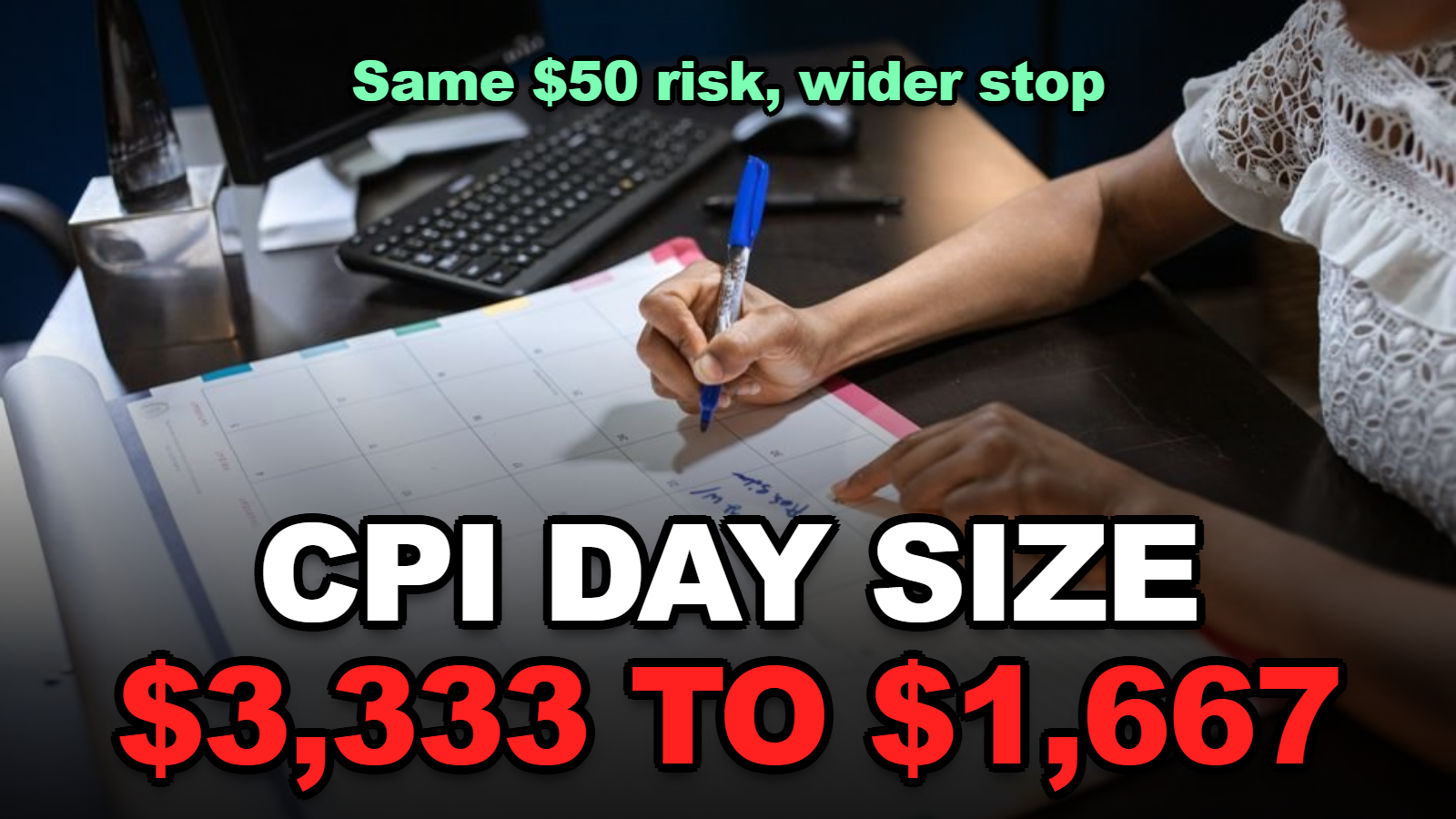
Short answer: Decide your dollar risk first. Divide it by your stop distance. That gives the position size. On CPI or FOMC days the stop usually needs more room, so the same dollar risk buys a smaller position. In the example below, a $5,000 account risking 1% drops from a $3,333 position to $1,667 when the stop widens from 1.5% to 3%. Fee payback barely moves the result on these days. Slippage does.
The October 27-28 FOMC meeting wraps up today, and the next US inflation report is less than two weeks away. Both are the kind of release that moves crypto futures in seconds.
The FuturesAI Economic Calendar lists FOMC, CPI and Bank of Korea decisions with every time already converted to Korea Standard Time. Knowing when is half the job. The other half is deciding how big a position you can afford to hold through it. That’s the calculation below.
Not investment advice. Leveraged futures can lose your full principal. The numbers here are worked examples, not recommendations.
Contents
- When are the next CPI and FOMC releases in KST?
- How do you work out position size from a stop?
- How much does slippage add on a release?
- Does fee payback cover the event-day cost?
- What changes at 10x leverage?
- A pre-release routine you can repeat
When are the next CPI and FOMC releases in KST?
The next US CPI report is due on November 10, 2026 at 8:30 a.m. Eastern Time, which is 10:30 p.m. KST, according to the BLS CPI release schedule, and the next FOMC meeting runs December 8-9, 2026 per the Federal Reserve’s meeting calendar.
| Release | US date and time | Korea time (KST) | Source |
|---|---|---|---|
| FOMC meeting (current) | October 27-28, 2026 | Statement lands early morning, October 29 | Federal Reserve |
| CPI for October 2026 | November 10, 2026, 8:30 a.m. ET | November 10, 10:30 p.m. | BLS |
| FOMC meeting (with projections) | December 8-9, 2026 | Statement lands early morning, December 10 | Federal Reserve |
| CPI for November 2026 | December 10, 2026, 8:30 a.m. ET | December 10, 10:30 p.m. | BLS |
Here’s where people get tripped up. US daylight saving time ends on November 1, so the gap to Korea grows from 13 hours to 14. A CPI print that hit at 9:30 p.m. KST in the summer now arrives at 10:30 p.m. The FuturesAI calendar already shows the converted time, which saves you the arithmetic.
How do you work out position size from a stop?
A futures position size based on risk is your dollar risk divided by your stop distance as a percentage, so a $50 risk with a 1.5% stop allows a $3,333 position and a 3% stop allows $1,667.
The formula ignores leverage on purpose. Leverage changes how much margin you post. It doesn’t change what you lose when price hits your stop.
| Account $5,000, risk 1% = $50 | Stop distance | Position size (notional) | Margin at 10x |
|---|---|---|---|
| Normal session | 1.5% | $3,333 | $333 |
| Release day, wider stop | 3.0% | $1,667 | $167 |
| Release day, widest stop | 4.5% | $1,111 | $111 |
When I checked the numbers across all three rows, I noticed that the margin column shrinks with the position. People often keep the same margin and raise leverage to “make up” for the smaller size. That puts the risk right back where it was.

How much does slippage add on a release?
A stop-market order that fills 1% beyond its trigger on a $3,333 futures position adds about $33 to the loss, turning a planned 1% account loss into roughly 1.74% once taker fees are included.
The 1% slip is an assumption for illustration, not a measured figure. Release candles can be smaller or much bigger. The fee is Bybit’s 0.055% market rate as listed on FuturesAI’s payback page on October 28, 2026, charged on both entry and exit.
| Scenario | Price loss | Taker fees (0.11% round trip) | Total loss | Share of $5,000 |
|---|---|---|---|---|
| $3,333 at 1.5% stop, clean fill | $50.00 | $3.67 | $53.67 | 1.07% |
| $3,333 at 1.5% stop, 1% slip | $83.33 | $3.67 | $87.00 | 1.74% |
| $1,667 at 3% stop, clean fill | $50.00 | $1.83 | $51.83 | 1.04% |
| $1,667 at 3% stop, 1% slip | $66.67 | $1.83 | $68.50 | 1.37% |
When I compared rows two and four, I found that sizing down didn’t remove the slip. It cut the damage by $18.50 because the same 1% slip hits a smaller position.
That’s the whole case for sizing down. Not prediction. Just a smaller base for the bad fill to multiply.
Does fee payback cover the event-day cost?
Fee payback covers very little of an event-day loss: on a $3,333 Bybit position, the 20% payback listed by FuturesAI cuts round-trip taker fees from $3.67 to $2.93, a saving of about $0.73.
| Exchange (FuturesAI page, Oct 28, 2026) | Market fee | After payback | Round trip on $3,333 | Saved per trade |
|---|---|---|---|---|
| Bybit, 20% payback | 0.055% | 0.044% | $2.93 | $0.73 |
| OKX, 20% payback | 0.05% | 0.04% | $2.67 | $0.67 |
| Bitget, 50% payback + 50% discount | 0.06% | 0.015% | $1.00 | $3.00 |
| Gate, 70% payback | 0.05% | 0.015% | $1.00 | $2.33 |
Payback is worth having, and it adds up over hundreds of normal trades. Our FuturesAI Payback: Break-Even Win Rate After Fees works through that side. But on a single release candle the $33 slip from the table above is roughly 11 to 50 times bigger than any saving here.
Most people skip this comparison and assume a cheap fee makes event trading cheap. It doesn’t.
What changes at 10x leverage?
At 10x leverage on a $3,333 position, the $333 margin is wiped out by a roughly 10% adverse move before fees and maintenance margin, which is why a stop must always sit well inside the liquidation price.
The sizing rule above already keeps your loss near 1% of the account if the stop works. The danger on release days is a stop that doesn’t fill near its price. If your liquidation level sits close to your stop, a gap can skip both. Our breakdown of FuturesAI Payback at 10x Leverage: Fees vs Margin shows how fees eat margin at that leverage, and Nearly $1 Billion Liquidated in a Day shows how fast a cascade can move.
A pre-release routine you can repeat
- Open the FuturesAI calendar and note the KST time of the next CPI or FOMC release.
- Write down your dollar risk. Keep it the same as on a normal day.
- Choose a stop distance that gives the release room.
- Divide risk by stop distance. That’s your maximum notional.
- Check that the liquidation price sits well beyond the stop.
- Assume a worse fill and work out the loss again. If that number scares you, halve the size.
If two or three bad fills in a row would hurt, our look at FuturesAI Hit Rate: How Long a Losing Streak Gets puts numbers on how often streaks happen.
Tips
- Set a phone alarm 30 minutes before 10:30 p.m. KST on November 10. That’s when you still have time to resize.
- Keep your dollar risk fixed and let the position size move. Not the other way round.
- Use the converted KST times on the FuturesAI calendar so the daylight-saving switch doesn’t catch you.
- Treat fee payback as a long-run saving, not an event-day hedge.
Warnings
- Stop-market orders can fill far from the trigger during a fast release. The 1% slip here is only an example.
- Leveraged futures can lose your full principal. Nothing on this page is investment advice.
- Release dates can change. Check the Federal Reserve and BLS pages before the day.
FAQ
What time is the November 2026 CPI release in Korea?
The October 2026 CPI report comes out on November 10, 2026 at 8:30 a.m. Eastern Time, according to the BLS release schedule. US clocks are on standard time by then, so that is 10:30 p.m. KST on November 10.
Should I close my futures position before CPI?
That depends on your plan, and this page is not advice. If you keep a position open through CPI, size it so that a stop filled well past its level still costs only what you are willing to lose. The worked example here shows a 1% planned loss turning into 1.74% at normal size.
Does fee payback help on event days?
Only a little. On a $3,333 position, the 20% Bybit payback listed on FuturesAI’s payback page saves about $0.73 per round trip, while a stop that fills 1% late costs about $33. Payback lowers routine costs; it does not offset slippage.
Sources
- Federal Reserve: Meeting calendars and information (2026 and 2027 FOMC dates)
- U.S. Bureau of Labor Statistics: Schedule of CPI releases
- FuturesAI: Economic Calendar (KST)
- FuturesAI: Payback exchange fee table (read October 28, 2026)
The sizing check takes about two minutes. Run it before every release you plan to hold through, then decide.
Fact-checked against Federal Reserve, BLS and FuturesAI public pages as of October 28, 2026. Fee rates change; the exchange shows the current figure. Not investment advice; leveraged trading can lose your full principal.
🔗 Related guides