FuturesAI Demo Trading: How to Check Profit Survives Fees
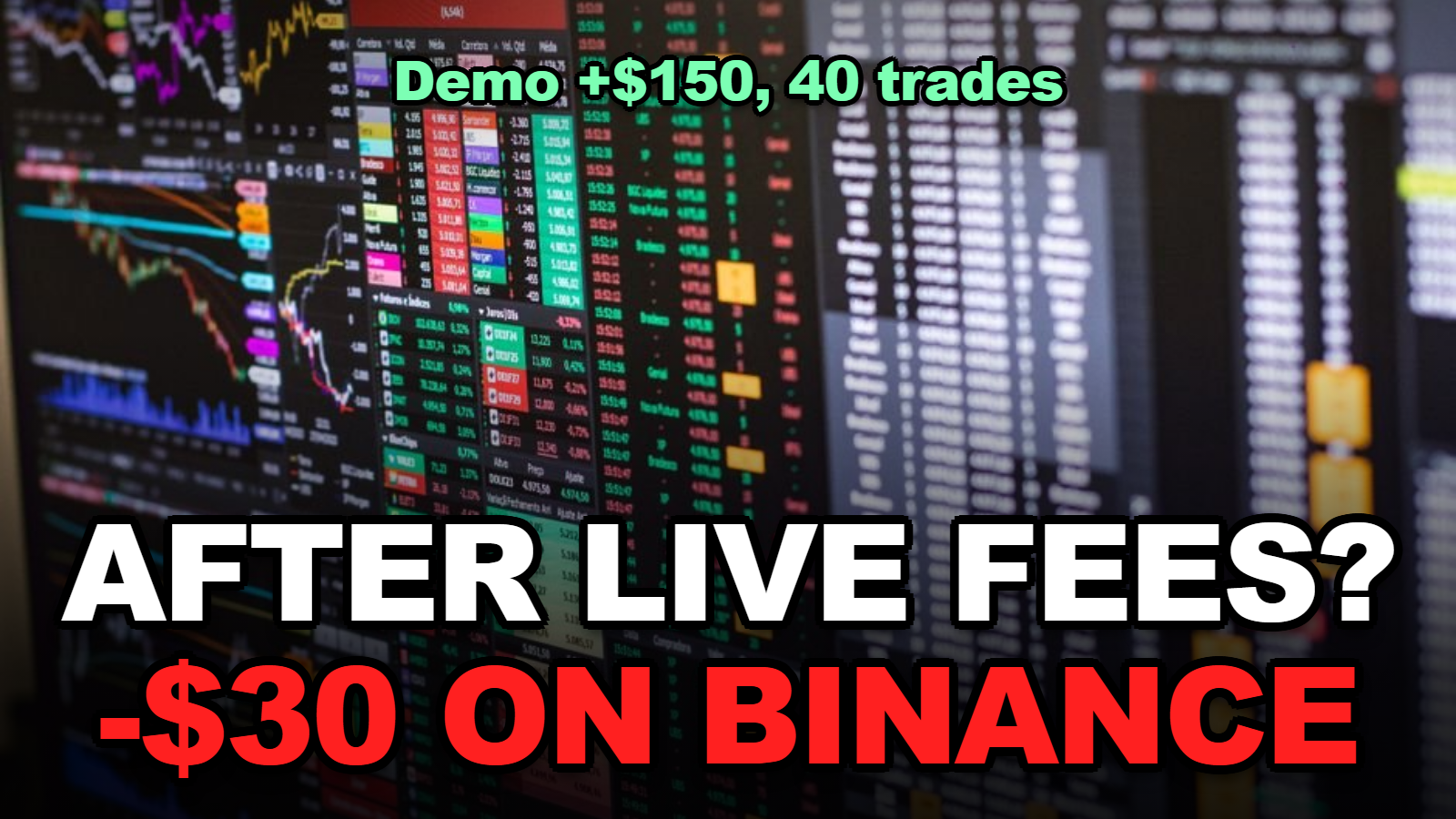
Short answer: Treat a demo profit as a before-fees number until you prove otherwise. In the worked example below, a +$150.00 demo record over 40 round trips keeps +$90.00 at Bitget’s effective taker rate on the FuturesAI table. At Binance’s rate it becomes −$30.00. Add a modest slippage allowance and only the two cheapest rows stay positive. Re-price every demo trade before you move real money.
A green demo account feels like proof. It’s closer to a first draft.
The FuturesAI demo trading page lets you practice perpetual futures with virtual USDT, using live Bitget quotes with simulated fills, and it ends with a “Profitable on demo? Go live” prompt. This post shows how to check whether that profit would survive real trading costs, using the effective fees on the FuturesAI payback table as shown on October 27, 2026.
Not investment advice. Leverage can lose your full principal. The demo record below is a made-up example for the arithmetic, not a real result, and nothing here promises a profit.
See the FuturesAI payback table
What This Works Out
- What does the FuturesAI demo show, and what doesn’t it?
- What do fees do to a +$150 demo record?
- How much should you allow for slippage?
- What profit per trade does a demo need?
- How do you re-price your own demo history?
What does the FuturesAI demo show, and what doesn’t it?
The FuturesAI demo is a practice futures screen with virtual USDT, live Bitget quotes and simulated fills, offering leverage from 1x to 125x and an estimated liquidation price for longs and shorts, according to the demo page on October 27, 2026.
When I checked the page’s account panel and order history, I found that they list used margin, unrealized and realized PnL, entry, exit and size. I didn’t see a separate fee column.
That doesn’t prove the simulator ignores fees. It means you can’t read the fee off the screen. So the safe move is to assume the realized PnL is before fees and re-price it yourself.
The order ticket also shows a market order that “fills instantly at market.” On a live exchange, a market order pays the taker fee. That’s the rate used below.
What do fees do to a +$150 demo record?
A hypothetical demo record of +$150.00 over 40 market-order round trips at $5,000 notional each pays between $60.00 and $180.00 in live taker fees at the effective rates on the FuturesAI table, so it ends between +$90.00 and −$30.00.
The example: $500 of margin at 10x, so $5,000 of notional per trade. One round trip is an open and a close, so each trade pays the taker fee twice.
| Exchange | Effective taker fee | Fee per round trip | Fees over 40 trips | Demo PnL after fees | After fees and 0.02% slippage per side |
|---|---|---|---|---|---|
| Bitget | 0.015% | $1.50 | $60.00 | +$90.00 | +$10.00 |
| Gate | 0.015% | $1.50 | $60.00 | +$90.00 | +$10.00 |
| Toobit | 0.027% | $2.70 | $108.00 | +$42.00 | −$38.00 |
| OKX | 0.04% | $4.00 | $160.00 | −$10.00 | −$90.00 |
| Bybit | 0.044% | $4.40 | $176.00 | −$26.00 | −$106.00 |
| Binance | 0.045% | $4.50 | $180.00 | −$30.00 | −$110.00 |
| Listed 0.05% fee, no payback (Gate, OKX, Binance) | 0.05% | $5.00 | $200.00 | −$50.00 | −$130.00 |
Here’s the part that trips a lot of people up. The same demo skill produces a small gain on one exchange and a loss on another. Nothing about the trades changed. Only the price list did.
The listed fees aren’t made up by the payback site either. Bybit’s help center lists a 0.055% taker fee for non-VIP perpetual and futures trading, according to Bybit’s fee article, the same rate the FuturesAI table shows before its 20% payback.

How much should you allow for slippage?
A demo fill doesn’t move a real order book, so a live market order can fill at a worse price; allowing 0.02% per side on $5,000 costs $2.00 per round trip, or $80.00 over 40 trips.
0.02% is an assumption, not a measured number. On a liquid BTC perpetual in calm hours it may be less. On a thin contract or during news it can be far more.
Honestly, if a strategy only works with zero slippage, it doesn’t work.
The last column of the table above shows the damage: with slippage added, only the Bitget and Gate rows stay above zero, and only by $10.00. For a closer look at why live fills drift from what you expected, see You Followed the Trading Signal and Got a Different Result.
What profit per trade does a demo need?
To break even live in this example, each demo round trip has to average more than its fee plus slippage: about $3.50 at Bitget’s effective rate and about $6.50 at Binance’s, on $5,000 notional.
| Exchange | Fee per round trip | Slippage allowance | Hurdle per round trip | Hurdle over 40 trips |
|---|---|---|---|---|
| Bitget | $1.50 | $2.00 | $3.50 | $140.00 |
| OKX | $4.00 | $2.00 | $6.00 | $240.00 |
| Binance | $4.50 | $2.00 | $6.50 | $260.00 |
When I compared that hurdle with the example’s average demo gain of $3.75 per trip, I noticed how thin the margin is. The two cheapest rows clear it. The others don’t.
A per-trade hurdle is easier to use than a total. You can check it after every demo session. For the same idea expressed as a win rate, see FuturesAI Payback: Break-Even Win Rate After Fees.
How do you re-price your own demo history?
To check whether a demo profit survives live trading, subtract twice the notional times your exchange’s effective taker fee from each round trip, then subtract a slippage allowance, and see what’s left.
- Copy each closed demo trade: entry, exit, size and realized PnL.
- Work out the notional per trade (size × price).
- Multiply by 2 for the round trip, then by the effective taker fee for the exchange you’d use.
- Subtract a slippage allowance. Start with 0.02% per side and raise it for fast markets.
- Add it all up. If the total is negative, keep practicing, not trading.
If you’d hold positions for hours or days, funding payments come on top of all this. FuturesAI Payback vs Funding: How Long a Hold Erases It shows how long a hold takes to cancel out the fee saving.
See the FuturesAI payback table
How big should the sample be before any of this means something? How Many Trades Before You Know a Signal Works? (2026) covers that. For the yearly value of payback by trading style, see FuturesAI Payback: Work Out a Year by Trading Style.
Tips
- Log every demo trade, including the ones you’d rather forget; a cherry-picked demo record is worse than none.
- Re-price with the exchange you will actually use, not the cheapest row on the table.
- Run the demo through at least one fast market day before you trust the slippage allowance.
Warnings
- Demo balances are virtual USDT. Real money changes how people trade, usually for the worse at first.
- Leverage can lose your full principal; an estimated liquidation price is not a guaranteed exit.
- Fee rates on the FuturesAI table are a snapshot from October 27, 2026 and can change.
FAQ
Does the FuturesAI demo use real prices?
The FuturesAI demo page says it shows live Bitget quotes while fills are simulated, and it uses virtual USDT with no real funds. Fills, leverage and liquidation are described as working like the real thing.
How many demo trades do I need before going live?
There is no fixed number, but a handful is not enough. A short record says little about whether a result is skill or luck, so keep logging until it includes losing stretches as well as winning ones.
Is slippage included in demo trading results?
Not in the same way as live trading. A simulated fill does not move a real order book, so live market orders can fill at a worse price than the demo showed, especially in fast markets or on thin contracts.
Sources
- FuturesAI, Demo trading (checked Oct 27, 2026)
- FuturesAI, Partner exchanges and fee payback table (checked Oct 27, 2026)
- Bybit Help Center, Bybit’s Fees That You Need to Know
The demo record is hypothetical. Fee rates from the FuturesAI table as of October 27, 2026; slippage is an assumption. Not investment advice; leveraged trading can lose the full principal.
🔗 Related guides