FuturesAI Payback: Work Out a Year by Trading Style
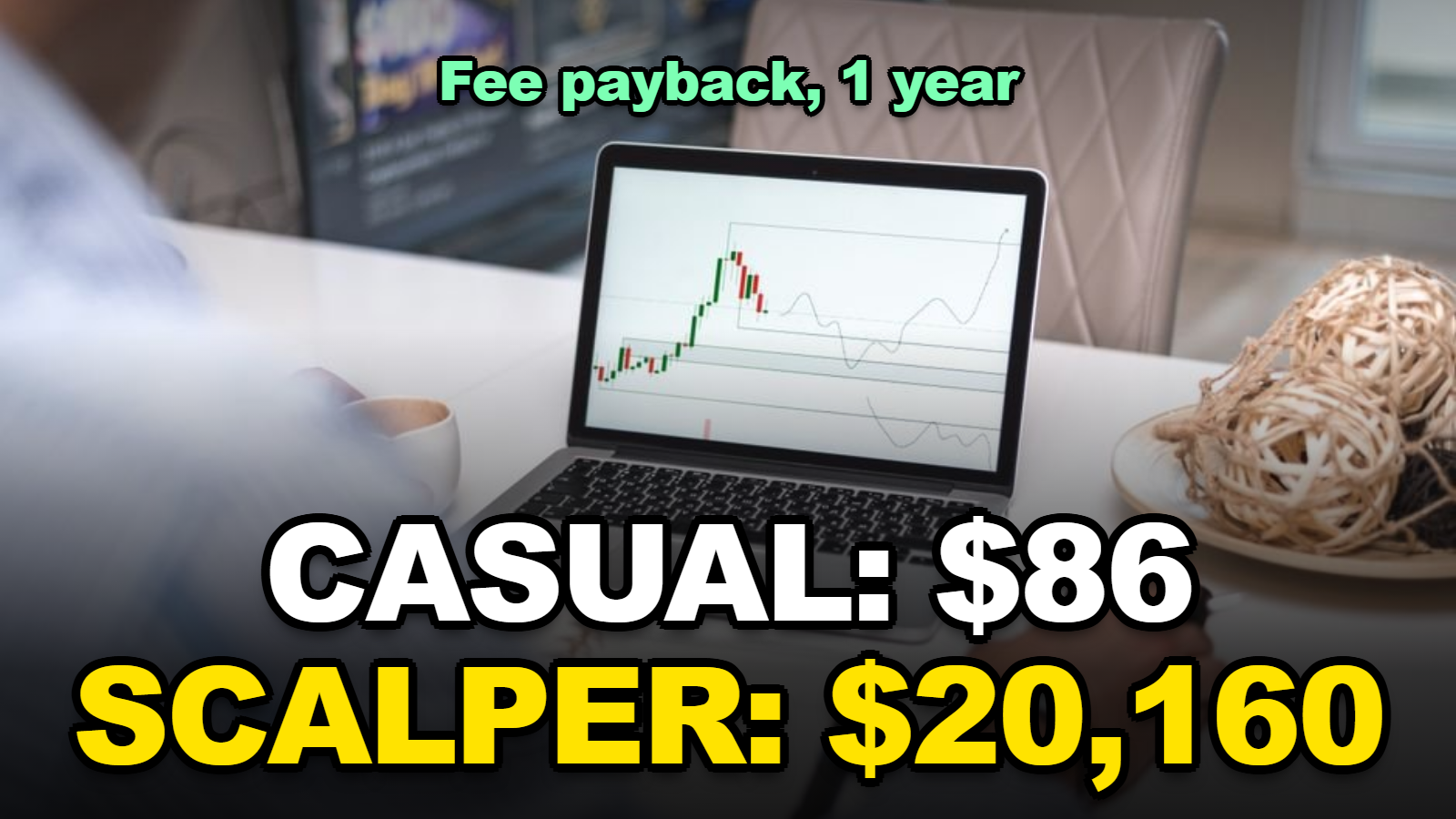
Short answer: Fee payback is worth what your trading style makes it worth. A casual trader doing four small market-order round trips a month keeps about $86.40 a year at the best rate on the FuturesAI table. A scalper doing 400 a month keeps about $20,160. The exchange you pick matters more than the payback headline. So does how many of your orders are limit orders.
A 50% payback sounds like the same deal for everybody. It isn’t.
The dollars depend on three things you control: how often you trade, how big each position is, and whether you hit the market or wait with a limit order. This post runs four example trading styles through the fee rates on the FuturesAI payback table as shown at 16:50 KST on October 27, 2026, and turns them into a yearly number.
Not investment advice. Leveraged futures can lose your full principal, and a fee saving does nothing to protect it. The four traders below are made-up examples for the arithmetic, not real accounts.
See the FuturesAI payback table
What This Works Out
- What rates does the calculation use?
- Which four trading styles are in the example?
- How much does payback save in a year?
- How much of the fee bill is left after payback?
- Is a higher payback worth more than using limit orders?
- Run your own year in five lines
What rates does the calculation use?
The FuturesAI payback table lists each partner exchange’s regular limit (maker) and market (taker) fee, and in brackets the rate you actually pay once the fee discount and payback are applied.
When I checked the table on October 27, 2026, these were the five centralized exchanges with the biggest names:
| Exchange | Payback | Limit fee (effective) | Market fee (effective) |
|---|---|---|---|
| Bitget | 50% + 50% fee discount | 0.02% (0.005%) | 0.06% (0.015%) |
| Gate | 70% | 0.02% (0.006%) | 0.05% (0.015%) |
| Bybit | 20% | 0.02% (0.016%) | 0.055% (0.044%) |
| OKX | 20% | 0.02% (0.016%) | 0.05% (0.04%) |
| Binance | 10% | 0.02% (0.018%) | 0.05% (0.045%) |
The listed numbers line up with the exchanges’ own pages where I could check them. Bybit’s help center lists a 0.055% taker fee and a 0.02% maker fee for non-VIP perpetual and futures trading, according to Bybit’s “Fees You Need to Know” article, which is the same pair the FuturesAI table shows before payback.
Toobit, Echobit and OrangeX (55%) are on the table too. They’re left out here to keep the tables readable.
Which four trading styles are in the example?
The four example traders differ in round trips per month, position size and the share of market orders, which together set their monthly volume.
One round trip is an open plus a close, so it counts the position size twice. That doubling is where most back-of-envelope estimates go wrong.
| Style (hypothetical) | Round trips a month | Position size (notional) | Market / limit orders | Monthly volume |
|---|---|---|---|---|
| Casual | 4 | $2,000 | 100% / 0% | $16,000 |
| Swing | 10 | $10,000 | 30% / 70% | $200,000 |
| Day trader | 60 | $5,000 | 60% / 40% | $600,000 |
| Scalper | 400 | $5,000 | 90% / 10% | $4,000,000 |
Position size here is notional, not margin. A $5,000 position could be $500 of margin at 10x. For how leverage changes the fee picture, see FuturesAI Payback at 10x Leverage: Fees vs Margin.
How much does payback save in a year?
On the FuturesAI table’s October 27, 2026 rates, a year of payback is worth roughly $9.60 to $86.40 for the casual example and $2,256 to $20,160 for the scalping example, depending on the exchange.
Yearly saving = 12 × monthly volume × (market share × taker gap + limit share × maker gap). The gaps are listed fee minus effective fee.
| Style | Bitget | Gate | Bybit | OKX | Binance |
|---|---|---|---|---|---|
| Casual | $86.40 | $67.20 | $21.12 | $19.20 | $9.60 |
| Swing | $576 | $487 | $146 | $139 | $69.60 |
| Day trader | $2,376 | $1,915 | $590 | $547 | $274 |
| Scalper | $20,160 | $15,792 | $4,944 | $4,512 | $2,256 |
Read across a row and the exchange choice swings the result by roughly 8 to 9 times. Read down a column and trading frequency swings it by a factor of a few hundred.
Honestly, the casual row is the one most people are in.
At that level the best case is under $90 for a whole year, and under $10 on Binance. That’s not a reason to skip payback. It’s a reason not to switch exchanges for it alone.
How much of the fee bill is left after payback?
Payback cuts the fee bill but never removes it: on Bitget the effective rates are a quarter of the listed ones, and on Binance they are nine-tenths, according to the FuturesAI table on October 27, 2026.
The table below compares the yearly fee bill at Binance’s listed rates with what each style pays after payback on Binance and on Bitget.
| Style | Yearly fees, Binance listed | Binance after payback | Bitget after payback | Difference vs Binance listed |
|---|---|---|---|---|
| Casual | $96.00 | $86.40 | $28.80 | $67.20 |
| Swing | $696 | $626 | $192 | $504 |
| Day trader | $2,736 | $2,462 | $792 | $1,944 |
| Scalper | $22,560 | $20,304 | $6,720 | $15,840 |
Here’s where people get tripped up. The scalper’s saving looks huge, and it is. But the scalper still pays $6,720 a year in fees on the cheapest row. Trading that often has to earn more than that before it earns anything.
At that volume, exchanges usually offer VIP fee tiers. Bybit’s fee article says lower rates apply by VIP level. How payback stacks on a VIP rate isn’t shown on the FuturesAI table, so the scalper row is an upper-level sketch, not a quote.
Is a higher payback worth more than using limit orders?
For the example day trader on Binance, shifting from 60% to 30% market orders saves about $583 a year at the effective rates, while Binance’s 10% payback alone saves about $274.
When I compared the two levers side by side, I found that order type beat a low payback rate on Binance, but not a high one. Moving the same trader to Bitget’s rates saves about $2,376 a year without changing a single order.
Limit orders aren’t free money, though. They can miss the fill, and a missed exit can cost more than a year of fee savings. The maker-taker split is worked out in more detail in Maker vs Taker Rebate Calculator: Your Mix Sets the Cost.
Run your own year in five lines
Your own yearly payback value equals twelve times your monthly volume times the weighted gap between listed and effective fees on your exchange.
- Export last month’s trade history from the exchange.
- Add up the notional of every fill. That is your monthly volume.
- Split it into market (taker) and limit (maker) fills.
- Multiply each part by the listed fee and by the effective fee in brackets on the FuturesAI table.
- Subtract, then multiply by 12.
If you’ve ever guessed your volume, you’ll probably be surprised. Most people undercount, because they forget the close counts too.
See the FuturesAI payback table
For the flat $100,000-a-month version of this math, see FuturesAI Fee Payback: What It Is Worth in Dollars. If a payout doesn’t show up later, Futures Fee Rebate Not Received? 4 Causes, in Order (2026) walks through the usual causes.
Tips
- Use your real trade export for volume, not a guess; the close of every trade counts as volume too.
- Compare effective fees, not payback percentages. Bitget at 50% and Gate at 70% end up at the same 0.015% market rate.
- Re-check the FuturesAI table before you switch; the rates on this page are a snapshot from October 27, 2026.
Warnings
- Never trade more just to earn payback. The fee you pay is always larger than the part that comes back.
- Leverage can lose your full principal. A yearly fee saving does not change that risk.
- High-volume traders should confirm how payback works at a VIP tier before counting on the scalper row.
FAQ
Is fee payback worth it if I only trade a few times a month?
Only a little. In this worked example, four $2,000 round trips a month at market orders add up to $16,000 of monthly volume, and the yearly saving on the FuturesAI table runs from about $9.60 on Binance to $86.40 on Bitget.
Does payback apply to limit orders too?
Yes, on the FuturesAI table. It lists an effective rate for both the limit (maker) and market (taker) columns. On Bitget, for example, the 0.02 percent maker fee becomes 0.005 percent after the fee discount and payback.
Will a high-volume trader get the same payback rate at a VIP fee tier?
Not guaranteed. The FuturesAI table shows regular-user fee rates, and exchanges such as Bybit cut the base fee as your VIP level rises. Ask the exchange or FuturesAI how payback is calculated at your tier before relying on these numbers.
Sources
- FuturesAI, Partner exchanges and fee payback table (checked Oct 27, 2026)
- Bybit Help Center, Bybit’s Fees That You Need to Know
- OKX, Trading fee rates and tiers
Calculations use the FuturesAI table as of October 27, 2026. Example traders are hypothetical. Not investment advice; leveraged trading can lose the full principal.
🔗 Related guides