

1099-K Threshold for 2026: What Etsy, eBay, and DoorDash Sellers Actually Need to Know
Quick answer: For 2026, the federal 1099-K threshold is back to $20,000 and 200 transactions per platform — the One Big Beautiful Bill Act rolled back the $600 rule that was supposed to phase in. That means most Etsy, eBay, DoorDash, and Venmo sellers won’t get a 1099-K unless they clear both numbers on one platform. But four states set their own lower bar, and you owe tax on every dollar either way, form or no form.
If you sold on Etsy this year, drove for DoorDash, or just got paid through Venmo for side work, you’ve probably seen at least three different numbers thrown around for what triggers a 1099-K — $600, $5,000, $20,000. Only one of those is actually the rule for 2026, and a lot of side-hustle advice online still hasn’t caught up.
Here’s the number that matters right now, which platforms actually send the form, the state-level exception that catches people off guard, and what you still owe even without one landing in your inbox.
Jump to a Section
- Why Did the 1099-K Threshold Change Back to $20,000?
- Which Platforms Actually Send You a 1099-K?
- Do You Still Owe Taxes If You Don’t Get a 1099-K?
- The State-Level Catch Most People Miss
- How Do You Report Gig Income Without a 1099-K?
- How Much Should You Actually Set Aside for Taxes?
- What If Your 1099-K Numbers Look Wrong?
Why Did the 1099-K Threshold Change Back to $20,000?
The $20,000-and-200-transaction threshold is back for 2026 because the One Big Beautiful Bill Act, signed in July 2025, reversed a phase-down that had already started. The American Rescue Plan Act of 2021 had set the threshold on a path down to just $600, with no transaction minimum at all — a change that would have sent millions of casual sellers a form they’d never gotten before.
That $600 rule technically took effect in stages before OBBBA reversed it, which is exactly why so many “what triggers a 1099-K” articles from 2023-2025 are now out of date. When I checked the current IRS guidance against those older posts, the mismatch was obvious — plenty of them still quote $600 as if it’s still current.
Which Platforms Actually Send You a 1099-K?
Any third-party settlement organization — the IRS’s term for payment apps and marketplaces — has to send a 1099-K once you cross both the dollar and transaction thresholds in a calendar year.
| Platform Type | Examples | Counts Toward Threshold? |
|---|---|---|
| Marketplaces | Etsy, eBay, StubHub, Airbnb | Yes — goods/services sales |
| Gig apps | DoorDash, Uber, Instacart | Yes — payouts for work performed |
| Payment apps (business) | Venmo, PayPal, Cash App for Business | Yes — goods/services payments only |
| Payment apps (personal) | Venmo/PayPal friends & family | No — excluded by design |
| Payment processors | Stripe, Square | Yes — merchant transaction volume |
That personal-vs-business split trips people up constantly. Splitting a dinner bill on Venmo isn’t a taxable transaction and doesn’t count toward your threshold — but tagging that same payment as “goods and services” so it’s protected by purchase coverage does count, even between friends.

Do You Still Owe Taxes If You Don’t Get a 1099-K?
Yes — every dollar of gig or side-hustle income is taxable whether or not a platform sends you paperwork for it. The 1099-K threshold only controls when a company is required to report your activity to the IRS on your behalf; it was never a tax-free allowance.
This part trips a lot of people up on a first side hustle: no 1099-K doesn’t mean no obligation. If you made $8,000 reselling sneakers on eBay this year and never crossed 200 transactions, you still owe tax on that $8,000 and still need to report it on your return.
The State-Level Catch Most People Miss
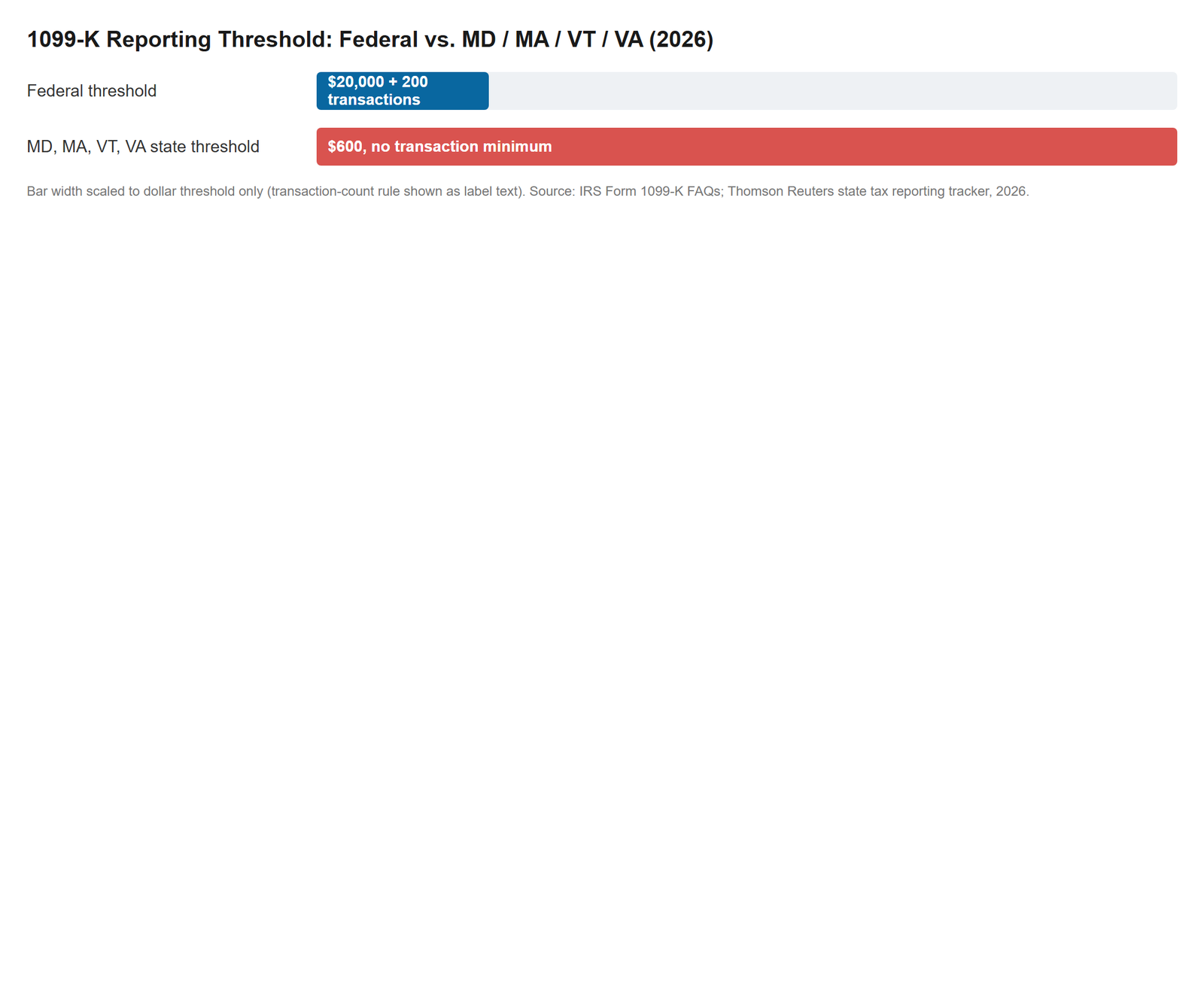
Four states set their own 1099-K threshold well below the federal number, and platforms follow the state rule for residents of those states regardless of what the federal law says. According to Thomson Reuters’ state tax reporting tracker, Maryland, Massachusetts, Vermont, and Virginia each require reporting at just $600 in payments, with no minimum transaction count at all.
- ✅ Live in MD, MA, VT, or VA and sell online? Expect a 1099-K well before you’d hit the federal $20,000 mark.
- ✅ Illinois, Missouri, and Washington, DC also run thresholds lower than the federal line, though not as low as the $600 group.
- ✅ Moving states mid-year doesn’t erase the form — the platform reports based on where your account is registered.
How Do You Report Gig Income Without a 1099-K?
You report it the same way you’d report any self-employment income: on Schedule C, using your own records rather than a form a platform never sent you. Bank statements, payment app histories, and your own sales log are all acceptable documentation if the IRS ever asks.
I found that the IRS’s own gig economy guidance pushes the same approach most accountants already recommend: track income as it comes in rather than trying to reconstruct a year of Venmo payments in April. If you’re clearing more than a few thousand dollars a year, setting aside a share of each payment for taxes as you go avoids the spring scramble entirely — the exact share is covered next.
How Much Should You Actually Set Aside for Taxes?
A reasonable starting point is 25-30% of your gig income, and the reason it’s a range rather than one number comes down to two separate taxes stacking on top of each other. Self-employment tax alone runs 15.3% on net earnings, covering the Social Security and Medicare contributions an employer would normally split with you.
| Component | Rate | Applies To |
|---|---|---|
| Self-employment tax | 15.3% | Net gig/side-hustle profit |
| Federal income tax | 10-22% (most side hustlers) | Net profit, on top of any W-2 income |
| State income tax | 0-9%+ (varies by state) | Net profit, where applicable |
You’ll probably notice the self-employment tax alone is bigger than most people expect, since a W-2 job hides half of that same cost inside employer payroll contributions you never see. Stacking a modest federal bracket on top is usually what lands people in that 25-30% range, and setting aside quarterly rather than waiting until April keeps a surprise bill from showing up all at once.
What If Your 1099-K Numbers Look Wrong?
A 1099-K reports gross payments, not profit — so a number that looks alarmingly high is often correct, just before your costs are subtracted. Reselling something for $200 that you bought for $180 still shows up as $200 in gross payments on the form; your actual taxable profit is the $20 difference, which you calculate separately.
Honestly, that distinction is the single most common reason people panic over a 1099-K for no reason. If the gross number still looks wrong after accounting for cost basis — say it includes refunded or canceled transactions — contact the platform directly, since only they can issue a corrected form.
Keep basic records as you go rather than trying to rebuild them later: purchase receipts for resale inventory, mileage logs for delivery driving, and a running total of platform fees all reduce what you actually owe once you get to Schedule C. A shoebox of receipts in December is a rough way to spend a weekend that a simple spreadsheet updated monthly would have avoided entirely.
FAQ
Does the 1099-K threshold apply per platform or across all my accounts combined?
It applies per platform. If you make $12,000 on Etsy and $12,000 on eBay in the same year, neither individually crosses $20,000, so neither is required to send you a 1099-K, even though your combined gig income is $24,000.
Will the $20,000 / 200-transaction threshold change again after 2026?
As of this writing, the One Big Beautiful Bill Act’s reinstated threshold has no scheduled further reduction, unlike the American Rescue Plan Act’s rule it replaced. Future legislation could still change it, so it’s worth checking IRS guidance each filing season.
Do gifts or reimbursements from family count toward the threshold?
No. Personal payments, gifts, and reimbursements sent outside a platform’s goods-and-services flow are excluded from 1099-K reporting entirely, regardless of dollar amount.
Sources
- IRS — Form 1099-K FAQs
- IRS — Gig Economy Tax Center
- Thomson Reuters Tax — State 1099-K Reporting Changes for 2026
This article is for general informational purposes and is not tax advice. Consult a qualified tax professional about your specific situation. Figures reflect IRS and OBBBA guidance published at time of writing and may change with future legislation.