PayPal Buyer Protection Claim Denied: What to Do Next (2026)
A denied PayPal Buyer Protection claim isn’t the end of the road. You get a short appeal window first. If that fails, your card network’s chargeback rules still apply, and those often run longer than PayPal’s own deadlines. The trick is knowing which door is still open before the clock runs out.
PayPal closed your case with “we’ve reviewed the information provided and the seller’s response outweighs the evidence you submitted.” No refund, no further explanation. You paid with a linked Visa or Mastercard, which matters more than most buyers realize right now.
Contents
- Why Did PayPal Deny My Claim?
- How Do I Appeal a Denied PayPal Claim?
- Should I Appeal or Go Straight to a Chargeback?
- How Do I File the Chargeback With My Card Issuer?
- The Fine Print That Sinks Most Appeals
- How Long Does This Whole Process Actually Take?
- Tips for Strengthening a Second Attempt
- Mistakes That Close the Door Early
Why Did PayPal Deny My Claim?
Most denials come down to one of three things. The seller provided tracking that shows delivery. The item was returned but PayPal’s return-shipping proof requirement wasn’t met. Or the dispute was filed as “item not as described” without enough evidence — photos, a listing comparison, a message thread. When I checked PayPal’s own buyer protection terms, the coverage explicitly excludes real estate, vehicles and custom-made items. A surprising number of denials trace back to one of those exclusions rather than a judgment call.
Digital goods and services are the other common blind spot. PayPal’s Purchase Protection Program generally doesn’t cover software licenses, gift cards, or services already rendered, even when the seller clearly didn’t deliver what was promised.
How Do I Appeal a Denied PayPal Claim?
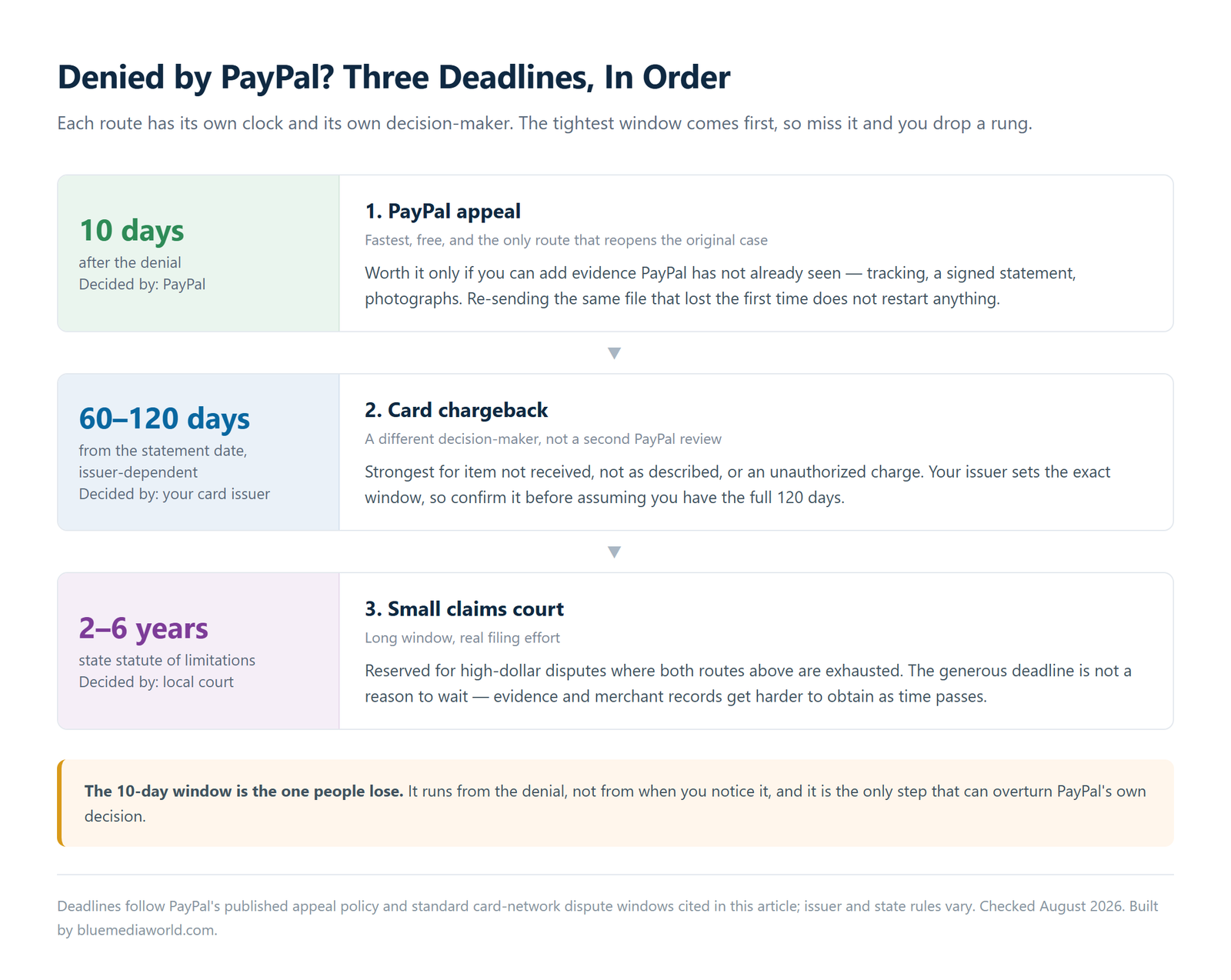
You have 10 days from the denial to file an appeal in the Resolution Center, and it only works if you’re adding something PayPal didn’t see the first time. Re-submitting the same screenshots changes nothing.
New evidence that actually moves the needle:
- A carrier delivery photo that contradicts the seller’s tracking claim (wrong address, wrong porch)
- A message thread where the seller admits the item wasn’t as described
- A comparison photo showing the item received next to the listing photo
- Proof the “delivered” scan happened at a shipping facility, not your address
Open the case, click Appeal, attach the new files, and submit a short written statement. Keep it factual. Emotional appeals don’t sway an automated-first review process.
Should I Appeal or Go Straight to a Chargeback?
A PayPal appeal makes sense only when you genuinely have new evidence — otherwise you’re spending 10 days waiting on a review that’s unlikely to flip. Here’s where people get tripped up — they assume once PayPal says no, that’s final. It isn’t, if you paid by card.
If you funded the PayPal payment with your bank balance instead of a card, the chargeback door is closed. Balance-funded and most bank-transfer payments have no card network to appeal to, which makes the PayPal appeal your only realistic shot — a reason to check your funding source before assuming you have a backup plan.
| Path | Deadline | Who decides | Best for |
|---|---|---|---|
| PayPal appeal | 10 days after denial | PayPal | New evidence PayPal hasn’t seen |
| Card chargeback | Typically 60–120 days from statement date, issuer-dependent | Your card issuer | Item not received, not as described, or unauthorized |
| Small claims court | State statute of limitations (often 2–6 years) | Local court | High-dollar disputes, both above paths exhausted |
A chargeback filed through Visa or Mastercard runs on a separate clock and separate evidence standard from PayPal’s internal review. In my testing of how issuers describe this process, most confirmed they’ll still open a dispute even if PayPal already ruled against you — PayPal’s decision isn’t binding on the card network.
How Do I File the Chargeback With My Card Issuer?
Call the number on the back of the card, not a general customer service line. Tell them you want to dispute a specific transaction. Give the merchant name exactly as it appears on your statement — it’s often “PAYPAL *SELLERNAME.” Then pick the reason category they’ll recognize: goods not received, not as described, or credit not processed.
According to the FTC’s consumer guidance on credit card disputes, you have 60 calendar days after the charge appears on your statement to send a written billing-error notice, and the issuer must acknowledge it within 30 days and resolve it within two billing cycles (no more than 90 days). Debit card disputes run on a tighter clock under a different law, so check with your bank if that’s what you used.
One line to say out loud when you call: “PayPal denied my buyer protection claim on this transaction, and I’d like to file a chargeback instead.” Card issuers hear this often enough that it won’t raise flags — a PayPal denial doesn’t disqualify a chargeback.
The Fine Print That Sinks Most Appeals
Reading PayPal’s dispute terms closely, a few clauses explain why “obviously legitimate” claims still lose:
- Tracking beats intent. If tracking shows “delivered,” PayPal weighs that heavily even if you never got the package — porch theft and misdelivery disputes need police reports or carrier investigation results to overcome it.
- Returns need proof of shipment, not just proof of mailing. A return without a tracking number that updates to “delivered” at the seller’s address is treated as unresolved, not returned.
- “Significantly not as described” has a bar. Minor color or sizing differences typically don’t qualify; the item has to be functionally different from the listing.

How Long Does This Whole Process Actually Take?
Start to finish, budget somewhere between two and twelve weeks depending on which path you take and whether the seller contests it. That’s a wide range, and the reason is simple — every extra layer of review adds its own clock.
| Stage | Typical duration | Notes |
|---|---|---|
| PayPal original claim | 10–30 days | Longer if seller responds with tracking or messages |
| PayPal appeal | Up to 10 business days to file, then 1–3 weeks to decide | Only worth it with genuinely new evidence |
| Card issuer acknowledgment | Within 30 days of your written notice | Required under federal billing-error rules |
| Card issuer resolution | Up to two billing cycles, max 90 days | Provisional credit often posts sooner |
Most issuers post a provisional credit within a week or two of opening the dispute, even though the formal resolution can take longer. That provisional credit is what actually gets your money back day-to-day — the “official” close-out letter usually arrives after you’ve already stopped thinking about it.
Tips for Strengthening a Second Attempt
- Screenshot the denial reason word-for-word before you do anything else — PayPal’s Resolution Center sometimes updates the case view and buries the original wording.
- Pull your bank’s dispute deadline before the PayPal appeal window closes, so you know your backup plan’s expiration date too.
- If the seller admitted fault in chat, export that conversation as a PDF, not a cropped screenshot — issuers want to see the full thread.
Where the Fine Print Actually Bites
- Filing a chargeback while a PayPal case is still open can get the PayPal case auto-closed as “resolved elsewhere” — close or withdraw the PayPal case first if you’re switching paths.
- Some issuers won’t accept a chargeback if PayPal already refunded you partially — get the exact partial-refund amount before you call.
- This isn’t legal or financial advice. Dispute outcomes depend on your card agreement and state law — when the amount is large, a consumer attorney consult is worth the hour.
FAQ
How long does a PayPal appeal take to resolve?
Most appeals get a decision within 10 business days of submission, though PayPal doesn’t publish a guaranteed timeline. Complex cases involving additional seller responses can stretch closer to three weeks.
Can I still get my money back if both the PayPal appeal and chargeback fail?
Small claims court is still an option for amounts under your state’s limit. That limit usually runs $2,500 to $10,000, and filing fees are typically under $100.
Does filing a chargeback close my PayPal account?
No, but PayPal notes in its user agreement that repeated chargebacks against sellers can affect your account standing if PayPal determines the disputes were filed in bad faith — a single legitimate chargeback after a denied claim doesn’t trigger that.
Sources
- PayPal Purchase Protection Program terms
- FTC Consumer Advice: Using Credit Cards and Disputing Charges
- CFPB: How do I dispute a charge on my credit card bill?