

Freelance Bookkeeping vs Freelance Writing: Which Side Hustle Actually Pays More in 2026?
Quick answer: Freelance bookkeeping pays more on average than general freelance writing, and it’s also held up better against AI than writing has. Bookkeeping’s routine tasks got automated, but judgment calls stayed human. Writing’s routine tasks got automated too, and a lot of the low-end market that used to support beginners went with it. Specialized writing is the exception that still pays well.
Two side hustles, one shared problem: AI tools now do the entry-level version of both jobs. What’s left over is where the actual money is, and it isn’t spread evenly between bookkeeping and writing.
When I checked pay-rate data from ZipRecruiter, PayScale, and Salary.com side by side, bookkeeping came out slightly ahead on average annual pay, and its hourly floor held up better for beginners. Writing’s ceiling is higher for people with a specialization, but its floor dropped further once AI started handling generic blog content.
What This Comparison Covers
- How Much Does Freelance Bookkeeping Actually Pay in 2026?
- How Much Does Freelance Writing Actually Pay in 2026?
- Why Has AI Hit Writing Harder Than Bookkeeping?
- Which One Should You Actually Start?
- What Does It Take to Get Started in Each One?
How Much Does Freelance Bookkeeping Actually Pay in 2026?
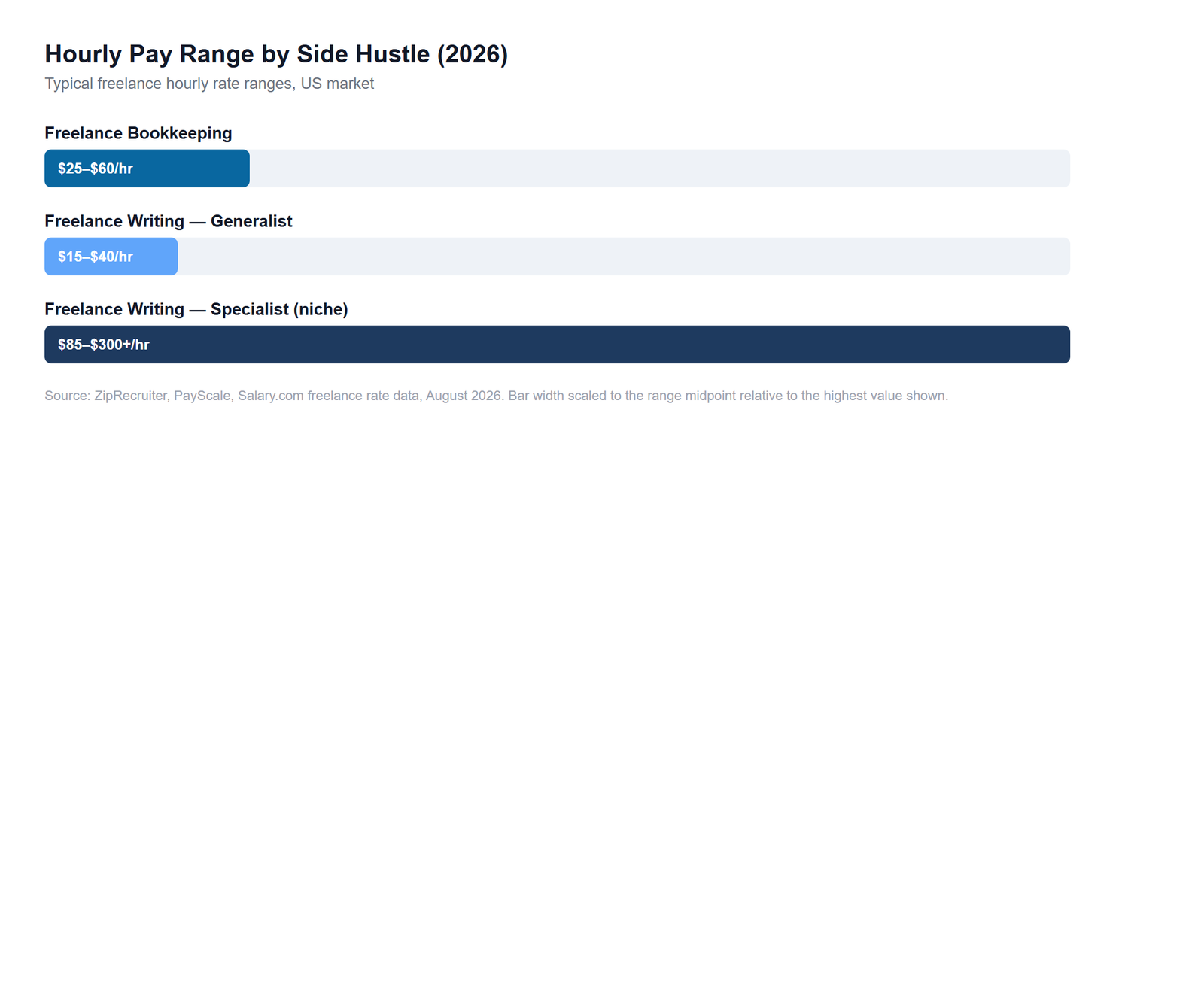
A freelance bookkeeper in the US averages around $50,573 a year as of August 2026, with hourly rates typically running $25 to $60 depending on credentials and location.
Retainer-based pricing is common once a bookkeeper has a handful of steady clients: a basic bank-reconciliation retainer runs roughly $200–$400 a month per client, while a premium retainer that adds payroll and advisory work can reach $800–$1,500 a month. That recurring structure is a real advantage over project-based gig work — income doesn’t reset to zero every time a project wraps.
Experienced bookkeepers with a decade or more in the field don’t see runaway hourly growth compared to writing specialists, but the client relationships tend to be stickier, which matters more for predictable monthly income than a high ceiling that depends on constantly landing new clients.
How Much Does Freelance Writing Actually Pay in 2026?
General freelance writers average close to $48,412 a year, with reported hourly rates clustering in the low $20s to $40 range for generalist content work on platforms like Upwork.
The spread gets much wider once specialization enters the picture. Junior copywriters in a defined niche report $50–$85 an hour, mid-level specialists $85–$160, and senior technical, medical, or B2B SaaS writers $160–$300 or more. Per-word rates for specialized verticals can reach roughly $0.42 a word, well above generalist content pricing.
That range is the whole story with writing right now: the generalist tier compresses toward bookkeeping’s low end or below it, while the specialist tier can beat bookkeeping by a wide margin. There isn’t much stable middle ground left.

| Metric | Freelance Bookkeeping | Freelance Writing (Generalist) | Freelance Writing (Specialist) |
|---|---|---|---|
| Average annual pay | ~$50,573 | ~$48,412 | Varies, often higher |
| Typical hourly rate | $25–$60 | $15–$40 | $85–$300+ |
| Income structure | Monthly retainers common | Per-project or per-word | Per-project, higher per-word |
| AI exposure | Routine coding of transactions automated; judgment calls still human | Generic content generation largely automated | Lower — requires domain expertise AI can’t fully replicate |
Why Has AI Hit Writing Harder Than Bookkeeping?
AI now codes routine bank transactions with 85 to 95 percent accuracy and covers roughly 80 percent of the repetitive side of bookkeeping. That sounds like it should have gutted bookkeeping income, and it hasn’t, because the remaining 20 percent is the part clients actually pay for: judgment calls on filing positions, deduction decisions, and reading a client’s full financial picture.
Tax and accounting billing rates are actually climbing faster than average right now, up about 10.8 percent year over year against a general 4.5 percent baseline — a sign that the AI-exposed part of the job got cheaper while the human-judgment part got more valuable, not less.
In my experience comparing the two fields side by side, writing didn’t have the same clean split. Generic blog posts, product descriptions, and SEO filler were the bulk of the entry-level writing market, and that’s precisely the segment large language models replicate well. There wasn’t a protected 20 percent for beginners the way there was in bookkeeping — the protection only shows up once a writer has built specific domain expertise.
Which One Should You Actually Start?
If you’re starting from zero with no existing expertise in either field, bookkeeping has the more reliable on-ramp right now. A bookkeeping certification plus QuickBooks proficiency is a defined, learnable path, and the retainer model means your third or fourth client adds to steady monthly income instead of resetting the clock.
Writing still makes sense if you already have real expertise in a specific field — healthcare, finance, SaaS, legal — because that expertise is exactly what AI struggles to fake convincingly to an informed reader. Starting a generalist writing side hustle from scratch in 2026, competing purely on speed and low rates, is the version of this hustle that AI has made hardest to sustain.
You’ll probably notice both paths reward the same underlying thing: existing knowledge that AI can accelerate but not originate. Neither field rewards showing up with just a ChatGPT subscription and no prior background.
What Does It Take to Get Started in Each One?
For bookkeeping, the realistic starting kit is a bookkeeping fundamentals course, a QuickBooks Online or Xero certification, and one or two initial clients found through local small-business networks rather than broad freelance marketplaces, where undifferentiated bookkeeping gigs get bid down fast.
For writing, the starting kit looks different: a portfolio built around one specific industry rather than general topics, a couple of published samples in that niche, and direct outreach to companies in that space instead of competing in the generalist bidding pools on Upwork or Fiverr.
Either way, the pattern holds: pick the field where you already know something a generic AI prompt can’t reconstruct from public information alone.
Before You Pick One
- ✅ Add up what you already know, not just what you’re willing to learn — existing expertise is the actual moat in both fields now.
- ✅ If choosing bookkeeping, budget for a real certification before pitching clients — it’s what separates you from the AI-automatable tier.
- ✅ If choosing writing, pick one industry and go deep instead of marketing yourself as a generalist.
- ✅ Compare retainer-based income (bookkeeping) against project-based income (writing) against your own cash flow needs, not just the headline hourly rate.
Where This Comparison Gets Misread
The biggest mistake is comparing bookkeeping’s average pay against writing’s ceiling, or the reverse. Specialist writers earning $160–$300 an hour aren’t the typical writing outcome; they’re the outcome for writers who already had deep subject expertise before AI became a factor.
A second one: assuming any bookkeeping certification guarantees the $25–$60 hourly floor. That floor holds for bookkeepers who land steady retainer clients — a bookkeeper stuck bidding on one-off marketplace gigs sees compressed rates too, just like generalist writers do.
A quieter mistake: treating this as a permanent verdict. Both fields are still being reshaped by how fast AI tools improve, and today’s protected 20 percent in bookkeeping isn’t guaranteed to stay protected forever.
FAQ
Does freelance bookkeeping pay more than freelance writing in 2026?
On average, yes. Freelance bookkeepers average about $50,573 a year versus roughly $48,412 for freelance writers, though specialized technical or medical writers can out-earn bookkeepers significantly.
Is freelance writing still worth starting in 2026?
It’s worth starting if you already have expertise in a specific industry. Generalist freelance writing has been squeezed hardest by AI, while specialized writers in fields like healthcare or SaaS still command $85 to $300 an hour.
Will AI eventually replace freelance bookkeepers too?
Current data doesn’t support that outlook for 2026. AI handles roughly 80 percent of routine transaction coding, but professional judgment on filing positions and deductions remains a human task, and billing rates for that judgment work are rising faster than average.
Sources
- ZipRecruiter: Freelance Bookkeeper Salary (August 2026)
- PayScale: Average Freelance Writer Hourly Pay
- CPA Trendlines: Tax Prep Billing Rates Lift Busy Season 2026
Fact-checked based on public sources as of August 31, 2026.