

1099-NEC vs 1099-K in 2026: Which One Actually Applies to Your Side Hustle?
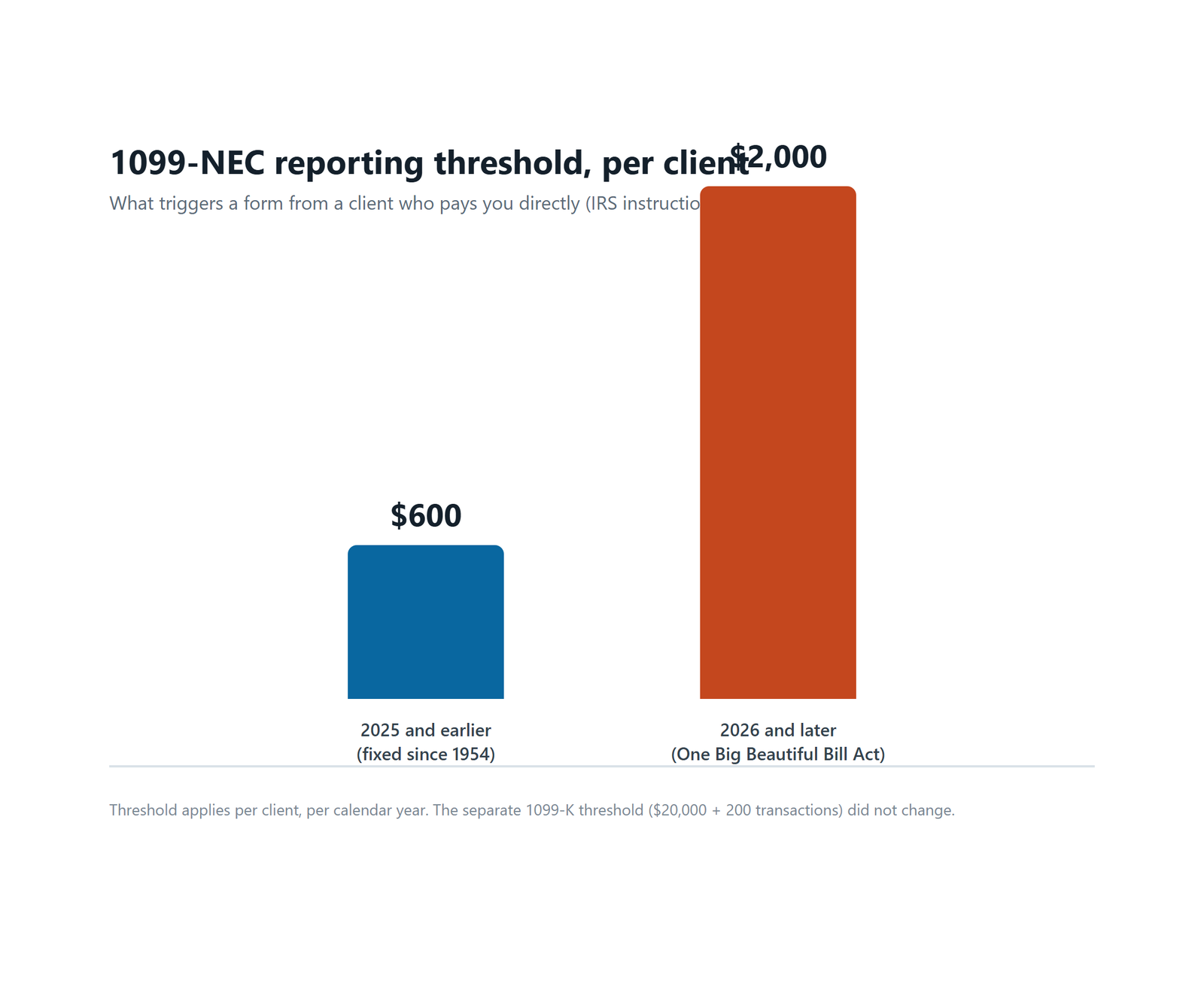
Quick answer: A 1099-NEC comes from a client who pays you directly — check, ACH, wire — and it now only kicks in above $2,000 a year per client, up from $600. A 1099-K comes from a payment platform like PayPal, Stripe, or Etsy, and only fires above $20,000 and 200 transactions. You can owe tax on income that triggers neither form, and you can also get both forms for the same side hustle if you’re paid multiple ways.
You picked up a $1,200 project this year, paid straight to your bank account by a client’s ACH transfer. No 1099 shows up in January, and for a second you wonder if that means the IRS doesn’t know about it. Then a totally separate $900 you made through PayPal for a different gig triggers nothing either. Meanwhile a friend doing similar work got a form for a smaller amount. None of this is random — it comes down to which of two very different forms applies, and the rules for one of them just changed.
Here’s what actually separates a 1099-NEC from a 1099-K, why the NEC threshold moved for 2026, what stayed exactly the same, and what you still owe even when no form ever lands in your inbox.
Jump to a Section
- What’s the Actual Difference Between a 1099-NEC and a 1099-K?
- Why Did the 1099-NEC Threshold Change for 2026?
- Does the 1099-K Threshold Change Too?
- 1099-NEC vs 1099-K, Side by Side
- Can You Get Both Forms for the Same Side Hustle?
- The Reporting Gap Nobody Warns You About
- Before Tax Season, Do These Three Things
- Common Mistakes With These Two Forms
What’s the Actual Difference Between a 1099-NEC and a 1099-K?
A 1099-NEC reports money a client paid you directly for services, while a 1099-K reports money that moved through a third-party payment platform — the difference is who’s doing the reporting, not what kind of work you did.
If a client cuts you a check, wires you money, or pays by direct deposit for freelance or contract work, that client is the one responsible for issuing a 1099-NEC once your total for the year crosses the threshold. If you get paid through PayPal, Venmo for business, Stripe, Square, Etsy, eBay, or a similar platform, the platform itself issues a 1099-K — your client never touches that paperwork at all.
In my experience mapping out where side hustle income actually comes from, most people mentally lump every 1099 together as “the freelance tax form,” which is exactly what makes a missing or unexpected form so confusing when it happens.
Why Did the 1099-NEC Threshold Change for 2026?
The 1099-NEC and 1099-MISC reporting threshold rose from $600 to $2,000 per client for payments made in 2026 and later, under the One Big Beautiful Bill Act signed into law in July 2025, according to the IRS’s own instructions for these forms.
The old $600 figure had been fixed since 1954 and was never adjusted for inflation, so a threshold that once meant something in the 1950s economy had quietly become a very low bar for a modern freelancer with even one mid-sized client. The new $2,000 threshold applies per client, per calendar year — not to your total side hustle income across every client combined.
Starting in 2027, that $2,000 figure is set to adjust for inflation going forward, so it won’t sit frozen the way $600 did for seven decades.
Does the 1099-K Threshold Change Too?
No — the 1099-K threshold stayed at $20,000 in gross payments and more than 200 transactions per platform for 2026, per the IRS’s guidance on Form 1099-K, unaffected by the same bill that raised the NEC threshold.
That $20,000 figure had actually been scheduled to drop sharply, first to $5,000 and eventually toward $600, before the same 2025 legislation reversed course and restored the older, higher threshold. Our full breakdown of the 1099-K threshold for Etsy, eBay, and DoorDash sellers covers that reversal and the handful of states that still enforce their own lower state-level thresholds regardless of the federal number.
You’ll probably notice the gap between $2,000 and $20,000 is enormous. That’s not a typo — it’s two different reporting regimes moving on completely separate tracks.
1099-NEC vs 1099-K, Side by Side
| 1099-NEC | 1099-K | |
|---|---|---|
| Who issues it | The client who paid you | The payment platform |
| 2026 threshold | $2,000 per client/year | $20,000 and 200+ transactions |
| 2025 threshold | $600 per client/year | $20,000 and 200+ transactions |
| Typical payment method | Check, ACH, wire, direct deposit | PayPal, Venmo (business), Stripe, Etsy, eBay |
| Do you owe tax below the threshold? | Yes, always | Yes, always |

Can You Get Both Forms for the Same Side Hustle?
Yes — it’s common to receive a 1099-NEC and a 1099-K in the same year if a side hustle pays you through more than one channel.
A retainer client who wires you $3,000 over the year triggers a 1099-NEC from that client alone. A separate stream of one-off gig payments collected through Stripe or PayPal, once it crosses $20,000 and 200 transactions, triggers a 1099-K from the platform on top of that. Neither form cancels the other out, and neither one substitutes for tracking your own total income across every source.
The Reporting Gap Nobody Warns You About
Falling under both thresholds doesn’t mean the income is tax-free — it just means nobody else reported it to the IRS on your behalf, and you’re still required to.
When I checked how this plays out in practice, the pattern that trips people up is treating “no form arrived” as “this doesn’t count.” A $1,800 payment from one client and $4,000 spread across small PayPal gigs could both land under their respective thresholds and generate zero paperwork — and both are still fully taxable self-employment income you’re expected to report yourself.
This part trips a lot of people up at filing time, usually after the fact rather than before.
Before Tax Season, Do These Three Things
- ✅ Track every payment as it comes in, by client and by platform, instead of waiting to see which 1099s show up in January.
- ✅ Ask new clients upfront how they plan to pay you — direct deposit versus a platform like PayPal changes which threshold applies to that relationship.
- ✅ Set aside a running percentage for taxes on every payment, regardless of whether it crosses a reporting threshold.
Most people skip this and regret it every April.
Common Mistakes With These Two Forms
Assuming a missing 1099 means the IRS has no record of the payment is the single most common mistake — platforms and clients still track what they paid you internally even when no form is legally required.
Mixing up per-client and per-platform thresholds is the second: the $2,000 1099-NEC threshold resets separately for every client who pays you directly, but the $20,000 1099-K threshold is measured per platform, combining every payment that moves through it regardless of how many different customers or clients are on the other end.
FAQ
Do I need to report side hustle income if I never get a 1099 at all?
Yes. Both the 1099-NEC and 1099-K thresholds only control who has to send you a form — they don’t set a minimum for what’s taxable. Every dollar of self-employment income is reportable regardless of paperwork.
What if a client pays me $2,500 but splits it across two payments?
The $2,000 1099-NEC threshold is based on the total paid to you by that client over the calendar year, not the size of any single payment. Two payments of $1,250 from the same client still add up to $2,500 and cross the threshold.
Does the new $2,000 NEC threshold apply to 2025 income too?
No. The higher threshold applies to payments made in 2026 and later. Income you were paid directly in 2025 still falls under the old $600 threshold for 1099-NEC reporting purposes.
Sources
- IRS — Instructions for Forms 1099-MISC and 1099-NEC
- IRS — Understanding Your Form 1099-K
- IRS — Forms and Associated Taxes for Independent Contractors
Not tax or legal advice. Thresholds and effective dates above reflect IRS guidance published at time of writing and may be updated further — confirm current figures at IRS.gov or with a tax professional before filing.