Fat Cat Card: Compare Crypto Card FX Fees on a Euro Trip
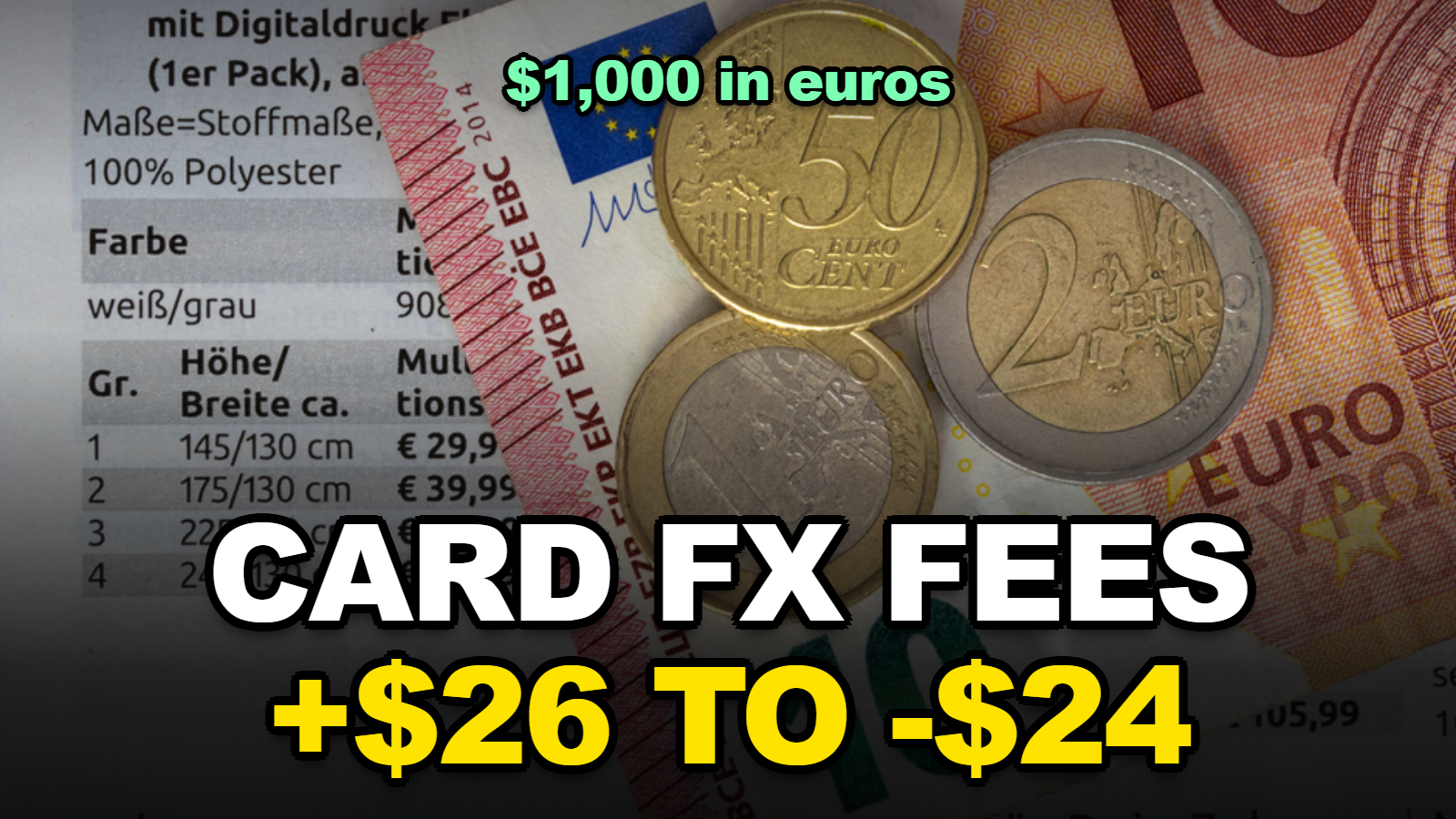
Short answer: On $1,000 of euro spending, the free tiers of four crypto cards land between about +$26.00 and −$24.18 once FX fees and cashback are netted. ether.fi Cash charges no FX markup on euro purchases. Jupiter’s 2% cashback beats its own FX fee. Bybit’s Asia Pacific card loses the most, because its cashback stops at $5 a month. KAST depends on which FX rate your country gets.
Most crypto cards hold dollars. The moment you pay in euros, a second price list kicks in.
That second list is the foreign exchange (FX) fee, and it is rarely on the card’s front page. This comparison puts four cards’ free tiers side by side for a trip with $1,000 of euro spending, then again at $3,000, using each issuer’s own fee page as it read on October 27, 2026. These four were picked because their fee pages are public and readable.
Jump to a Section
- What does each card charge on a euro purchase?
- What does $1,000 of euro spending cost?
- Does the ranking change at $3,000?
- Why does the small print matter more than the rate?
- How do you run this for your own trip?
What does each card charge on a euro purchase?
For a purchase charged in euros, the free tiers of KAST, Bybit, Jupiter and ether.fi Cash charge FX fees of 0.5%–1.75%, 2%, 1% or 1.8%, and 0% respectively, according to each issuer’s fee page on October 27, 2026.
| Card (free tier) | FX fee on non-USD spend | Other per-purchase cost | Cashback | Source |
|---|---|---|---|---|
| KAST Standard | 0.5%–1.75% (by country of residence and of purchase) | $0.10 on non-USD purchases under $25 | 1.5% on the first $2,000 a month | KAST fees |
| Bybit Card (Asia Pacific, Australia, Mexico) | 2% on top of the network rate | 0.9% conversion when paid with crypto | 2%, capped at $5 a month, crypto-funded spend only | Bybit fees |
| Jupiter Card | 1% (Rain-issued) or 1.8% (DCS-issued) | None listed | 2%, capped at $100 a month | Jupiter docs |
| ether.fi Cash (Core) | 0% on euro merchants (beta); 0.5% added on other currencies | None listed | Euro spend: 3% on the first $800, then 1% to $1,500, paid in ETHFI | ether.fi EUR FX |
Which issuer you get can depend on where you live. Jupiter says DCS issues its cards to residents of Australia, Japan, Malaysia, the Philippines, Singapore, South Korea, Taiwan, Thailand and Vietnam, and Rain issues them everywhere else it operates. Bybit runs its EEA card separately, and that card isn’t covered by the Asia Pacific fee row above.
When I checked KAST’s fee page, I found that it doesn’t promise one FX number. It gives a 0.5%–1.75% range and says the exact fee shows in the app before you confirm. So KAST gets a range in every table below.
What does $1,000 of euro spending cost?
On $1,000 of euro spending, the net result after FX fees and free-tier cashback ranges from about +$26.00 on ether.fi Cash Core to about −$24.18 on Bybit’s Asia Pacific card paid in USDT, based on the issuers’ published rates on October 27, 2026.
A plus sign means cashback exceeded fees. A minus sign means you paid more than the sticker prices.
| Card | FX fee | Other fees | Cashback | Net |
|---|---|---|---|---|
| KAST Standard | $5.00 to $17.50 | — | $15.00 | +$10.00 to −$2.50 |
| Bybit Card, Asia Pacific (paid in USDT) | $20.00 | $9.18 | $5.00 | −$24.18 |
| Jupiter Card, Rain-issued | $10.00 | — | $20.00 | +$10.00 |
| Jupiter Card, DCS-issued | $18.00 | — | $20.00 | +$2.00 |
| ether.fi Cash, Core (EUR merchant) | $0.00 | — | $26.00 | +$26.00 |
Bybit’s numbers stack. The 2% FX fee is added first, then the 0.9% conversion applies to the whole USDT amount sold to pay it. Bybit’s own example on its fee page shows a 250 AED purchase becoming 68.07 USD plus a 1.36 USD FX fee.
This part trips a lot of people up.
Bybit’s free tier advertises 2% cashback, but its rewards page caps Tier 1 at $5 a month and, since October 5, 2026, counts only purchases funded with crypto. Paying from a fiat balance would skip the 0.9% conversion. It would also earn no cashback at all.
ether.fi’s cashback arrives as ETHFI, not dollars. The help center says it is converted at the current price, locked for 7 days, and its market value can move. The $26.00 figure is the dollar value at the time of purchase, not a guarantee.
Does the ranking change at $3,000?
At $3,000 of euro spending, the gap between ether.fi Cash Core and Jupiter’s Rain-issued card shrinks to $2.50, because ether.fi’s euro cashback drops to 0.1% above $1,500 while Jupiter keeps paying 2% up to its $100 monthly cap.
| Card | FX fee | Other fees | Cashback | Net |
|---|---|---|---|---|
| KAST Standard | $15.00 to $52.50 | — | $30.00 | +$15.00 to −$22.50 |
| Bybit Card, Asia Pacific (paid in USDT) | $60.00 | $27.54 | $5.00 | −$82.54 |
| Jupiter Card, Rain-issued | $30.00 | — | $60.00 | +$30.00 |
| Jupiter Card, DCS-issued | $54.00 | — | $60.00 | +$6.00 |
| ether.fi Cash, Core (EUR merchant) | $0.00 | — | $32.50 | +$32.50 |
When I compared the two tables, I noticed that every cap bites somewhere. Bybit’s $5 cap bites almost at once. KAST’s $2,000 ceiling bites on a big trip. Jupiter’s $100 cap isn’t reached until $5,000 of spending in a month.
Honestly, the card that wins depends on how much you’ll spend and where.
Why does the small print matter more than the rate?
On a crypto card, fixed per-purchase fees and how a terminal converts currency can cost more than the gap between two FX rates.
- Small purchases on KAST. KAST charges $0.10 on each non-USD purchase under $25. Forty coffees and metro tickets on a week away would add $4.00. That’s not in the table above.
- Dynamic Currency Conversion. If a terminal offers to charge you in dollars, say no. ether.fi’s FX help page says that option usually carries a higher markup than letting the card convert, and its euro 0% FX doesn’t apply when the merchant charges in another currency.
- Settlement timing. ether.fi notes the FX rate can be the one at settlement, 1 to 2 days after the purchase, so the final amount may differ slightly from what you saw.
- Non-euro trips. In yen or pounds, ether.fi Core adds a 0.5% FX margin, and the euro row in these tables no longer applies.
If you’ve ever looked at a card statement after a trip and found a dozen tiny extra lines, you know how this adds up. For what happens when a card gets declined abroad instead, see Crypto Card Declined Abroad 2026: The Four Causes.
How do you run this for your own trip?
To compare crypto card FX costs for a trip, multiply your expected foreign-currency spend by each card’s FX fee, add any conversion or per-purchase fees, then subtract cashback only up to the monthly cap.
- Estimate the trip spend in the local currency and convert it to dollars.
- Look up the FX fee for your country on each card’s own fee page, not a review site.
- Add any conversion fee for paying with crypto and any small-purchase fee.
- Apply cashback, then cut it at the monthly cap and check whether it pays in dollars or a token.
- Subtract. Compare the net numbers, not the headline cashback rates.
For the cap math in more depth, read Fat Cat Card: USDT Cashback Cap and Fees, Worked Out. To check a card’s basics before any of this, see How to Choose a Crypto Spending Card: 5-Question Table. Comparing against a bank-style option? Crypto Card vs Wise for Overseas Spending 2026 lays that out.
Tips
- Choose the local currency at every card terminal and on foreign checkout pages.
- Group small purchases where you can if your card has a per-purchase fee on non-USD spending.
- Read the FX fee shown in the app before you confirm; KAST says the exact rate appears there.
Warnings
- Fee pages change often. Bybit’s was last updated September 10, 2026, and KAST’s ATM limits changed on October 22, 2026.
- Cashback paid in a token such as ETHFI can lose value before you claim or sell it.
- Card availability depends on your country. Check that the card and the fee row you’re using actually apply to you.
FAQ
Which crypto card has no FX fee in Europe?
ether.fi Cash says it applies zero FX markup when a merchant charges in euros, for any spending token, and calls the feature a beta. Of the four free tiers compared here, it is the only one with no FX fee on a euro purchase.
Does a crypto card charge FX fees on US dollar purchases?
Usually not, because these cards hold a US dollar balance. KAST lists 0% for USD card spend, and Jupiter says there is no fee on USD payments. Bybit charges FX only when the purchase currency differs from the card currency.
Should I pay in my home currency when a terminal offers it?
No. That offer is Dynamic Currency Conversion, and ether.fi’s help center says it usually carries a higher exchange rate markup than letting the card convert. Choose the local currency, such as euros, at the terminal.
Sources
- KAST, What Are the Fees and Conditions for KAST Cards and Accounts
- Bybit Help Center, Fees and Limits (Bybit Card), updated Sep 10, 2026
- Bybit Help Center, Introduction to Bybit Card Rewards
- Jupiter docs, Jupiter Card and Rewards & Referrals
- ether.fi Help Center, EUR purchases 0% FX Rate, How does cashback work? and FX rate on Cash transactions
Fees and cashback checked on each issuer’s page on October 27, 2026. Free tiers only. Cashback is calculated on the purchase amount; issuers may treat FX fees differently.
🔗 Related guides