
How to Use Keepa and CamelCamelCamel to Check If a Labor Day Deal Is Actually Real (2026)
Quick answer: Two Amazon shoppers sued the company in September 2025 over Prime Day discounts they say were calculated against fake list prices. Their evidence came from price-history trackers. You can run the exact same check on any Labor Day 2026 deal in under a minute using Keepa or CamelCamelCamel — here’s the case, and here’s how to do it yourself.
Cathy Armstrong bought a pair of headphones marked 44% off. Oluwa Fosudo bought a tablet marked 40% off. Both later found the same thing: the “before” price used to calculate their discount didn’t match what the product had actually been selling for.
Their case is still working through federal court in Washington state, but the method they used to catch it is public, free, and takes less time than reading this paragraph. If you’ve already read our general breakdown of how to tell a real Labor Day discount from an inflated one, this is the hands-on version — the actual tool, the actual clicks, walked through against a real legal case as the example.
📌 Related reading: price verification matters just as much outside electronics — see how collectors handle it in How to Verify a Sports Memorabilia COA Before You Buy.
What This Guide Walks Through
- What Did the Amazon Prime Day Lawsuit Actually Allege?
- How Do Price-History Trackers Catch a Fake Discount?
- How Do You Check a Labor Day Deal With CamelCamelCamel?
- How Is Keepa Different From CamelCamelCamel?
- What Counts as a Genuinely Good Labor Day Deal?
What Did the Amazon Prime Day Lawsuit Actually Allege?
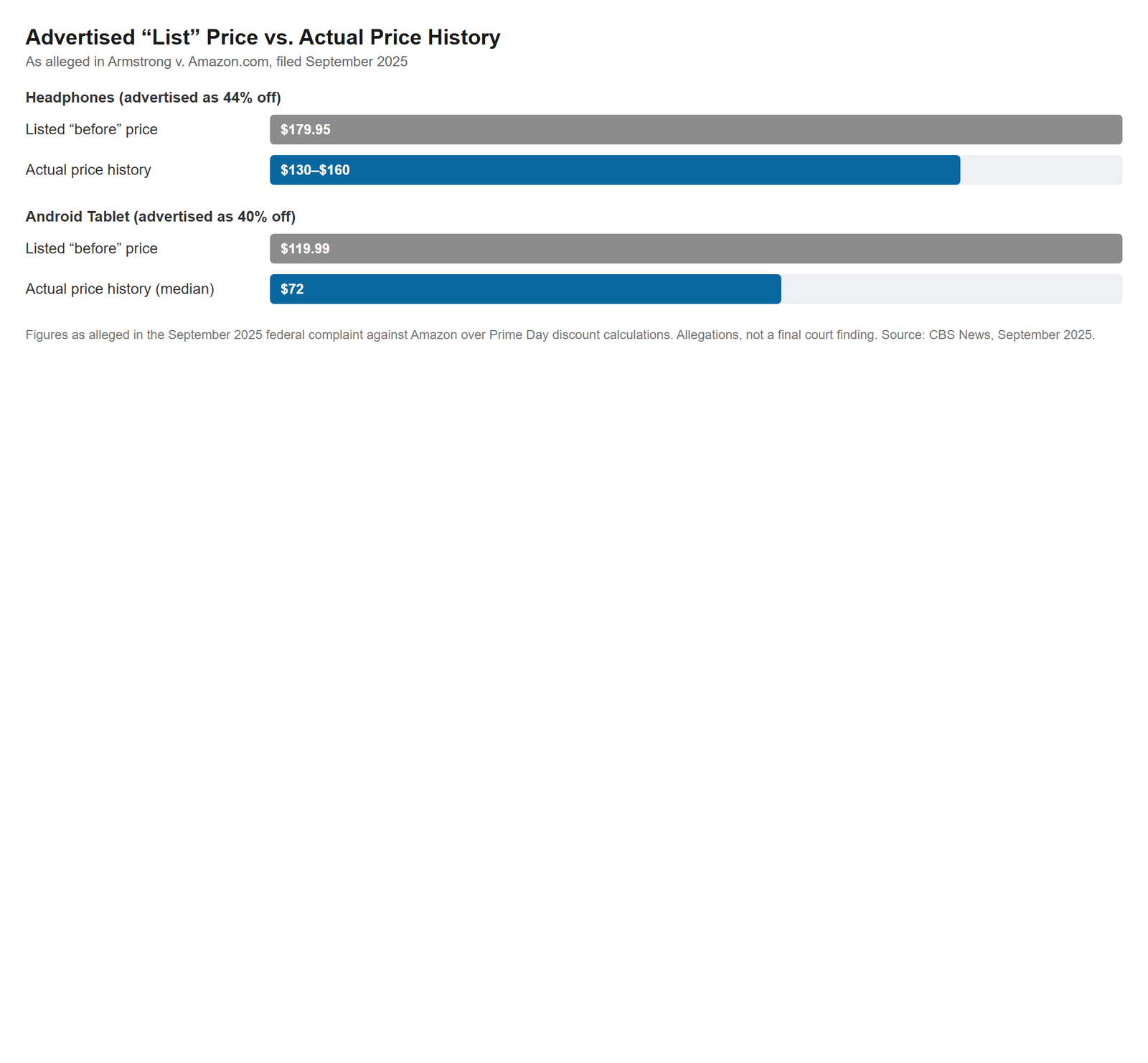
Two plaintiffs, Cathy Armstrong of California and Oluwa Fosudo of Maryland, filed a federal lawsuit in September 2025 alleging Amazon used “fictional” list prices to inflate the percentage discounts shown during its July 8–11 Prime Day sale.
| Product | Advertised Discount | Listed “Before” Price | Actual Price History (per the complaint) |
|---|---|---|---|
| Headphones | 44% off | $179.95 | Historically sold for $130–$160 |
| Android Tablet | 40% off | $119.99 | $50–$85 over the prior 90 days; median $72 |
The tablet example is the sharper one: the complaint states the “sale” price of $72.18 was actually higher than the $50 price the same tablet had sold for back in April, meaning the shopper paid more while being told they were getting a bigger discount.
Amazon declined to comment on the lawsuit when it was filed, while the company’s own site described the same event as its “biggest Prime event to date,” where customers “saved billions.” Both things can be technically true at once — aggregate savings across millions of orders don’t rule out individual listings using an inflated reference price.
How Do Price-History Trackers Catch a Fake Discount?
Price-history trackers like CamelCamelCamel and Keepa work by logging a product’s Amazon price at regular intervals over months or years, then charting that history so a shopper can see whether today’s price is actually a low point or just an average day wearing a discount label.
When I checked how the lawsuit’s own evidence was built, both examples relied on exactly this kind of historical chart rather than any insider information — the plaintiffs’ lawyers pulled the same public price history any shopper can pull today, and used it to show the “before” price never really existed at that level.
Honestly, that’s the whole trick behind most inflated “sale” tags: retailers only need the reference price to have existed briefly, sometimes for a single day, for the percentage-off math to look legitimate on the page.
How Do You Check a Labor Day Deal With CamelCamelCamel?
CamelCamelCamel checks an Amazon product’s price history for free once you paste in the product’s URL, with no account or browser extension required for a one-time check.
- Open the Amazon product page for the Labor Day deal you’re considering and copy its URL.
- Paste that URL into CamelCamelCamel’s search bar and load the price history chart.
- Switch the chart view to at least 90 days, not the default short window, so a single-day price spike doesn’t get mistaken for the “real” price.
- Compare today’s advertised sale price against the lowest point on that chart, not just the average — if today’s price sits above a price the item hit organically within the last month or two, the “deal” isn’t doing much.
I found that the browser extension version, called the Camelizer, saves a step by showing the chart directly on the Amazon product page, which is worth installing if you’re checking more than one or two items during the sale window.
How Is Keepa Different From CamelCamelCamel?
Keepa tracks a larger catalog across 11 Amazon marketplaces with hourly price updates, and adds sales-rank and Buy Box history on top of the raw price chart that CamelCamelCamel shows.
That extra data matters for one specific Labor Day scenario: a listing where a third-party seller has taken over the Buy Box from Amazon itself. Keepa’s Buy Box history shows when that handoff happened, which can explain a price jump that has nothing to do with a real discount and everything to do with which seller currently owns the listing.
For a single quick check before checkout, CamelCamelCamel is faster since it needs no install. For tracking several wishlist items across the whole sale week with price-drop alerts, Keepa’s browser extension is the more complete tool.
What Counts as a Genuinely Good Labor Day Deal?
A genuinely good Labor Day deal is one where today’s price sits at or below the lowest point the product has organically reached in the past 90 days, not just below an inflated list price set days before the sale started.
Amazon’s Labor Day sale runs through September 7, 2026, which leaves enough time to price-check a handful of candidates before buying rather than grabbing the first item that shows a big percentage-off badge. You’ll probably notice that the items with the smallest advertised discounts are sometimes the better deals once you check the actual chart — a modest 15% off a price that’s genuinely at a yearly low beats 44% off a number that was inflated to begin with.
Before You Add Anything to Cart
- ✅ Pull up the 90-day (or longer) price chart before checkout, not after.
- ✅ Check who currently holds the Buy Box if the price looks unusually high for a “sale.”
- ✅ Compare the sale price against the lowest recent price, not the crossed-out list price.
- ✅ Screenshot the chart if you’re on the fence — it’s useful evidence if the price drops further right after you buy.
Does Checking Price History Guarantee a Refund If You Overpaid?
No. Confirming a price was inflated doesn’t automatically get you a refund — it only tells you whether to buy now, wait, or look elsewhere, and any compensation for past purchases depends on Amazon’s own policies or, as in the pending lawsuit, a court decision.
This lawsuit follows a separate case: in September 2025, the FTC secured a $2.5 billion settlement against Amazon over deceptive Prime enrollment and cancellation practices, according to the FTC’s own press release, which included $1.5 billion earmarked for consumer refunds tied to that specific issue. That settlement was about subscription practices, not pricing, so it doesn’t cover the discount allegations in the Armstrong/Fosudo case — the two are separate legal actions against the same company.
FAQ
Is CamelCamelCamel or Keepa free to use?
Yes. CamelCamelCamel is free with no account needed for a basic price-history check, and Keepa’s core price-tracking and browser extension are also free, with optional paid tiers for advanced alerts.
What did the Amazon Prime Day lawsuit allege about fake discounts?
Filed in September 2025, the lawsuit alleges Amazon calculated Prime Day discounts against inflated list prices that did not match the products’ actual recent price history, using examples like a tablet whose 40%-off sale price was higher than its price two months earlier.
How long does Amazon’s Labor Day 2026 sale run?
Amazon’s Labor Day 2026 sale runs through September 7, 2026, giving shoppers time to price-check items with a history tracker before buying.
Sources
- CBS News: Amazon Sued Over Allegedly Fake Prime Day Sale Prices
- FTC: FTC Secures Historic $2.5 Billion Settlement Against Amazon
- Keepa: Amazon Price Tracker
Fact-checked based on public sources as of August 31, 2026. This lawsuit is ongoing and its allegations are not a final court finding; sale dates and pricing are current as of publication and may change.