Bitget Fee Discount and Payback Stacked (2026): How 0.06% Becomes 0.015%
Updated 8 October 2026. TetherBase revised its exchange rates on 28 September 2026. The OKX, Binance, Bybit and EdgeX figures in the comparison table below are recalculated against the new rates. Check tetherbase.io before you trade.
⚠️ September 2026 incident notice
Bitget suspended withdrawals after a hack on September 24, 2026. Withdrawals restart in phases from September 28, with full restoration expected October 2. The fee maths below was written before the incident and the rates still stand, but check the resumption schedule before depositing or signing up. What happened and when each asset reopens
Quick answer
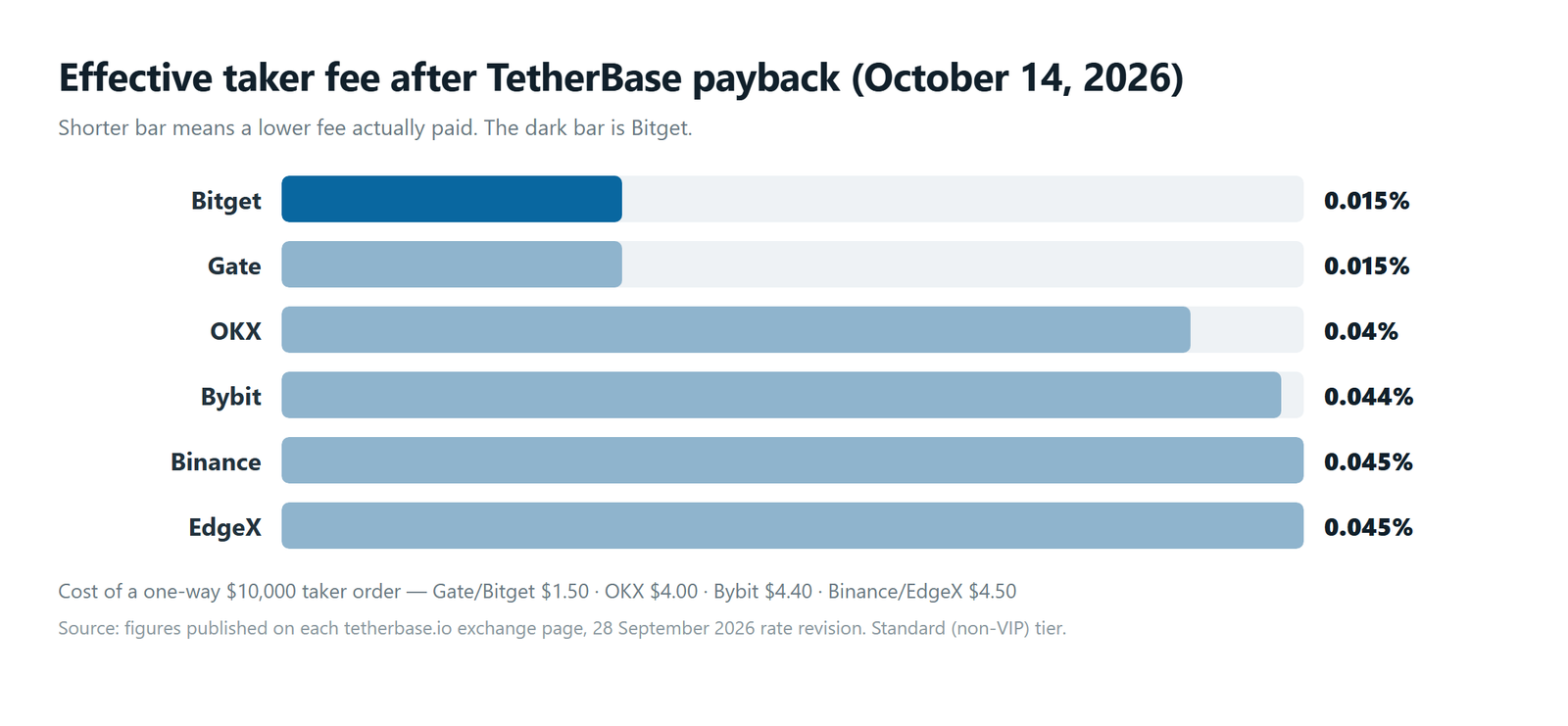
Listed taker 0.06% → 50% discount → 0.03% → 50% payback → 0.015% effective. That is $1.50 on a $10,000 market order.
Maker fees land at 0.005%, lowest of the six exchanges. The discount-then-rebate structure is also why collateral drains slower here than on a pure rebate program.
Bitget advertises a 50% payback — below Gate at 70%. Its effective taker fee still ties Gate for the lowest on the platform, and its maker fee beats everything else outright. The reason is that Bitget is the only program here besides Bybit that stacks a discount underneath the payback. Here is how that plays out in dollars, using figures checked on September 20, 2026.
What this page covers
- How Does Bitget Stack a Discount on Top of the Payback?
- A 0.005% maker fee, lowest of the six
- All six exchanges, same yardstick
- Why Can a Discount Model Beat a Rebate Model?
- The order of operations that actually works
How Does Bitget Stack a Discount on Top of the Payback?
Of the six exchanges TetherBase supports, only Bitget and Bybit apply a fee discount and a payback. The other five charge the standard fee and return a slice of it.
On Bitget the sequence runs like this. The listed taker fee of 0.06% is cut by 50% to 0.03%. Then 50% of that reduced amount comes back as payback, leaving 0.015%. Because the two steps multiply rather than add, the headline “50%” understates what actually happens.
Miss that and the arithmetic breaks. Treating Bitget as a plain payback program — 50% off 0.06% — produces 0.03%, exactly double the real figure.
A 0.005% maker fee, lowest of the six
On taker fees Bitget ties Gate at 0.015%. On limit orders it stands alone. The listed maker fee of 0.02% falls to 0.005% after the discount and payback. Gate lands at 0.006%, OKX at 0.009%, and the on-chain venue EdgeX at 0.036%.
One basis point of a basis point sounds like nothing. It compounds for anyone working limit orders all day. Route $1,000,000 of monthly limit volume through Bitget and the fee is $50; through Gate it is $60. Small in absolute terms, and it scales linearly with size.
All six exchanges, same yardstick
Figures as published on each TetherBase exchange page, checked September 20, 2026. All rows assume a standard non-VIP account.
| Exchange | Listed taker fee | TetherBase payback | Effective taker fee | Cost per $10,000 |
|---|---|---|---|---|
| Gate | 0.05% | 70% | 0.015% | $1.50 |
| Bitget | 0.06% | 50% + 50% fee discount | 0.015% | $1.50 |
| OKX | 0.05% | 20% | 0.04% | $4.00 |
| Binance | 0.05% | 10% | 0.045% | $4.50 |
| Bybit | 0.055% | 20% (no fee discount) | 0.044% | $4.40 |
| EdgeX (on-chain) | 0.045% | None | 0.045% | $4.50 |
Gate and Bitget tie on taker fees despite a twenty-point gap in their headline payback rates. That single row is the clearest argument against shopping by advertised percentage.
Why Can a Discount Model Beat a Rebate Model?
If the effective cost matches, the tiebreaker comes down to when the money leaves your account.
Under a discount model the reduced fee is the only amount ever debited. Under a rebate model the full fee is debited and returned later on the settlement cycle. Same final cost, different balance in the meantime. For a high-leverage position sitting close to its liquidation price, collateral that drains faster is a real disadvantage, not a rounding error.
Bookkeeping cuts the other way. Gate’s trade log shows the standard fee and the rebate arrives as its own line, so reconciling monthly cost is one subtraction. Bitget’s log already shows a discounted number that then receives a payback, so working back to true cost takes two steps.
The order of operations that actually works
- Open the TetherBase page for Bitget and use its sign-up link to create a new account.
- Complete Bitget’s identity verification.
- Find your UID in the Bitget app.
- Link that UID on TetherBase.
- Trade only after the link is confirmed.
Reverse the order and early trades fall outside the payback window. The discount has the same dependency: an account that did not sign up through the affiliate link never receives the 50% reduction in the first place. If you already hold a Bitget account, decide what happens to it before opening another.
And the obvious caveat. Cutting fees by three quarters does not make a larger position safer. Liquidation risk is indifferent to what you paid in fees.
Frequently asked questions
Does a 50% payback mean I pay half the fee?
You pay less than half. Bitget discounts the listed 0.06% taker fee by 50% to 0.03% first, then returns 50% of that, leaving 0.015%. Calculating the payback against the undiscounted fee gives 0.03%, which is double the real number.
Is Gate or Bitget cheaper?
On taker fees they are identical at 0.015%. On maker fees Bitget is marginally lower at 0.005% against Gate’s 0.006%. Limit-heavy traders should lean Bitget; anyone who values simpler cost reconciliation may prefer Gate’s flat fee-plus-rebate structure.
Will my existing Bitget account get the discount?
Generally no. Both the discount and the payback depend on the account being attributed to the affiliate at sign-up, and retroactive attribution is usually blocked. Check with the platform’s support before opening a second account.
Sources
- TetherBase — Bitget payback and effective fee page (checked September 20, 2026)
- TetherBase — full list of partner exchanges and rates
- Bitget — official trading fee schedule
🔗 Related guides
This article is general information about exchange fee structures, not investment advice or a recommendation to use any particular exchange. It contains affiliate links to TetherBase (tetherbase.io). Leveraged crypto futures can lose your entire deposit, and fee and payback rates change without notice — confirm current terms on each official page before trading.
Fact-checked based on public sources as of September 20, 2026.