MAI-Voice-2.1 Pricing: What a Voiceover or Podcast Episode Actually Costs vs ElevenLabs (October 2026)
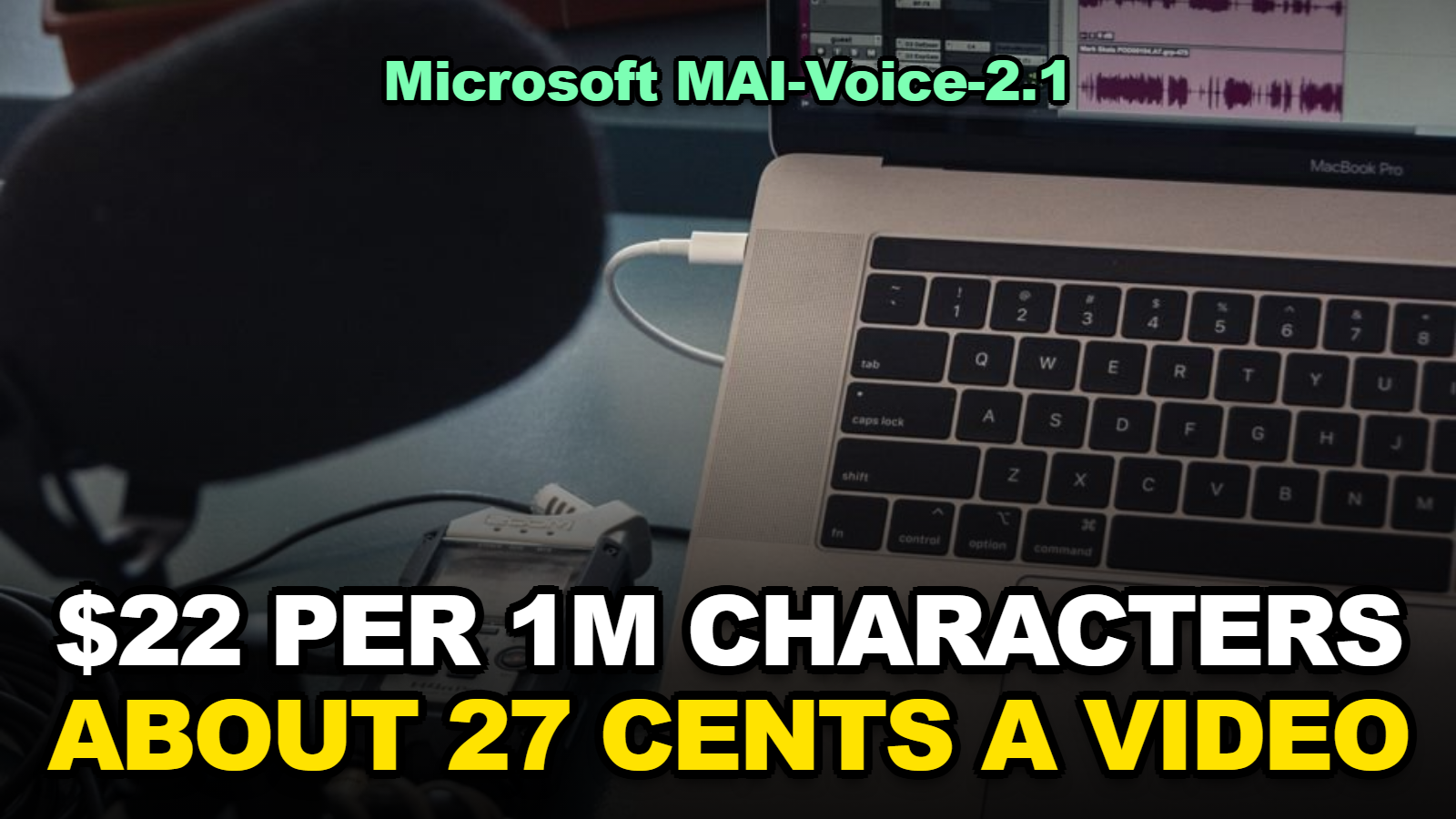
Short answer: As of October 1, 2026, Microsoft prices MAI-Voice-2.1 at $22 per million characters and MAI-Voice-2.1-Flash at $15 (microsoft.ai). A 10-minute voiceover script runs about 12,000 characters. So one video costs roughly a quarter on Voice 2.1. For captions on recorded videos, the streaming model is the wrong pick. The batch MAI-Transcribe-2 model is about five times cheaper per hour.
Twenty-seven cents. That’s roughly what Microsoft’s new MAI-Voice-2.1 charges to voice a 10-minute YouTube script.
Microsoft AI shipped three speech models on October 1: MAI-Voice-2.1, a faster MAI-Voice-2.1-Flash, and MAI-Transcribe-2-Streaming for live captions. The launch post is full of latency charts and benchmark rankings. What it doesn’t do is tell a solo creator what an episode costs, or whether it beats the ElevenLabs plan they already pay for.
So here’s the per-episode math, the caption trap most people will fall into, and where you can actually use these models today.
Contents
- How Much Does MAI-Voice-2.1 Cost per Video or Podcast Episode?
- Is MAI-Voice-2.1 Cheaper Than ElevenLabs After October 12?
- Which Microsoft Transcription Model Is Cheapest for Captions?
- Voice 2.1 or Voice 2.1 Flash: Which One Should Creators Pick?
- Where Can You Use MAI-Voice-2.1 Without a Developer Team?
- The Fine Print Before You Re-Voice Your Back Catalog
- Tips
- Warnings
- FAQ
- Sources
How Much Does MAI-Voice-2.1 Cost per Video or Podcast Episode?
MAI-Voice-2.1 costs $22 per 1 million characters of text as of its October 1, 2026 launch, according to Microsoft AI’s announcement, which works out to about $0.27 for a 10-minute voiceover script of roughly 12,150 characters.
Text-to-speech is billed on characters, not minutes. Spaces and punctuation count. A typical narrator reads about 150 words a minute, and English averages a bit over five characters per word once you include spaces. Add one retake pass for the lines you’ll inevitably rewrite, and a 10-minute script lands near 12,150 characters.
That’s the basis for every number below. Your own scripts may run 20% longer or shorter. Scale accordingly.
- One 10-minute YouTube voiceover: about $0.27 on Voice 2.1, about $0.18 on Flash.
- One 30-minute solo podcast episode: roughly 36,450 characters, so about $0.80 on Voice 2.1.
- An 80,000-word audiobook: about 648,000 characters with retakes, or roughly $14.26.
Honestly, at these rates the voice bill stops being the thing you budget for. Your time fixing pronunciation is the real cost.
Is MAI-Voice-2.1 Cheaper Than ElevenLabs After October 12?
Yes: from October 13, 2026, MAI-Voice-2.1 at $22 per million characters costs about 72% less than Eleven v4 at its regular API rate of $0.08 per 1,000 characters ($80 per million), and roughly 45% less than Eleven v4 Turbo at $0.04 per 1,000.
Until October 12 the gap disappears. The ElevenLabs API pricing page currently shows Eleven v4 at $0.022 per 1,000 characters during its 72%-off launch window. That’s exactly $22 per million, the same as Microsoft’s list price. When I compared the two pages side by side, I noticed that the coincidence ends the moment the ElevenLabs promo does.
| Monthly workload | Characters (with retakes) | MAI-Voice-2.1 ($22/M) | MAI-Voice-2.1-Flash ($15/M) | Eleven v4 regular ($80/M) | Eleven v4 Turbo regular ($40/M) |
|---|---|---|---|---|---|
| 4 × 10-min YouTube voiceovers | ~48,600 | ~$1.07 | ~$0.73 | ~$3.89 | ~$1.94 |
| 4 × 30-min solo podcast episodes | ~145,800 | ~$3.21 | ~$2.19 | ~$11.66 | ~$5.83 |
| One 80,000-word audiobook | ~648,000 | ~$14.26 | ~$9.72 | ~$51.84 | ~$25.92 |
Table: our own calculation from Microsoft AI’s October 1, 2026 list prices and the ElevenLabs API pricing page checked October 5, 2026 (regular rates that apply after the October 12 promo). Character counts assume 150 words per minute plus one retake pass. API rates only; subscription plans bill differently.
For the audiobook, that’s a $37 difference against Eleven v4. For four YouTube videos, it’s under $3 a month.
So the price gap only matters at volume. If you voice a handful of short videos, stick with whichever voice sounds better to you. We ran the full ElevenLabs side of this in our Eleven v4 switching math.
Which Microsoft Transcription Model Is Cheapest for Captions?
For captions on videos you’ve already recorded, the batch model MAI-Transcribe-2 is the cheapest Microsoft option at $0.10 per audio hour through the end of 2026, per Microsoft AI’s September 2026 launch post, while the new MAI-Transcribe-2-Streaming costs $0.54 per hour.
Here’s where people get tripped up. The October news cycle is all about the streaming model, because it’s new and it topped Artificial Analysis’s accuracy ranking. But streaming exists for live audio: voice agents, live captions on a stream, call centers. If the file already sits on your drive, you’re paying for speed you don’t use.
| Model | Price per audio hour | 4 × 30-min episodes (2 hrs) | Built for |
|---|---|---|---|
| MAI-Transcribe-2 (batch) | $0.10 (limited-time, through 2026) | $0.20 | Recorded files |
| ElevenLabs Scribe v2 | $0.22 | $0.44 | Recorded files |
| ElevenLabs Scribe v2 Realtime | $0.39 | $0.78 | Live audio |
| MAI-Transcribe-2-Streaming | $0.54 (introductory, through 2026) | $1.08 | Live audio |
Table: Microsoft AI announcements (September 3 and October 1, 2026) and the ElevenLabs API pricing page, checked October 5, 2026. Add-ons such as entity detection are excluded.
I found that Microsoft’s streaming model is actually the most expensive of the four on a per-hour basis. Its pitch is accuracy and speed, not price.
Two hours of audio a month costs pocket change either way. The ratio starts to matter if you’re captioning a back catalog of 200 hours: $20 on batch versus $108 on streaming.
Voice 2.1 or Voice 2.1 Flash: Which One Should Creators Pick?
MAI-Voice-2.1-Flash at $15 per million characters is built for fast, back-and-forth replies such as voice agents, while the standard MAI-Voice-2.1 at $22 per million is the better fit for narration and long-form content where expressiveness matters more than a 150-millisecond response.
Microsoft says Flash generates 45 seconds of audio with about 150 ms end-to-end latency. That’s impressive for a phone bot and irrelevant for a YouTube voiceover you’ll render once and export.
A rough rule:
- Narration, explainers, audiobooks: Voice 2.1. The extra $7 per million characters is under $1 for most monthly workloads.
- Interactive bots, tutoring apps, customer replies: Flash. Latency is the product there.
- High-volume short clips, like hundreds of product videos: test Flash first. If listeners can’t tell, take the 32% saving.
Most people skip the side-by-side test and just pick the cheaper one. Render the same 200-word paragraph on both before committing a whole series.
Where Can You Use MAI-Voice-2.1 Without a Developer Team?
As of October 2026, Microsoft lists MAI-Voice-2.1 as available through Microsoft Foundry, the MAI Playground, OpenRouter, Vercel, and Azure Voice Live, with LiveKit support marked as coming soon; it is not a consumer app with a monthly plan like ElevenLabs.
That last part matters if you’re not a developer. ElevenLabs gives you a web editor, a voice library, and a subscription. Microsoft gives you an API and a playground.
- MAI Playground: the easiest way to hear the voices and test a script before you pay for anything at volume.
- OpenRouter: one account and one bill, useful if you already route other AI models through it. The OpenRouter model page lists the voice IDs per language. Check the per-character price shown there, since a reseller’s rate can differ from Microsoft’s list price.
- Microsoft Foundry: the route for anyone already on Azure, and where voice cloning is managed.
The headline feature for multilingual creators is one voice across all 23 languages. Microsoft’s launch post describes “one single ‘voice’ to use all languages with a truly native accent.” If you publish the same video in English and Spanish, your narrator can sound like the same person in both.
The Fine Print Before You Re-Voice Your Back Catalog
Microsoft’s two transcription prices are explicitly temporary: the $0.10 batch rate is a limited-time offer and the $0.54 streaming rate is introductory, both running only through the end of 2026, and Microsoft has not published what they’ll cost in 2027.
The voice prices weren’t labeled as introductory in the launch post. Still, nobody should plan a two-year production budget around launch-week pricing from any AI vendor.
Other things worth knowing before you move a series over:
- Voice cloning has gates. Microsoft says cloning across all supported languages comes with “built-in consent guardrails.” For the earlier MAI-Voice-2, cloning access required an application form. Expect paperwork if you want your own voice.
- Consistency across episodes. Switching TTS providers mid-series changes how your channel sounds. Finish the series, then switch.
- Pronunciation fixes. Brand names, acronyms, and non-English names still need manual spelling tweaks. Budget an hour for your first script.
If you’re deciding whether AI voiceover is worth building a side income around at all, our comparison of UGC creator work versus AI consulting covers what actually pays.
Tips
- Count characters with spaces, not words, when you estimate a TTS bill. A word counter will undershoot by about five times.
- Caption recorded videos with the batch model. Save streaming for anything live.
- If you have a large render queued on ElevenLabs, finish it before October 12 while Eleven v4 is still at $0.022 per 1,000.
- Keep one master script file with your pronunciation fixes so every future episode reuses them.
Warnings
- MAI-Transcribe-2 pricing at $0.10 and $0.54 per hour ends with 2026. Recheck the rate before you commit a 2027 budget.
- Don’t clone a voice you don’t own or have written permission to use, even if a tool makes it technically possible.
- Reseller platforms can add their own margin. Compare the per-character price on the platform you’ll actually pay through.
- Client work deserves a production-grade route. Ask whether the endpoint you’re using comes with a service-level agreement before promising delivery dates.
FAQ
Does MAI-Voice-2.1 support Korean and Spanish?
Yes. MAI-Voice-2.1 covers 23 languages across 26 locales, including Korean and Spanish for both Spain and Mexico. Microsoft says a single voice can speak all of them with a native accent.
Is MAI-Transcribe-2-Streaming worth it for YouTube captions?
Usually not. Captions for a video you already recorded are cheaper on the batch MAI-Transcribe-2 model at $0.10 per hour through 2026. Streaming at $0.54 per hour is meant for live audio.
Can I use MAI-Voice-2.1 without an Azure account?
Yes. Microsoft lists OpenRouter and Vercel as access routes alongside Foundry, and the MAI Playground lets you test voices. Check the price on whichever platform you pay through.
Sources
- Microsoft AI — MAI-Transcribe-2-Streaming, MAI-Voice-2.1 and MAI-Voice-2.1-Flash announcement (October 1, 2026)
- Microsoft AI — MAI-Transcribe-2 launch and pricing (September 2026)
- ElevenLabs — API pricing (text-to-speech and Scribe)
🔗 Related guides
Fact-checked against Microsoft AI’s September and October 2026 model announcements and the ElevenLabs API pricing page as of October 5, 2026. Per-episode costs are our own estimates; your character counts will vary.