Gemini 3.7 Flash vs DeepSeek V4 Pro: Which One Should You Actually Use in 2026?
Quick answer: Pick Gemini 3.7 Flash if you need image, audio, video, or PDF input, or you want one flat price you can budget around. Pick DeepSeek V4 Pro 0813 if your workload is text-only, you want MIT-licensed weights you can run yourself, and you’re willing to time API calls around its new peak-hour pricing. Neither model is a strict upgrade over the other — they’re built for different jobs.
Two flagship-tier model releases landed less than 24 hours apart in mid-August, and most comparison posts about them just repeat a benchmark table without saying which one to actually open tomorrow morning. That gap is the point of this guide.
If you’re still deciding which assistant fits your daily workflow in the first place, our broader breakdown in Which AI Model Should You Use for What? covers the general decision tree. This piece goes narrower: two specific models, released a day apart, both claiming the “best value flagship” spot.
📌 Related reading: if Gemini is already part of your stack, a sync bug we covered recently is worth checking first — see Gemini Chat History Not Syncing Across Devices.
What This Comparison Covers
- What Are Gemini 3.7 Flash and DeepSeek V4 Pro 0813?
- How Do Their Prices Actually Compare?
- Which Model Handles Multimodal Input Better?
- Which Model Wins on Coding and Agent Benchmarks?
- So Which One Should You Actually Use?
What Are Gemini 3.7 Flash and DeepSeek V4 Pro 0813?
Gemini 3.7 Flash is Google’s fast, low-cost workhorse model, released August 13, 2026 and positioned specifically for coding and agent workloads, according to Google’s own announcement on the Google Blog.
DeepSeek V4 Pro 0813 reached general availability one day earlier, on August 12, 2026, shipping with MIT-licensed weights that businesses can download and run on their own infrastructure instead of calling DeepSeek’s hosted API at all.
Both models share the same 1,048,576-token context window, which makes the input side of a head-to-head comparison a non-issue — the real differences show up in output length, modality support, and price.
How Do Their Prices Actually Compare?
Gemini 3.7 Flash costs $0.75 per million input tokens and $3.75 per million output tokens through an introductory window that runs until December 31, 2026, after which Google’s posted rate rises to $1.50 and $7.50 per million tokens.
When I checked DeepSeek’s own pricing update against independent trackers, the picture was messier: starting August 16, 2026 at 16:00 UTC, DeepSeek raised V4 Pro API pricing by figures ranging from 50% up to 1,100% depending on the token type and the time of day, according to Enterprise DNA’s coverage of the change.
| Model | Input (per 1M tokens) | Output (per 1M tokens) | Pricing Model |
|---|---|---|---|
| Gemini 3.7 Flash | $0.75 (intro, through Dec 31, 2026) | $3.75 (intro) | Flat rate |
| DeepSeek V4 Pro 0813 | ~$1.12–$1.32 | ~$3.35–$3.96 | Peak/off-peak surge (varies by time of day) |
Here’s where people get tripped up: DeepSeek’s headline price looks cheaper in most comparison charts because those charts quote the off-peak rate. Run a heavy batch job during Beijing peak hours (09:00–12:00 or 14:00–18:00 local time) and the effective cost can land close to, or above, Gemini’s flat rate.
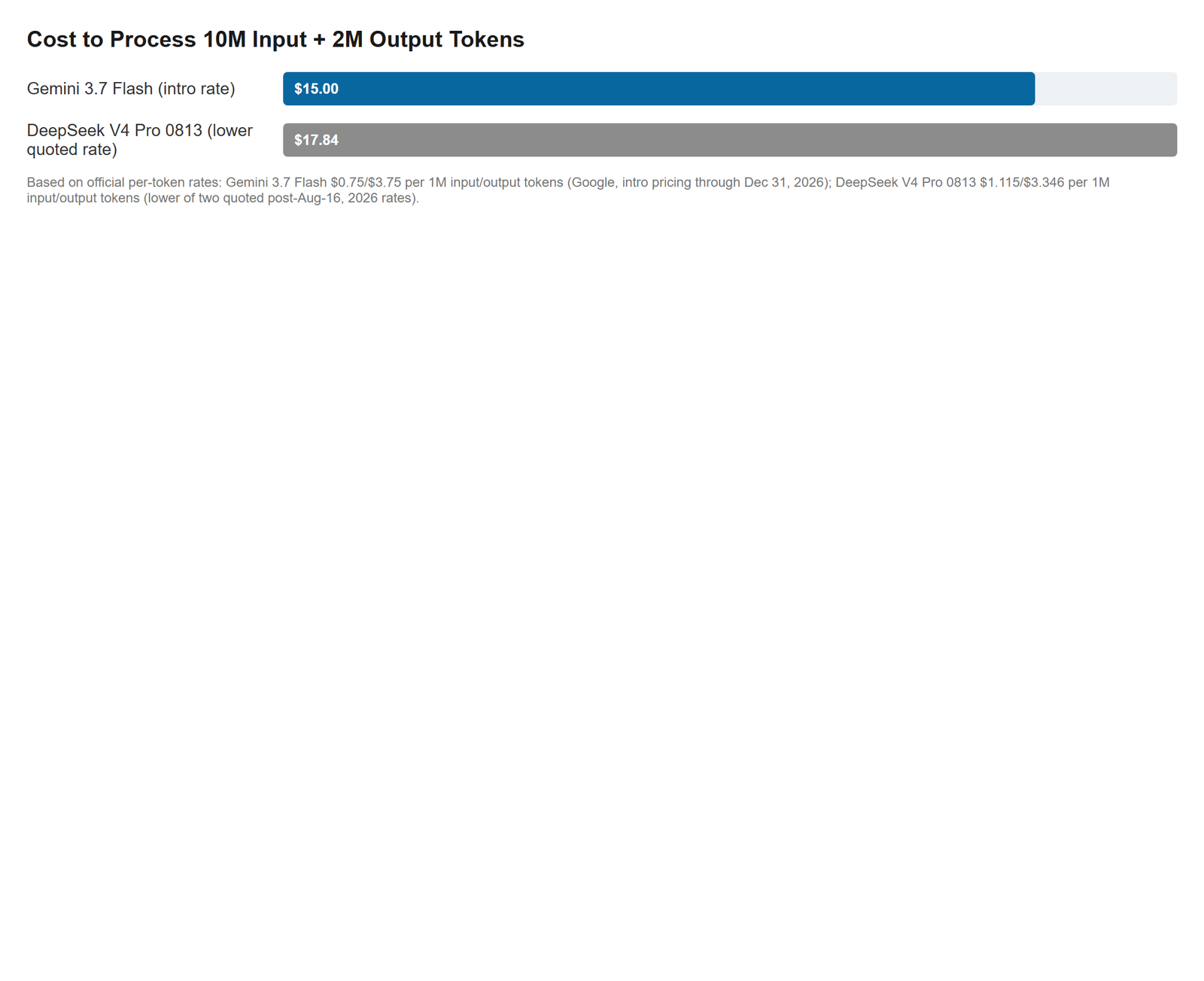
Put concrete numbers on it: processing 10 million input tokens and 2 million output tokens on Gemini 3.7 Flash at intro pricing costs $7.50 for input plus $7.50 for output, or $15.00 total. The same job on DeepSeek V4 Pro 0813, even at its lower quoted rate of $1.115/$3.346 per million, runs $11.15 for input plus $6.69 for output — $17.84 total, which is actually more expensive than Gemini’s flat rate on this mix, despite DeepSeek’s per-token sticker price looking cheaper on paper. The “2.8x cheaper” figure that comparison sites quote assumes a text-heavy, output-light workload; a more balanced input/output mix erases most of that gap.
Which Model Handles Multimodal Input Better?
Gemini 3.7 Flash accepts text, image, audio, video, and PDF input and returns text, while DeepSeek V4 Pro 0813 accepts text input only, with no native image, audio, or video support.
That single difference rules out DeepSeek immediately for a specific slice of use cases — anything involving screenshot analysis, voice input, or PDF parsing needs Gemini or a separate multimodal pipeline bolted onto DeepSeek’s text-only core. If your entire workload is text in, text out, this gap simply doesn’t matter to you.
Which Model Wins on Coding and Agent Benchmarks?
DeepSeek-V4-Pro-0813 outperforms Gemini 3.7 Flash on AutomationBench and Terminal-Bench 2.1, two benchmarks built around multi-step agentic and command-line tasks, while Gemini 3.7 Flash leads on Agents’ Last Exam.
I found that the practical gap between the two on everyday coding tasks is smaller than the benchmark spread suggests — both models handle typical refactoring and bug-fixing requests competently, and the AutomationBench/Terminal-Bench advantage matters most if your agent is chaining long, unsupervised command sequences rather than answering one coding question at a time.
DeepSeek V4 Pro 0813 can also generate responses up to 393,216 tokens, versus Gemini 3.7 Flash’s 65,536-token output cap, which matters for agents that need to produce very long structured output in a single pass rather than across multiple calls.
So Which One Should You Actually Use?
Choose Gemini 3.7 Flash if any part of your workflow touches images, audio, video, or PDFs, or if you’d rather budget a flat per-token rate than track a peak-hour pricing schedule.
- ✅ Building a multimodal app or an assistant that reads screenshots → Gemini 3.7 Flash.
- ✅ Running a self-hosted, text-only pipeline where you control the infrastructure → DeepSeek V4 Pro 0813.
- ✅ Long-running autonomous agents that chain terminal commands → DeepSeek V4 Pro 0813, timed to off-peak hours.
- ✅ Need a single response longer than 65K tokens in one call → DeepSeek V4 Pro 0813.
Most people skip reading the fine print on introductory pricing and regret it in January. Gemini’s $0.75/$3.75 rate is temporary and doubles on January 1, 2027 — if you’re building something that depends on that price holding, plan the switch-over now rather than after the bill arrives.
Before You Commit to Either API
- ✅ Run your own workload through both APIs on a small sample before migrating anything in production.
- ✅ If you’re on DeepSeek, log timestamps against Beijing peak hours to see your real blended rate, not the advertised off-peak number.
- ✅ Calendar Google’s January 1, 2027 price increase now if you’re relying on the introductory Gemini rate.
- ✅ Check whether your use case even needs multimodal input before paying a premium for it.
Is DeepSeek’s Self-Hosting Option Actually Cheaper Than the API?
Not automatically — DeepSeek V4 Pro 0813’s MIT license lets you download and run the model yourself, but that shifts the cost from per-token API fees to GPU infrastructure, which only comes out cheaper at meaningful, sustained request volume.
For occasional or bursty usage, paying DeepSeek’s hosted API rate (even at peak pricing) is almost always cheaper than provisioning and maintaining your own GPU cluster to run a 1M-context model. Self-hosting starts to make financial sense once your monthly token volume is high enough that GPU rental costs undercut the API bill, and that crossover point depends entirely on your own usage numbers, not a fixed rule of thumb.
FAQ
Is Gemini 3.7 Flash or DeepSeek V4 Pro cheaper?
DeepSeek V4 Pro 0813 is cheaper at off-peak hours, but its pricing now varies by time of day after an August 16, 2026 increase of up to 1,100% on some rates. Gemini 3.7 Flash charges one flat rate, which can end up cheaper during DeepSeek peak hours.
Can DeepSeek V4 Pro 0813 process images or audio?
No. DeepSeek V4 Pro 0813 accepts text input only. Gemini 3.7 Flash supports text, image, audio, video, and PDF input.
Does DeepSeek V4 Pro 0813 require using DeepSeek’s API?
No. DeepSeek V4 Pro 0813 ships with MIT-licensed weights, so it can be downloaded and self-hosted instead of called through DeepSeek’s paid API.
Sources
- Google Blog: Introducing Gemini 3.7 Flash
- Enterprise DNA: DeepSeek V4 Pro Launches GA, Then Hikes API Prices
- OpenRouter: DeepSeek V4 Pro 0813 Pricing & Benchmarks
Fact-checked based on public sources as of August 31, 2026. API pricing changes frequently for both providers — confirm current rates on each provider’s official pricing page before committing to production use.