Melatonin Making You Groggy the Next Day? Here’s What to Change (2026)
If melatonin knocks you out but leaves you dragging until noon, the dose is almost certainly the problem, not the ingredient.
That sounds backward. More of something that’s supposed to help you sleep should just mean better sleep, right? Not with melatonin. It works more like a timing signal to your brain than a sedative, and flooding that signal with 10 times the amount your body naturally produces doesn’t make you sleep deeper. It just keeps the signal running longer than it should.
Contents
- Why the grogginess happens
- The label problem nobody checks
- What to change tonight
- When it’s not the dose
- Quick questions

Waking Up at 3 AM Every Night: What’s Actually Going On (2026)
Why the grogginess happens
Your pineal gland releases roughly 0.1 to 0.3mg of melatonin on a normal night, according to the National Center for Complementary and Integrative Health. Most store-shelf gummies and tablets contain 5mg or 10mg — 15 to 30 times that amount.
When I checked dosage guidance across sleep researchers, the pattern was consistent: higher doses don’t shorten the time it takes to fall asleep by much, but they do extend how long melatonin stays active in your system. That’s the part that bleeds into your morning.
Timing compounds it. Take melatonin at 1 a.m. for a 6 a.m. wake-up and there’s a good chance active melatonin is still circulating when your alarm goes off — your brain is trying to wake up while a sleep signal is still running.
| Dose | Typical product | Next-day grogginess risk |
|---|---|---|
| 0.3-0.5mg | Rarely sold at this size in the US | Low — close to natural output |
| 1-3mg | Common “low dose” tablets | Moderate, timing-dependent |
| 5-10mg | Most gummies and drugstore bottles | Higher, especially on under-7-hour nights |
Short version: bigger dose does not equal better sleep. It usually just equals a longer hangover.
The label problem nobody checks
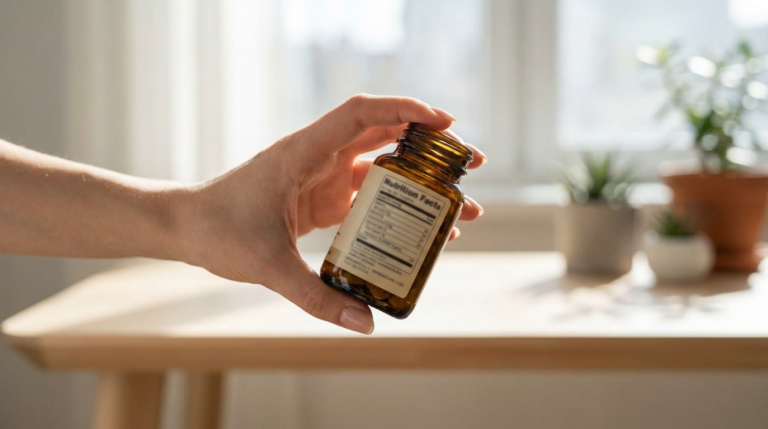
Here’s where it gets messier. A 2023 JAMA research letter tested 25 melatonin gummy products pulled from the NIH supplement label database and found 22 of them didn’t match their labels. Actual melatonin content ranged from 74% to 347% of what the label claimed. One product contained no melatonin at all, just CBD it never disclosed.
Reading that data next to the dosage question changes the advice a little. It’s not just “take less” — it’s “take less of a product whose actual dose you can’t fully trust.” Checking a product against how to read a supplement label properly before buying catches a chunk of this risk before it ever reaches your nightstand.
I found that gummy-specific complaints online follow a consistent pattern that isn’t ineffectiveness — it’s people who took what they thought was a modest 5mg and got hit with something closer to double that.

Tablets and capsules generally test closer to their labeled dose than gummies do — gummies have more manufacturing variability because the active ingredient has to be evenly suspended through a gel matrix. If accurate dosing matters to you, that’s worth knowing before you buy.
What to change tonight
Three adjustments, in order of how much they actually move the needle.
Cut the dose first. If you’re on 5-10mg, splitting a tablet down to 1-3mg is the single biggest lever. Sleep Foundation’s dosage guidance notes that lower doses in the 0.5-3mg range perform comparably to higher doses for most adults, with less carryover the next morning.
Move the timing earlier. Take it 60-90 minutes before bed rather than right as you’re turning off the light. That gives it time to do its job and clear more before your wake-up window.
Give yourself a full sleep window. Melatonin needs roughly 7-9 hours to fully process. Taking it and then only sleeping 5 hours is close to a guaranteed groggy morning regardless of dose.
Most people skip step three and wonder why step one and two didn’t fully fix it.
When it’s not the dose
If you’ve already cut the dose, shifted the timing, and gotten a full night, and you’re still groggy — that’s a different problem. Extended-release formulas are built to keep releasing melatonin through the night, which is useful for staying asleep but works against you if your wake-up time is fixed and early. Switching to immediate-release can help there.
Persistent morning grogginess that doesn’t respond to any of this is also worth mentioning to a doctor. It can point to something unrelated to melatonin entirely — when I cross-checked symptom overlap in clinical guidance, sleep apnea and iron deficiency both produce similar next-day fog, and neither improves by adjusting a supplement dose.
Quick questions
Is it safe to cut a melatonin tablet in half?
For standard (not extended-release) tablets, yes — this is a common way to get to a lower dose when smaller pills aren’t sold locally. Extended-release formulas shouldn’t be split, since that changes how they release.
Does taking melatonin every night make grogginess worse over time?
Current research on long-term daily use is limited, which is exactly why NCCIH flags long-term safety as unestablished. Short intermittent use has the best safety data.
Will a higher dose help me fall asleep faster?
Not by much, based on the dosage research above — most of the “falls asleep faster” effect plateaus at low doses, and everything past that mostly adds morning carryover.
This article is general information based on public research, not medical advice — talk to a doctor or pharmacist before starting, stopping, or changing any supplement, especially if you take other medications.
Sources
- NCCIH (NIH) — Melatonin: What You Need To Know
- JAMA — Quantity of Melatonin and CBD in Melatonin Gummies Sold in the US (2023)
- Sleep Foundation — Melatonin Dosage Guidance
Fact-checked based on public sources as of July 30, 2026. Not medical advice.