Fat Cat Card: What Declined USDT Card Payments Cost
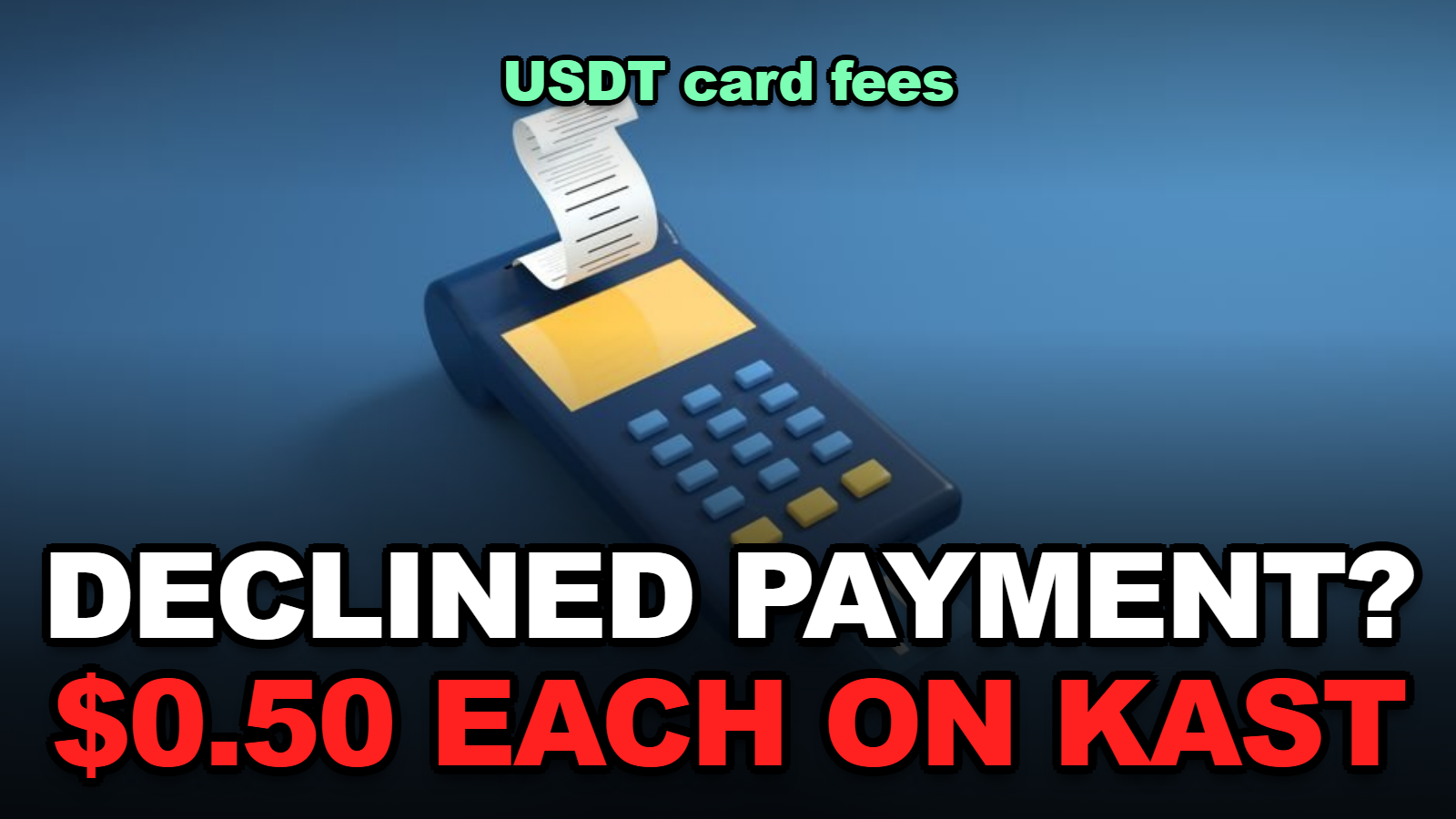
Short answer: A declined payment is not always free on a USDT card. KAST charges $0.50 when a payment fails for insufficient balance. RedotPay gives 3 free declines per card each month, then charges $0.50 each. Tiny charges cost money too. In the example month below, the fixed fees come to $4.00 on KAST and $1.10 on RedotPay, before any percentage fee.
Fifty cents doesn’t sound like much. It adds up when the same card fails four times at a ticket machine.
Most card comparisons look at cashback, top-up costs and FX. Fixed per-transaction fees sit lower on the fee page, and they hit hardest on people who use the card for lots of small things. So this is a straight calculation using each issuer’s published fee page, checked on October 27, 2026. Fees change, and the exact fee can depend on your country and card program, so check the live page before you rely on any number. This is information, not financial advice.
Compare card fees on Fat Cat Card
Contents
- Which USDT cards charge for a declined payment?
- What does a month of small payments cost?
- Why do cards decline when the balance looks fine?
- What does a declined ATM attempt cost?
- How do you stop paying for failures?
Which USDT cards charge for a declined payment?
KAST charges a $0.50 Declined Transaction Fee when a card payment fails for insufficient balance, according to KAST’s fee and conditions page updated October 22, 2026.
RedotPay works on an allowance. Its card fee table waives the first 3 declined transactions per card each month, then charges 0.5 USD for each one after that. The table names insufficient balance, frozen cards, lost cards and incorrect card information as reasons, and says the list isn’t complete.
Small charges are the second fixed fee to watch.
| Fee | KAST (Standard) | RedotPay |
|---|---|---|
| Declined payment | $0.50 (insufficient balance) | First 3 per card per month free, then $0.50 each |
| Tiny payments | No fee listed for USD payments | Payments of $1.00 or less: first 5 per card per month free, then $0.20 each |
| Small foreign payments | $0.10 per non-USD payment under $25 | No fixed fee listed; 1.20% on non-default currency payments |
| Source checked | KAST fee page, updated Oct 22, 2026 | RedotPay Help Center fee table |
When I compared the two tables, I noticed that the cheaper card depends on how many times things go wrong. One decline a month costs $0.50 on KAST and nothing on RedotPay. KAST’s $0.10 charge only applies to non-USD payments under $25, so a card used mostly in US dollars won’t see it.
What does a month of small payments cost?
In the example month below, a USDT card user would pay $4.00 in fixed fees on a KAST Standard card and $1.10 on RedotPay, using each issuer’s published per-transaction fees as of October 2026.
The month is made up. The fees aren’t. Picture a traveller on one card who has 4 payments declined for low balance, 20 non-USD purchases under $25 (coffee, transit, snacks), and 8 authorizations of $1 or less, like a subscription checking that the card works. Assume the $1 checks are in USD.
| Fee line (example month, one card) | KAST Standard | RedotPay |
|---|---|---|
| 4 declines for low balance | 4 × $0.50 = $2.00 | 3 free, 1 × $0.50 = $0.50 |
| 20 non-USD purchases under $25 | 20 × $0.10 = $2.00 | $0 fixed (1.20% FX applies instead) |
| 8 USD authorizations of $1 or less | $0 | 5 free, 3 × $0.20 = $0.60 |
| Fixed fees for the month | $4.00 | $1.10 |
That isn’t the full bill. Both cards also charge percentage fees on foreign spending, which this table leaves out on purpose so the fixed part is easy to see. KAST lists an FX fee of 0.5% to 1.75% on non-USD payments, and RedotPay lists 1.20% on non-default currency payments.
Here’s where people get tripped up. RedotPay’s free allowances are per card. Someone who keeps two RedotPay cards gets two sets of free declines and small payments. Someone who keeps one gets one.
Why do cards decline when the balance looks fine?
A USDT card can decline a purchase even when the balance covers the price, because some issuers hold a little extra for currency changes and some block whole merchant categories.
Bybit’s fees and spending limits page says FX padding may be applied when it freezes funds for authorization, to allow for exchange-rate changes before the merchant completes the transaction. It says any excess is refunded to your Funding Account’s available balance afterwards. So a card topped up to the exact price of a foreign purchase can come up short at the moment it matters.
Merchant type is the other one. Jupiter’s fees and limits page says transactions from certain merchant categories may be declined automatically for compliance and risk reasons, and lists money transfers, remittance services, quasi-cash and stored value loads among them.
Honestly, that second list explains a lot of “why won’t it load my transit wallet” posts. A stored value load is a top-up of another balance, and some card programs simply won’t do it.
Hotels and car rentals are their own problem, with large holds. Our guide Why Prepaid Crypto Cards Fail at Hotel Check-In and Car covers those.
What does a declined ATM attempt cost?
A declined ATM withdrawal costs $0.60 on Jupiter’s Rain-issued card and up to $2 on Tria, according to Jupiter’s fees and limits page and Tria’s international card terms checked on October 27, 2026.
| Card | Declined ATM attempt | Balance inquiry | Two failed tries, then a check |
|---|---|---|---|
| Jupiter (Rain card) | $0.60 | $0.60 | $1.80 |
| Tria | Up to $2 | Up to $2 | Up to $6 |
Jupiter also says its DCS-issued cards can’t withdraw cash at ATMs for now, so that attempt fails before any fee applies. Tria’s card terms list each ATM fee as a maximum (“up to”), so the real charge can be lower.
When I checked the Tria terms closely, I found that the decline fee and the balance inquiry fee sit on separate lines. Checking your balance at the machine after a failed try is a second charge, not part of the first. Check the balance in the app instead. If you’re planning a cash withdrawal anyway, our breakdown Fat Cat Card: What a $200 ATM Withdrawal Really Costs runs the numbers for $200 and $1,000.
How do you stop paying for failures?
The cheapest decline is the one that never happens. Most of the fixes are about timing, not about which card you hold.
- Top up a little above what you plan to spend, so a currency buffer doesn’t push a payment over your balance.
- Check the balance in the app, not at an ATM.
- Stop after one failed try. A second tap at the same terminal is a second decline.
- Don’t use the card to load other wallets or transit balances unless the issuer says it works.
- Group small foreign purchases where you can, on cards that charge a fixed fee under a set amount.
Topping up more often to avoid declines has its own fixed cost on some cards. Our worked example Fat Cat Card: Small USDT Top-Ups and Fixed Fee Drag shows where that line sits.
Compare card fees on Fat Cat Card
Tips
- Keep a small spare balance on the card for currency buffers on foreign purchases.
- If you rely on RedotPay’s free allowances, count them per card, not per account.
- Read the fee page line by line before a trip; fixed fees are often below the cashback table.
Warnings
- Fees vary by country and card program, and issuers change them; the figures here were checked on October 27, 2026.
- The ATM owner may add its own fee on top of the card issuer’s, as Jupiter’s fee page notes.
- This is information, not financial or investment advice. Crypto balances can lose value.
FAQ
Does a KAST card charge a fee when a payment is declined?
Yes, when the reason is insufficient balance. KAST’s fee page, updated October 22, 2026, lists a Declined Transaction Fee (Insufficient Balance) of $0.50.
How many free declined transactions does RedotPay allow?
RedotPay’s fee table waives the first 3 declined transactions per card each month and charges 0.5 USD for each one after that. The table lists insufficient balance, frozen cards, lost cards and incorrect card information as reasons.
Why was my crypto card declined even though I had enough balance?
Two common reasons are a currency buffer and a blocked merchant type. Bybit says it may apply FX padding when it freezes funds for authorization, so a purchase can need more than its price. Jupiter says some merchant categories, such as money transfers and stored value loads, may be declined automatically.
Sources
- KAST, What Are the Fees and Conditions for KAST Cards and Accounts? (updated Oct 22, 2026)
- RedotPay Help Center, card limitations and fees
- Jupiter docs, Spend fees and limits
- Tria, International Card Terms
- Bybit Help Center, Fees and Spending Limits of Bybit Card
Fact-checked against each issuer’s published fee pages as of October 27, 2026. Not financial advice.
🔗 Related guides