
Fat Cat Card: What a $200 ATM Withdrawal Really Costs
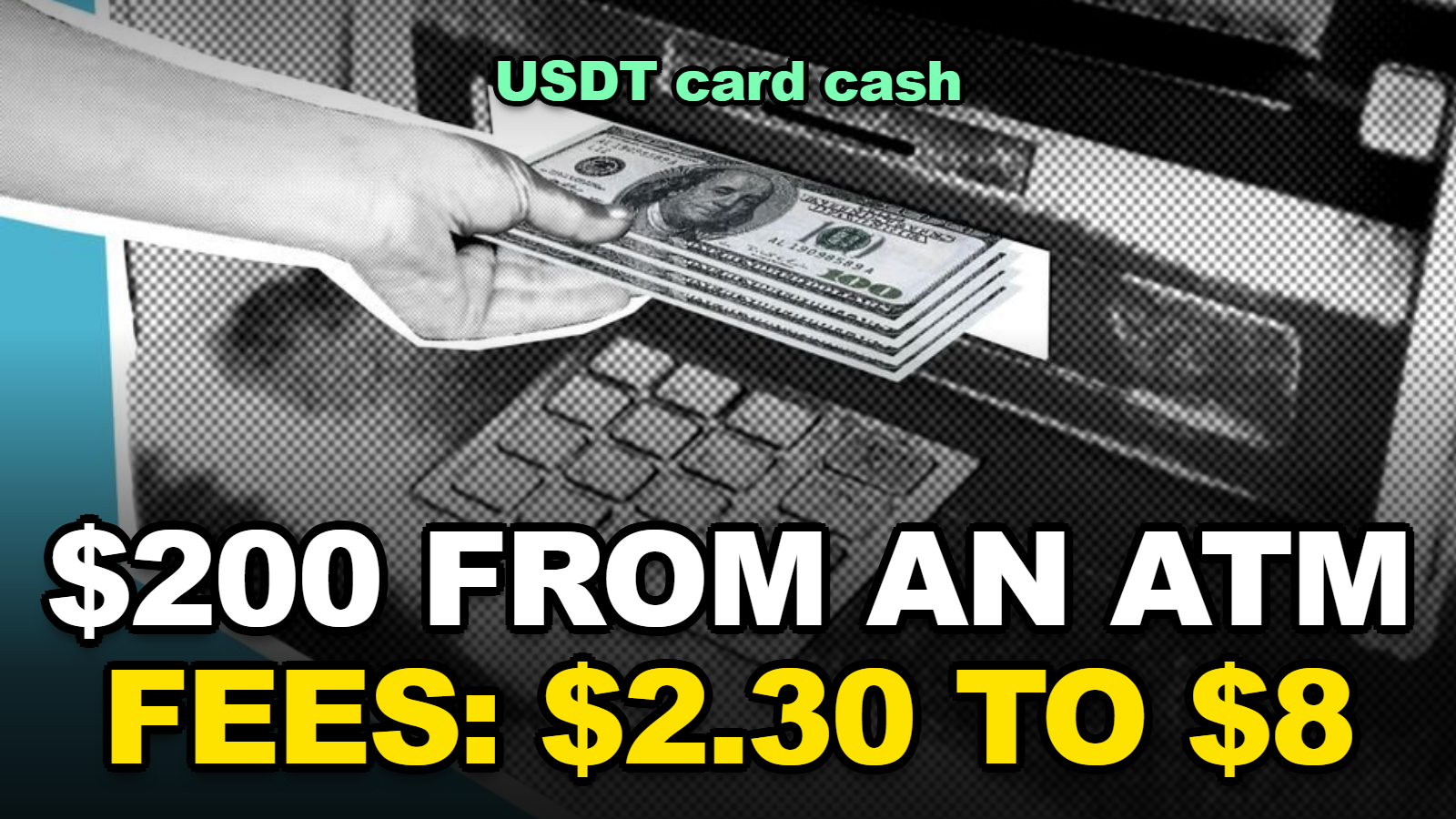
Short answer: Taking $200 in cash from an ATM with a USDT card costs anywhere from $2 to about $8 in card fees, based on the fee pages of six issuers. At $1,000 the range is $7.50 to $32. The cheapest option changes with the amount. Fixed per-withdrawal fees hurt small withdrawals. Percentage fees hurt big ones. The ATM owner can add its own fee on top.
Most USDT card comparisons stop at cashback and the top-up fee. Cash is where the numbers spread out the most.
So this is a straight calculation: two common amounts, six cards, and only the fees each issuer publishes. Every figure comes from the card issuer’s own fee page or the card pages on Fat Cat Card, which list the official source and the date each fee was checked. This is information, not financial advice. Fees vary by country and can change.
Compare card fees on Fat Cat Card
Contents
- How much does a $200 ATM withdrawal cost on each card?
- Why does the cheapest card change with the amount?
- Does crypto conversion add to the ATM fee?
- Which cards can’t withdraw cash at all?
- Limits That Shape the Math
How much does a $200 ATM withdrawal cost on each card?
A $200 USD ATM withdrawal costs $2.30 on Jupiter’s Rain-issued physical card, $2.00 on Bybit Card (after its first $100 free each month), $4.00 on RedotPay and Gate, $7.00 on KAST and up to $8.00 on Tria, using each issuer’s published ATM fee as of October 2026.
The table assumes one withdrawal in US dollars, the first cash of the month, and the issuer’s standard fee. It leaves out the ATM owner’s own surcharge, which no card controls.
| Card (published ATM fee) | $200 cash: fee (share) | $1,000 cash: fee (share) | How it’s worked out |
|---|---|---|---|
| Jupiter, Rain physical ($1 + 0.65%) | $2.30 (1.15%) | $7.50 (0.75%) | $1 + 0.65% of the amount, one withdrawal |
| Bybit Card (first $100/month free, then 2%) | $2.00 (1.00%) | $18.00 (1.80%) | 2% of the amount above $100 |
| RedotPay, USD physical card (2%) | $4.00 (2.00%) | $20.00 (2.00%) | 2% up to $10,000 a month |
| Gate Card, physical (2%) | $4.00 (2.00%) | $20.00 (2.00%) | 2% of the amount |
| KAST ($3 + 2%, max $250 per withdrawal) | $7.00 (3.50%) | $32.00 (3.20%) | $1,000 needs 4 withdrawals: 4 × $3 + 2% |
| Tria (up to $2 + 3%) | $8.00 (4.00%) | $32.00 (3.20%) | Upper limit of the published fee |
When I checked each issuer’s page against the card data on Fat Cat Card, I found that the Jupiter, RedotPay, Bybit and Tria fees matched the official pages word for word. The KAST and Gate figures come from Fat Cat Card’s card pages, which cite those issuers’ help centres. Those help centres blocked automated requests when I tried them.
Look at the $1,000 column. Jupiter comes out at under a quarter of KAST’s cost for the same cash.
Why does the cheapest card change with the amount?
The cheapest USDT card for ATM cash depends on the amount because some fees are a fixed charge per withdrawal plus a percentage (Jupiter’s Rain card, KAST, Tria), while others are a flat percentage, sometimes after a free monthly allowance (Bybit, RedotPay, Gate).
The break-even points are simple algebra. Here’s where they land.
| Comparison | Equation | Break-even (USD per month) | What it means |
|---|---|---|---|
| Jupiter Rain vs a flat 2% card | 1 + 0.0065x = 0.02x | about $74 | Above $74, Jupiter’s Rain card is cheaper than RedotPay or Gate |
| Jupiter Rain vs Bybit (ATM fee only) | 1 + 0.0065x = 0.02(x − 100) | about $222 | Up to about $222 a month, Bybit costs less |
| Jupiter Rain vs Bybit incl. 0.9% conversion | 1 + 0.0065x = 0.02(x − 100) + 0.009x | about $133 | If Bybit converts crypto for the cash, Jupiter wins sooner |
| KAST vs a flat 2% card | 3 + 0.02x = 0.02x | never | KAST costs $3 more on every withdrawal |
Honestly, that last row surprised me. KAST’s percentage is the same as Gate’s and RedotPay’s, so its $3 fixed charge simply sits on top every time.
Bybit is the odd one. The first $100 each month is free, so for one small withdrawal a month it’s hard to beat. Bybit says the free allowance varies by region, so check yours.
Does crypto conversion add to the ATM fee?
Crypto conversion can add to the cost of ATM cash: Bybit’s fee page says its 0.9% crypto conversion fee applies to all transactions funded with non-fiat assets, and RedotPay’s ATM help page lists a 1% crypto conversion fee among the fees that may apply.
That changes the table. If your Bybit card is funded from USDT rather than a fiat balance, $200 in cash costs $2.00 plus $1.80 conversion, so $3.80. At $1,000 it’s $18.00 plus $9.00, so $27.00.
| Card | $200: ATM fee + conversion | $1,000: ATM fee + conversion | Conversion rate used |
|---|---|---|---|
| Bybit Card | $2.00 + $1.80 = $3.80 | $18.00 + $9.00 = $27.00 | 0.9% (Bybit fee page) |
| RedotPay | $4.00 + $2.00 = $6.00 | $20.00 + $10.00 = $30.00 | 1% (RedotPay ATM page) |
Here’s where people get tripped up: the conversion line sits in a different part of the fee page from the ATM fee. When I compared the two RedotPay figures, I noticed that the help page lists them in the same fee table. It’s easy to read only the ATM row.
Withdrawing in a currency other than the card’s own currency adds more again. Jupiter’s page, for example, adds $0.30 plus 1% for a non-USD withdrawal on the Rain card. That turns $200 from $2.30 into $4.60.
Which cards can’t withdraw cash at all?
Virtual USDT cards generally can’t take cash out: RedotPay says ATM withdrawals need its physical card, Gate’s ATM access is physical-card only per Fat Cat Card’s Gate page, and Jupiter says its DCS-issued cards cannot withdraw cash at ATMs for now.
That matters for the cost too. A physical card can carry its own issuance fee, which our guide to Physical Crypto Card Fees 2026: When $100 (or $460) Actually works through. If you only need cash once or twice a year, that fee can outweigh any difference in the table above.
Before a trip, open the card app and confirm which card type you actually hold. Plenty of people find out at the ATM.
Limits That Shape the Math
Withdrawal limits can force you into more transactions, and each one can carry a fixed fee.
- KAST: up to $250 per withdrawal, and 3 withdrawals or $750 per 24 hours, per Fat Cat Card’s KAST page. So $1,000 takes two days and four fixed fees.
- RedotPay: the 2% rate applies up to $10,000 a month, and 3% above that, per its ATM help page.
- Gate: 2% with high caps, physical card only, per Fat Cat Card’s Gate page.
- Jupiter (Rain): a balance inquiry or declined withdrawal costs $0.60 each, per Jupiter’s fees and limits page.
- Tria: balance inquiries and declined withdrawals are up to $2 each, per its international card terms.
A declined withdrawal costing money is the one that stings. Check your balance in the app, not at the ATM.
Spending the cash in small top-ups first? The same fixed-fee logic is in Fat Cat Card: Small USDT Top-Ups and Fixed Fee Drag. Planning a hotel stay with the card? Read Why Prepaid Crypto Cards Fail at Hotel Check-In and Car first.
Compare card fees on Fat Cat Card
Tips
- Take one larger withdrawal instead of several small ones on cards with a fixed fee per withdrawal.
- Decline the ATM’s offer to convert to your home currency and let the card handle it; the ATM’s rate is set by the ATM operator.
- Use Bybit’s free monthly allowance for small amounts if your region has one.
Warnings
- Fees here are the issuers’ published rates as of October 2026 and vary by country, card type and account tier.
- The ATM owner’s own surcharge is not included in any figure above.
- This is information, not financial advice; check the card’s current fee page before relying on a number.
FAQ
Can I withdraw cash from an ATM with a virtual USDT card?
Usually not. RedotPay, Gate and Jupiter all limit ATM cash to physical cards, and Jupiter says its DCS-issued cards cannot withdraw cash at ATMs for now. Check the card’s own fee page before you travel.
Does the ATM owner charge a fee on top of the card fee?
It can. Jupiter’s fee page says the ATM owner may add its own fee, and Bybit warns that some ATM acquirers charge an access fee or offer currency conversion. Those charges are separate from the card issuer’s ATM fee.
Is it cheaper to take out cash in one go or in small amounts?
On cards with a fixed fee per withdrawal, one larger withdrawal is cheaper. KAST charges $3 plus 2% per withdrawal and Jupiter’s Rain card charges $1 plus 0.65%, so splitting the same cash into more withdrawals adds the fixed part each time.
Sources
- Bybit, Fees and Spending Limits: Bybit Card
- RedotPay Help Center, Can I withdraw cash from an ATM, and are there any fees?
- Jupiter docs, Fees and limits
- Fat Cat Card, USDT card fees explained
Calculations by the editor from published fee pages checked October 26, 2026. Not financial advice.
🔗 Related guides