FuturesAI Tokenized Stocks: What a 5% Premium Costs
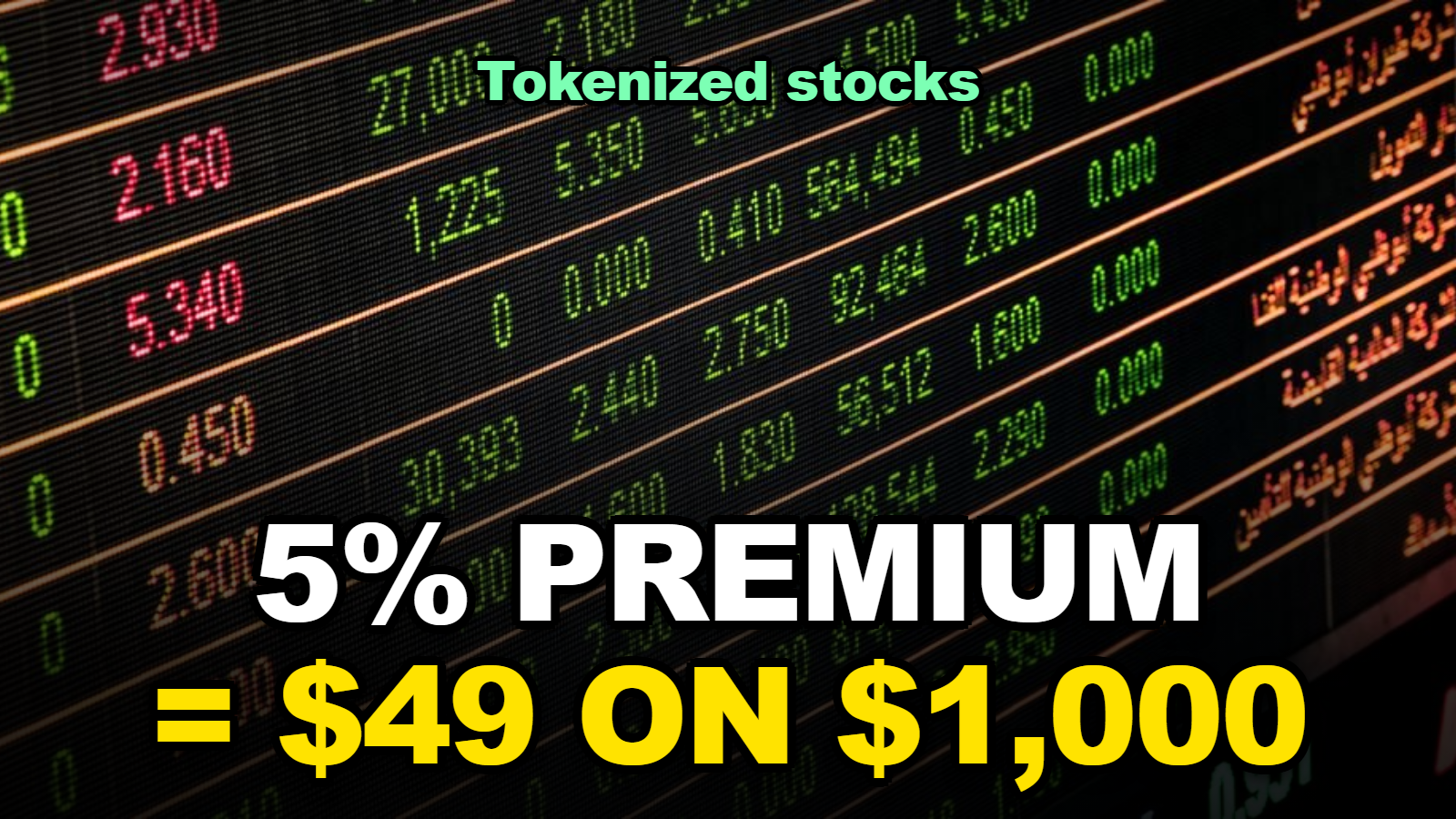
Short answer: On a tokenized stock, the premium over the regular-market price can matter far more than the trading fee. A $1,000 position bought at a 5.19% premium gives up about $49.34 if that premium closes while the stock doesn’t move. The fee round trip on the same position is about $0.30 at Bitget’s effective rate on FuturesAI’s table. Check the premium first. The fee comes second.
Payback cuts trading fees. It does nothing about the price you pay to get in.
On tokenized stock perpetuals that trade nights and weekends, that entry price can sit several percent away from the real stock. This post works out what that gap costs in dollars, using the live snapshot on FuturesAI’s tokenized stock page at 09:18 KST on October 27, 2026, and the fee rates on the FuturesAI payback table. Premiums change by the minute, so treat these as one snapshot, not a forecast.
Not investment advice. Leveraged perpetual futures can lose your entire margin, and tokenized stock perps are not the same as owning shares.
See the FuturesAI payback table
What This Works Out
- What is a tokenized stock premium?
- How much can a premium cost on $1,000?
- How does that compare with the fee saving?
- What does leverage do to a premium?
- When is a premium not a loss?
- A Premium Check Before Each Entry
What is a tokenized stock premium?
A tokenized stock premium is how far the token trades above (+) or below (−) its regular-market reference price, and FuturesAI’s tokenized stock page tracks it live for the stock perpetuals listed on Bitget.
At 09:18 KST on October 27, 2026, the page listed 263 perpetuals with an average absolute premium of 1.78% against the regular reference. The largest premiums were SK Hynix PERP at +7.57% and Samsung Elec PERP at +5.19%. The deepest discount was SOXS (Semi Bear 3x ETF PERP) at −3.30%.
One line on the page matters more than the numbers. It says the premium is an estimate against the regular-market reference, which does not update while markets are closed.
So a premium is partly a bet on where the real stock will open. That’s the whole idea of trading after hours. It’s also where the cost hides.
How much can a premium cost on $1,000?
A $1,000 tokenized stock position bought at a +5.19% premium loses about $49.34 if the premium closes to zero while the reference price stays where it was, because the token has to fall about 4.93% to meet the reference.
The math is simple. If the token is 5.19% above the reference, the reference is 1 ÷ 1.0519 of the token price. Closing the gap means losing 1 − (1 ÷ 1.0519) of the position, which is 4.93%.
| Premium (FuturesAI snapshot, Oct 27, 09:18 KST) | Premium | Loss on $1,000 if the gap closes and the stock is flat | Times the $0.30 fee round trip |
|---|---|---|---|
| Average absolute premium, all listed tokens | +1.78% | $17.49 | about 58 times |
| Samsung Elec PERP | +5.19% | $49.34 | about 164 times |
| SK Hynix PERP | +7.57% | $70.37 | about 235 times |
When I checked the arithmetic against the snapshot, I found that even the average premium (1.78%) is worth about 58 times the round-trip fee on the cheapest exchange in the table. The largest one is worth more than 200 times.
The “flat stock” case is a test, not a prediction. The stock can open higher and erase the premium for free. It can also open lower and add to the loss.
How does that compare with the fee saving?
On the FuturesAI payback table checked on October 27, 2026, Bitget’s market-order fee is 0.06% listed and 0.015% effective after its 50% fee discount and 50% payback, so a $1,000 round trip costs about $1.20 listed and about $0.30 effective.
| Exchange (FuturesAI payback table) | Listed taker fee | Effective taker fee | $1,000 round trip, listed | $1,000 round trip, effective | Saving |
|---|---|---|---|---|---|
| Bitget (50% payback) | 0.06% | 0.015% | $1.20 | $0.30 | $0.90 |
| Gate (70% payback) | 0.05% | 0.015% | $1.00 | $0.30 | $0.70 |
| OKX (20% payback) | 0.05% | 0.04% | $1.00 | $0.80 | $0.20 |
| Bybit (20% payback) | 0.055% | 0.044% | $1.10 | $0.88 | $0.22 |
The saving is real. Over many trades it adds up, which is what our breakdown FuturesAI Fee Payback: What It Is Worth in Dollars works through. On a single entry, though, a 0.5% premium (about $4.98 on $1,000) is already worth more than five round trips of Bitget’s saving.
Honestly, this is the part most people get backwards. They shop hard for the fee and accept whatever entry price the screen shows.
The table shows Bitget because the tokenized stocks on FuturesAI’s page are Bitget listings. The other rows are there to compare fee levels, not to say the same tokens trade elsewhere.

What does leverage do to a premium?
Leverage turns a premium into a share of your margin: at 10x, a $1,000 tokenized stock position uses $100 of margin, so a 5.19% premium closing on a flat stock (about $49.34) would take roughly half of it.
| Leverage | Margin for $1,000 position | Loss if a 5.19% premium closes (flat stock) | Share of margin |
|---|---|---|---|
| 2x | $500 | $49.34 | 9.9% |
| 5x | $200 | $49.34 | 24.7% |
| 10x | $100 | $49.34 | 49.3% |
| 20x | $50 | $49.34 | 98.7% |
At 20x the premium alone is close to the full margin, before fees, funding or any real price move. A position that size would probably be liquidated before the loss reached the full amount.
The fee side of the same picture is in FuturesAI Payback at 10x Leverage: Fees vs Margin. This table is the other half of it.
When is a premium not a loss?
A tokenized stock premium is not a loss when the real stock opens at or above the token’s price, because the gap then closes from the reference side instead of from the token side.
That happens. After-hours prices often lead the next open. A token trading 5% above Friday’s close may simply be pricing news that arrived over the weekend.
Here’s the catch. You can’t tell in advance which kind of premium you’re looking at. The premium shown is measured against a reference that hasn’t moved since the last close, so it mixes “the market already knows something” with “this token is just stretched.” Our explainer Why Your Stock Perp Moves When the Stock Market Is Closed covers why the token keeps moving while the stock is shut.
When I compared the gainers list on the same snapshot, I noticed that many of the biggest movers also carried premiums of 2% to 7%. A large daily gain and a large premium often arrive together, which is exactly when the entry price deserves a second look.
A Premium Check Before Each Entry
- Look up the token’s premium against the regular reference before you place the order.
- Multiply your position size by the premium. That’s roughly what a flat open could cost you.
- Divide by your margin to see what share of it the premium uses at your leverage.
- Compare that number with your fee round trip. If the premium is many times larger, the fee isn’t the decision.
- Decide whether you’re trading the news or just the gap. If you can’t say, wait for the regular session.
See the FuturesAI payback table
Tips
- Write down the premium at entry; it explains a lot of Monday-morning moves in your P&L.
- Use limit orders where you can; FuturesAI’s table lists lower effective maker fees than taker fees on every exchange shown.
- Check the premium again right before the regular market opens, not only when you enter.
Warnings
- This is not investment advice. Leveraged perpetual futures can lose your entire margin.
- Premiums on FuturesAI’s page are estimates against a reference that does not update while markets are closed.
- A tokenized stock perpetual is a derivative contract, not a share; you do not get shareholder rights.
FAQ
What is the premium on a tokenized stock?
It is how far the token trades above or below its regular-market reference price. FuturesAI’s tokenized stock page shows it live and notes that the premium is an estimate, because the regular-market reference does not update while that market is closed.
Does a tokenized stock premium always turn into a loss?
No. If the real stock opens at the level the token was already trading at, the premium disappears without a loss. The loss only happens when the stock opens below the token’s price, and the token falls back toward it.
Do fee discounts and payback cover the premium?
Not usually. On the FuturesAI payback table, Bitget’s effective taker fee is 0.015 percent after discount and payback, so a $1,000 round trip costs about $0.30 in fees. A 1.78 percent premium on the same position is worth about $17.49.
Sources
- FuturesAI, 24/7 Tokenized Stock Center (premium and discount, snapshot 09:18 KST Oct 27, 2026)
- FuturesAI, Fee payback partner exchanges (listed and effective fees)
Figures checked on futuresai.io on October 27, 2026. Premiums and fees change constantly. Not investment advice.
🔗 Related guides