Why Your Stock Perp Moves When the Stock Market Is Closed
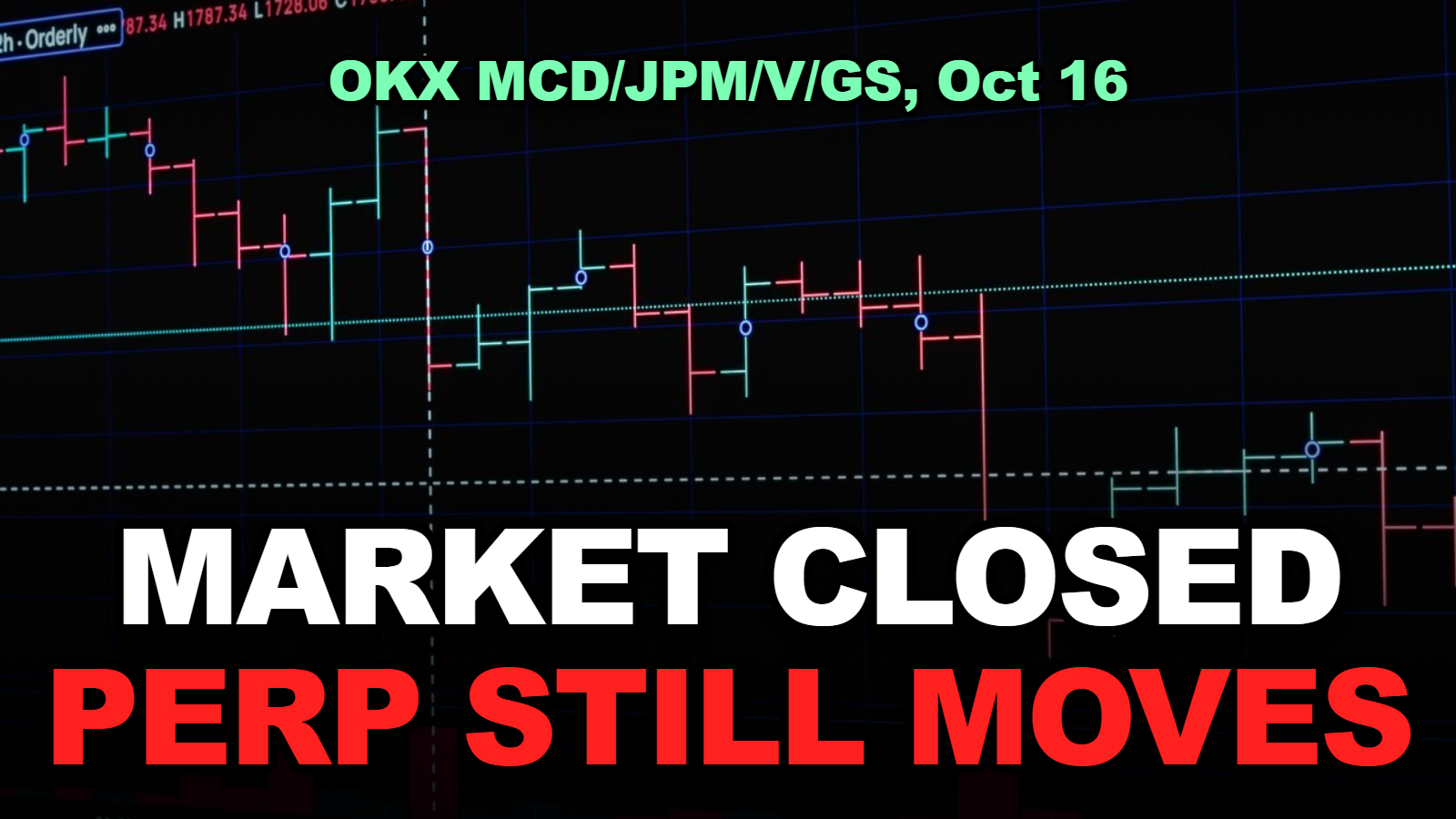
Short answer: A stock perpetual keeps trading after the stock it tracks has stopped, so the exchange has to invent a reference price for the hours in between. OKX’s stock perpetuals page, updated August 31, 2026, says the index “relies more on OKX’s own contract price and stock perps index price on other exchanges” during off-hours, held within a 10% band of the last real stock print. Bybit drops stale feeds from its index and clamps the mark price to within 5% of the index for single stocks. Bitget uses an EMA-based mark price outside market hours. In every case the number that can liquidate you moves on Saturday, and it can be several percent away from where the share actually opens on Monday. OKX’s new McDonald’s, JPMorgan, Visa and Goldman Sachs perpetuals, listed October 16, 2026, are having their first weekend right now.
The complaint is always phrased the same way: “the stock hasn’t traded since Friday, so why did my perp move 3% and why is my liquidation price closer?”
Because the perp was never priced off the stock alone. It is priced off an index, and the index has a weekend mode.
Not investment advice. Stock perpetuals are leveraged derivatives; you can lose your entire margin. Rules quoted are from OKX, Bybit and Bitget help pages as read on October 17, 2026 and can change without notice. Availability depends on your jurisdiction.
In This Troubleshooter
- Why is my stock perp price moving when the stock market is closed?
- How far can the perp drift from Friday’s close?
- Can I be liquidated on a Saturday?
- Three Venues, Three Weekend Rulebooks
- What happens at Monday’s open?
- Does funding still accrue over the weekend?
- Is a frozen 24/5 contract safer than a live 24/7 one?
- Before You Hold a Stock Perp Over a Weekend
- Tips
- Warnings
- FAQ
- Sources
Why is my stock perp price moving when the stock market is closed?
A stock perpetual on OKX, Bybit or Bitget moves while the underlying market is shut because its index price switches sources: OKX’s help page states that “during off-hours, weekends and market holidays” the index “relies more on OKX’s own contract price and stock perps index price on other exchanges,” naming Gate, Bitget, Hyperliquid and Binance, rather than the stock feed it leans on during regular hours (OKX, Stock perpetuals).
During regular hours the same page says the index “draws from all sources, with stock price feeds carrying significant weight,” those feeds coming from vendors such as Pyth and Ondo API. When the feed stops, the weight has to go somewhere, and it goes to the perp markets themselves.
So on a Saturday the “price of McDonald’s” on a perp is really the price that leveraged crypto traders on four or five venues are willing to pay for exposure to McDonald’s, bounded by a rule. That is a real price. It is just not the share price.
This matters more this weekend than most. OKX listed USDT-margined perpetuals on MCD, JPM, V and GS between 09:00 and 09:45 UTC on Friday, October 16, 2026 (OKX listing notice, October 16, 2026). None of those four contracts has a weekend of its own price history yet, and Bitget’s Toyota, Sony and MUFG perpetuals from October 13 are only on their first full weekend too; we covered what those Japanese stock perps cost against owning the shares on Thursday.
How far can the perp drift from Friday’s close?
On OKX the off-hours index price is “limited within a 10% range of the stock price,” with the last available stock price frozen as the anchor for that band, and the page adds that “the 10% index bands may be adjusted in real time according to market conditions” (OKX stock perpetuals help, updated August 31, 2026).
Ten percent is the ceiling, not the expectation. A liquid name on a quiet weekend will usually sit within a percent or so of Friday’s close. But the band tells you what the exchange is prepared to let happen, and 10% at 10x leverage is the whole account.
Bybit sets its limit one layer down, on the mark price rather than the index. Its TradFi perpetual page says the mark price is clamped to within ±5% of the index for single-stock contracts and ±3% for ETFs and commodities, and gives a worked example: index 5,150, calculated mark 4,890, allowed range 4,892.5 to 5,407.5, final mark 4,892.5 (Bybit, Introduction to TradFi Perpetual Contracts).
When I compared the three help pages side by side, I noticed that only OKX publishes a number for how far the index may wander from the stock. Bybit publishes how far the mark may wander from the index, and says stale feeds “may” be excluded. Bitget publishes the method name, “EMA-based mark price,” and no band at all (Bitget Academy, stock perpetual futures, May 18, 2026).
Can I be liquidated on a Saturday?
Yes. On OKX, Bybit and Bitget a stock perpetual is liquidated on its mark price, and all three venues keep publishing a mark price through weekends and holidays, so a position can be closed by the liquidation engine at 3 a.m. on a Sunday even though the underlying share has not traded since Friday afternoon.
OKX’s mark price formula for these contracts is “Index Price + Basis Moving Average,” where the basis term is a moving average of the gap between OKX’s own mid price and the index. Read that again with the weekend index in mind: both halves of the formula are now driven by perp-market trading, not by the stock.
Bybit’s formula is the standard one, the median of two index-derived prices and the last traded price, then clamped as described above. The clamp is a safety feature in both directions: it stops a thin weekend book from dragging the mark 8% away from the index, but it also means a genuine 8% move in sentiment shows up as a 5% move in your liquidation math until the stock reopens and the index catches up.
Honestly, the clamp is the most useful line on any of these pages, and almost nobody reads it.
The mechanics that decide whether the engine hits you are the same as for a bitcoin perp. Our piece on why positions get liquidated before a stop-loss triggers walks through the mark-versus-last-price problem that makes weekend liquidations feel unfair.
Three Venues, Three Weekend Rulebooks
Same product category, three different answers to “what is the price when there is no price.”
| Rule | OKX stock perpetuals | Bybit TradFi perpetuals | Bitget stock perpetuals |
|---|---|---|---|
| Trades on weekends? | Yes, 24/7 | Yes | Yes, 24/7 (the older “STOCK Index” line was 24/5) |
| Index when market is closed | Leans on OKX contract price and other exchanges’ stock-perp indexes | Stale components (e.g. Pyth US equities) may be temporarily excluded from the weighted average | Not specified; sources named are Pyth, dxFeed, Massive, Intrinio |
| Published band | Index within 10% of last stock price (adjustable) | Mark within ±5% of index (stocks), ±3% (ETFs, commodities) | None published |
| Mark price method | Index + moving average of (mid − index) | Median of two prices and last trade, then clamped | “EMA-based” outside market hours |
| Reopen handling | Not described | “Smoothing mechanism” during the transition period | Warns prices “can gap significantly when markets reopen” |
| Funding | 8-hour on the Oct 16 listings; switches to hourly if rate hits the ±1% cap; 0% interest component | Same as regular USDT perpetuals | Every 8 hours, 0.5% cap, 0% base rate |
| Weekend liquidity warning | “Liquidity may be lower and spreads may be wider” | “Liquidity may be significantly reduced, resulting in wider bid-ask spreads” | Leverage and margin warning tied to reopen gaps |
Compiled from the OKX stock perpetuals page (updated August 31, 2026), the OKX MCD/JPM/V/GS listing notice (October 16, 2026), Bybit’s TradFi perpetuals introduction, and Bitget’s May 18, 2026 academy guide. Where a cell says “not specified,” the page we read did not say.

What happens at Monday’s open?
When the underlying exchange reopens, the real stock feed resumes carrying weight in the index, and any difference between where the perp drifted over the weekend and where the share actually opens is resolved in minutes, which Bitget’s guide describes directly: “traditional stock prices can gap significantly when markets reopen,” so traders should watch leverage and margin (Bitget Academy, May 18, 2026).
There are two ways this goes, and both can hurt.
- The perp was right. Weekend traders priced in news, the stock opens there, the index snaps to it. Nothing happens to your position except that your unrealised P&L becomes “real.”
- The perp was wrong. The stock opens somewhere else, the index moves toward the feed, and the mark price follows. If the perp drifted up on thin weekend buying and the stock opens flat, longs get a Monday morning drawdown with no news attached.
Bybit is the only one of the three that describes a buffer here, “a smoothing mechanism” applied “during the transition period between market open and market closed,” and it reserves the right to decide when those periods start. That is a smoother slope, not a smaller move.
You’ll probably notice the same thing veteran Bitget traders already do with Tokyo-listed names: the first fifteen minutes after the home market opens are where the weekend’s mispricing is settled, and liquidations cluster there.
Does funding still accrue over the weekend?
Yes. OKX’s October 16, 2026 listing notice for the MCD, JPM, V and GS perpetuals sets an 8-hour funding interval that “switches automatically to hourly” if the rate hits its ±1.00% cap, and OKX’s stock-perpetuals page says funding is charged only if you hold a position at settlement time; Bitget’s guide gives an 8-hour interval with a 0.5% cap, and Bybit applies its standard USDT-perpetual funding to TradFi contracts.
Weekend funding is where a quiet position becomes expensive. With no stock feed to anchor the index, a crowded weekend long pushes the perp above the index, the basis widens, and funding rises to pay shorts to come in. On OKX the escalation is explicit: once the rate pins at 1%, you pay it every hour instead of every eight. Over a 48-hour weekend that is the difference between six payments and forty-eight.
Three funding payments a day at 0.01% is nothing. Hourly at the cap is 24% of position value a day. Check which regime you are in before you sleep on it.
Is a frozen 24/5 contract safer than a live 24/7 one?
A frozen design, like Bitget’s earlier STOCK Index perpetuals, which its September 22, 2025 listing notice described as trading “24/5: from Monday 12:00 AM to Saturday 12:00 AM (UTC-4)” and closed on market holidays, cannot liquidate you on a Saturday, but it concentrates the entire weekend’s news into the first print on Monday, which the same notice warns can differ significantly from the previous close (Bitget, STOCK Index perpetual listing notice).
So the choice is between two kinds of gap risk:
- Live 24/7 (OKX, Bybit, Bitget’s current stock perps): the weekend move happens gradually, you can see it, you can add margin or close, and you can be liquidated along the way.
- Frozen 24/5 (Bitget’s Index line): nothing can happen to you until Monday, and then everything happens at once, with no chance to react between Friday’s close and the reopen print.
Neither is “safer” in the abstract. Live is safer if you will actually watch it and have margin ready. Frozen is safer if you will not look at it until Monday anyway. Most retail accounts are the second kind of trader holding the first kind of contract.
Whether the position is isolated or cross changes how much of your account the weekend can take; the isolated versus cross margin comparison covers that trade-off.
Before You Hold a Stock Perp Over a Weekend
Five checks, in order, each one answerable from the venue’s own pages in under a minute.
- ✅ Find the band. OKX: 10% on the index. Bybit: 5% on the mark for stocks. Bitget: none published. If you cannot find a number, assume the worst case is your full margin.
- ✅ Recompute your liquidation price at the band edge. At 10x, a 10% adverse index move is a liquidation. At 5x it is half your margin. Decide now whether that is acceptable.
- ✅ Look at the funding regime. On OKX, is the rate near the 1% cap? If so you are paying hourly all weekend.
- ✅ Know the home market’s reopen time in your time zone. Tokyo opens at 00:00 UTC; New York at 13:30 UTC (14:30 in winter). Be awake for the first fifteen minutes or be flat.
- ✅ Confirm which product line you hold. On Bitget especially, a “STOCK Index” contract and a “stock perpetual” contract have different weekend behaviour.
Tips
- Open the contract’s index-composition page, not just the chart. The chart shows you the perp’s price; the index page shows you what is allowed to move it.
- On a new listing, as with OKX’s four October 16 contracts, give it one weekend before sizing up. There is no history for how the index behaves off-hours.
- Set alerts on the mark price, not the last price. The last price can print inside the band while the mark is already at your liquidation level.
- If you must hold, reduce leverage before Friday’s close rather than planning to add margin on Sunday. Transfers and app sessions fail at the worst moments.
- Keep a note of each venue’s clamp percentage. It is the single number that bounds your weekend.
Warnings
- Exchange bands are adjustable. OKX states its 10% band “may be adjusted in real time,” and Bybit reserves the right to define when “market closed” starts.
- A weekend price inside the band is still a price the liquidation engine will use. The band limits the move, not the consequence.
- Reopen gaps are not covered by the band. The stock can open outside it; the index then moves to the stock.
- Weekend liquidity is thinner on all three venues by their own description. Market orders can fill far from the displayed mid.
- Stock perpetuals are unavailable in many jurisdictions and confer no shareholder rights. This is not investment advice.
FAQ
Why does the same stock perp show different weekend prices on OKX and Bybit?
Each venue builds its own off-hours index from different sources and applies a different limit. OKX leans on its own book plus other exchanges’ stock-perp indexes inside a 10% band; Bybit may drop stale feeds and clamps the mark within 5% of the index. Two methods, two prices, until the stock reopens and both snap toward the same feed.
Will my stock perp be force-closed if the company reports earnings over the weekend?
Companies rarely report when markets are shut, but the perp will reprice on any news the moment traders act on it, within the venue’s band. If that move reaches your liquidation level on the mark price, the position is closed regardless of whether the share has traded. Bybit lists earnings releases explicitly under gap risk.
Does the 10% band mean I cannot lose more than 10% over a weekend?
No. The band is on the index price, not on your account. At 10x leverage a 10% index move is a 100% loss of margin, and the band can be adjusted by the exchange. It bounds the reference price while the market is closed; it does not bound what happens when the market reopens.
Sources
- OKX — Stock perpetuals help page (published February 24, 2026, updated August 31, 2026): off-hours index sources, 10% band, mark price formula
- OKX — Listing notice for MCD, JPM, V and GS USDT perpetuals (October 16, 2026): 8-hour funding, ±1% cap, hourly switch
- Bybit — Introduction to TradFi Perpetual Contracts: closed-market index handling, ±5% / ±3% mark price deviation limits, risk disclosures
- Bitget Academy — Stock perpetual futures guide (May 18, 2026): 24/7 trading, EMA-based mark price off-hours, 8-hour funding with 0.5% cap
- Bitget — STOCK Index perpetual listing notice (September 22, 2025): 24/5 schedule and reopen-gap warning
🔗 Related guides
Fact-checked against the OKX, Bybit and Bitget help pages and OKX’s October 16, 2026 listing notice as of October 17, 2026. Exchange rules change; this is not investment advice.