
FuturesAI Kelly: How to Size a Trade After Fees
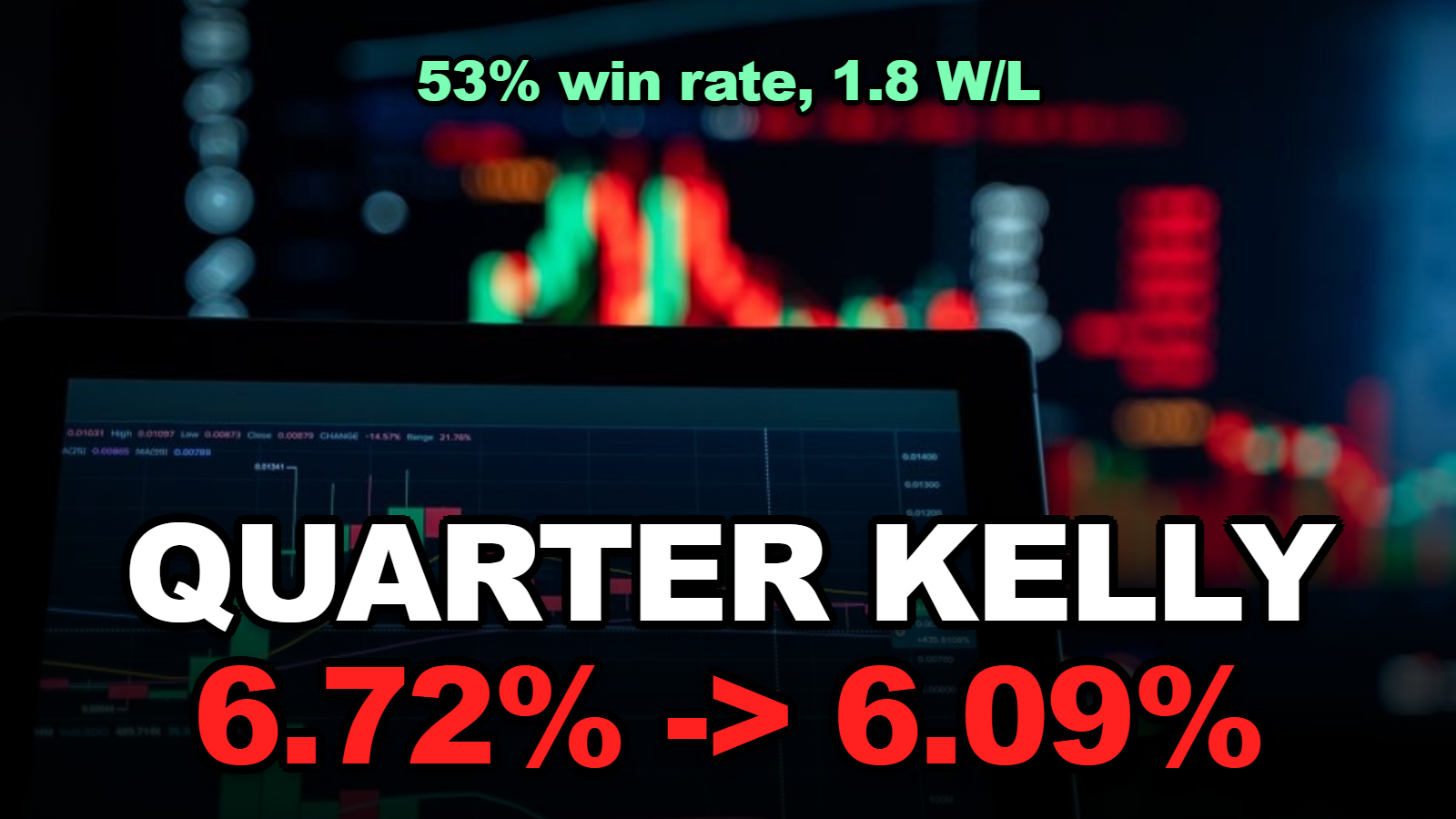
Short answer: The Kelly formula sizes a trade from your win rate and your average win over average loss. Fees shrink the win and grow the loss, so they shrink the fraction too. On FuturesAI’s own 53% example, quarter Kelly falls from 6.72% to 6.09% of capital once a 0.06% taker fee is counted. On FuturesAI’s live scoreboard, the fraction is below zero.
Kelly sizing looks precise. One formula, two inputs, and out comes the share of your account to risk on the next trade.
The catch is that both inputs are usually measured before fees. Every futures trade pays a fee to open and another to close, and that moves the answer in one direction only: smaller.
This walk-through uses FuturesAI’s Kelly article from February 28, 2026, the fee figures on FuturesAI’s Bitget payback page, and FuturesAI’s prediction scoreboard as of its October 28, 2026 auto-check. Nothing here is a forecast. It is a way to check a size before you place it.
On This Page
- What does the Kelly formula tell you to risk?
- How much do trading fees shrink the Kelly fraction?
- How do you turn a Kelly fraction into a position size?
- What does Kelly say about FuturesAI’s scoreboard?
- How wrong can a measured win rate be?
- A sizing check before each trade
What does the Kelly formula tell you to risk?
The Kelly criterion tells you to risk f* = (W/L × p − q) ÷ (W/L) of your capital per trade, where p is the win rate, q is 1 − p and W/L is average win over average loss, according to FuturesAI’s February 2026 article on optimal leverage.
The same article recommends quarter Kelly for crypto. It says this gives roughly 50% of the theoretical growth rate with much smaller drawdowns, because win rates and payoff ratios are estimates, and crypto returns have fat tails.
Here are the four examples from FuturesAI’s Kelly article, with the formula rerun next to them:
| Strategy (FuturesAI example) | Win rate | Avg W/L | Article’s full Kelly | Recomputed full Kelly | Recomputed quarter Kelly |
|---|---|---|---|---|---|
| Trend following | 42% | 2.8 | 21.3% | 21.3% | 5.3% |
| Mean reversion | 63% | 1.2 | 31.7% | 32.2% | 8.0% |
| Breakout | 35% | 3.5 | 16.4% | 16.4% | 4.1% |
| RSI divergence | 53% | 1.8 | 26.7% | 26.9% | 6.7% |
When I checked the article’s table against the formula, I found that two rows came out a little higher on a recompute: mean reversion at 32.2% rather than 31.7%, and RSI divergence at 26.9% rather than 26.7%. The gaps are small. They don’t change any conclusion below.
How much do trading fees shrink the Kelly fraction?
A 0.06% market fee per side cuts the quarter-Kelly risk for a 53% win rate, 1.8 W/L strategy on a 2% stop from 6.72% to 6.09% of capital, because the fee lowers each win to 3.48% and raises each loss to 2.12% of notional.
Here’s the setup. The RSI divergence example uses a 2% stop, so a 1.8 W/L means a 3.6% target. Fees come off the win and add to the loss, on both entry and exit.
FuturesAI’s Bitget payback page lists a 0.06% market fee before payback, and an effective 0.015% after the fee discount and payback. Both are in the table, with and without an assumed 0.05% slippage per side. The slippage figure is an assumption, not a measured number.
| Cost scenario (per side, on notional) | Net win | Net loss | Net W/L | Full Kelly | Quarter Kelly |
|---|---|---|---|---|---|
| No fees (FuturesAI’s example) | 3.60% | 2.00% | 1.80 | 26.89% | 6.72% |
| Bitget market fee 0.06% per side | 3.48% | 2.12% | 1.64 | 24.37% | 6.09% |
| FuturesAI effective market fee 0.015% per side | 3.57% | 2.03% | 1.76 | 26.27% | 6.57% |
| 0.06% fee + 0.05% assumed slippage per side | 3.38% | 2.22% | 1.52 | 22.13% | 5.53% |
| 0.015% fee + 0.05% assumed slippage per side | 3.47% | 2.13% | 1.63 | 24.15% | 6.04% |
So the fee level matters, but not as much as you might fear. The worst row still leaves 5.53%. The bigger risk is in the inputs, and that comes up two sections down.

How do you turn a Kelly fraction into a position size?
A Kelly fraction becomes a futures position size by dividing the dollar amount you’re willing to lose by the net loss per unit of notional, so 6.09% risk on a $1,000 account with a 2.12% net stop gives about $2,874 of notional, or 2.87x.
The steps:
- Multiply your account by the quarter-Kelly fraction. That’s the dollar loss if the stop hits.
- Add the round-trip fee to the stop distance. That’s the net loss per dollar of notional.
- Divide the first number by the second. That’s your notional.
- Divide notional by your account to get the effective leverage.
| Cost scenario, $1,000 account | Dollar risk (quarter Kelly) | Net loss per trade | Notional | Effective leverage |
|---|---|---|---|---|
| No fees (FuturesAI’s example) | $67.22 | 2.00% | $3,361 | 3.36x |
| Bitget market fee 0.06% per side | $60.92 | 2.12% | $2,874 | 2.87x |
| FuturesAI effective market fee 0.015% per side | $65.69 | 2.03% | $3,236 | 3.24x |
| 0.06% fee + 0.05% assumed slippage per side | $55.33 | 2.22% | $2,492 | 2.49x |
| 0.015% fee + 0.05% assumed slippage per side | $60.37 | 2.13% | $2,834 | 2.83x |
FuturesAI’s article rounds its no-fee case to “roughly 3x leverage on a 2% stop”. The first row gives 3.36x, and the fee rows land between 2.49x and 3.24x.
Most people skip step 2 and regret it. Without it, your stop loses more than you planned on every single trade. For the same steps around a scheduled data release, see FuturesAI Calendar: How to Size a Trade Before CPI Day.
What does Kelly say about FuturesAI’s scoreboard?
The Kelly fraction for following every FuturesAI prediction is about −2.6%, meaning risk nothing, because the scoreboard shows 45.8% accuracy over 295 scored predictions with a 1.12 payoff ratio as of its October 28, 2026 auto-check.
The FuturesAI prediction scoreboard publishes every call, hit or miss. On the day I read it, it showed 135 of 295 calls right and an average return of −0.29% per prediction, before fees. It also reported that the market rose 3.20% over the same windows.
| Scoreboard slice (Oct 28, 2026) | Accuracy | Scored calls | Kelly at 1.12 W/L | What it means |
|---|---|---|---|---|
| All predictions | 45.8% | 295 | -2.6% | Risk nothing |
| Crypto only | 57.1% | 84 | 18.8%* | Positive only on an assumed W/L |
| KR stocks | 39.7% | 121 | -14.1% | Risk nothing |
| US stocks | 43.8% | 105 | -6.4% | Risk nothing |
*The scoreboard gives a payoff ratio only for all predictions combined. The crypto row borrows that 1.12, so treat it as a what-if.
I noticed that the break-even point is close to the overall number. At a 1.12 payoff ratio, Kelly turns positive only above about 47.2% accuracy. Our guide to FuturesAI Payback: Break-Even Win Rate After Fees works through the same line from the fee side.
How wrong can a measured win rate be?
A win rate measured over 84 trades can be off by about 10.6 percentage points either way at 95% confidence, so FuturesAI’s 57.1% crypto accuracy is consistent with anything from roughly 46.5% to 67.7%, using the standard error √(p(1 − p) ÷ n).
| Sample | Measured accuracy | Standard error | 95% range | Kelly at the low end (1.12 W/L) |
|---|---|---|---|---|
| All predictions, 295 calls | 45.8% | 2.9 points | 40.1% to 51.5% | -13.4% |
| Crypto, 84 calls | 57.1% | 5.4 points | 46.5% to 67.7% | -1.2% |
This is why FuturesAI’s own article says to use a fraction of Kelly. If the low end of the range gives a negative number, the “edge” may not be there at all.
Honestly, 84 trades is not much. For how many you’d need, see How Many Trades Before You Know a Signal Works? (2026), and for what a run of losses at these rates looks like, see FuturesAI Hit Rate: How Long a Losing Streak Gets.
A sizing check before each trade
- Is the win rate from at least a few hundred trades, with the period written down?
- Is the W/L ratio measured after fees and slippage, or before?
- Does the Kelly fraction stay positive at the low end of the 95% range?
- Have you divided by quarter Kelly, at most?
- Have you added the round-trip fee to the stop before working out notional?
- Is the liquidation price well beyond your stop?
Tips
- Recompute the fraction monthly as new trades come in. The inputs drift.
- Use the fee you actually pay. A payback lowers it, but only once it is credited.
- If your stop is wider, the same risk fraction means less leverage, not more.
- Keep the calculation in a spreadsheet so you can see each input.
Warnings
- This is not investment advice. Leveraged futures can lose the full principal.
- Kelly assumes your win rate and payoff ratio are known. Measured figures are estimates.
- FuturesAI’s scoreboard returns exclude fees, so live results would be lower.
- Fee rates and payback terms can change. Check the exchange and FuturesAI before trading.
FAQ
Can the Kelly fraction be negative?
Yes. A negative Kelly fraction means the measured win rate and payoff ratio give a negative expected return, so the formula says to risk nothing. At the 1.12 payoff ratio on FuturesAI’s scoreboard, any win rate below about 47.2% gives a negative fraction.
Is quarter Kelly the same as 3x leverage?
Not always. Leverage depends on the stop distance as well as the risk fraction. FuturesAI’s February 2026 Kelly article turns 6.7% risk on a 2% stop into roughly 3x, but the same 6.7% risk on a 4% stop is only about 1.7x.
Should fees be counted per side or per round trip?
Count them on both the entry and the exit. A futures fee is charged on notional when you open and again when you close, so a 0.06% market fee costs about 0.12% of notional per round trip before slippage.
Sources
- FuturesAI: Optimal Leverage: A Quantitative Approach to Position Sizing (February 28, 2026)
- FuturesAI: AI Prediction Scoreboard (auto-check October 28, 2026)
- FuturesAI: Bitget payback policy
Next step: take your last 100 closed trades, work out the win rate and W/L after fees, and run row 2 of the sizing table with your own numbers before the next order.
Figures checked against FuturesAI’s pages on October 29, 2026. Not investment advice; leverage can lose the full principal.
🔗 Related guides