FuturesAI Whale Tracker: How to Size a Copied Position
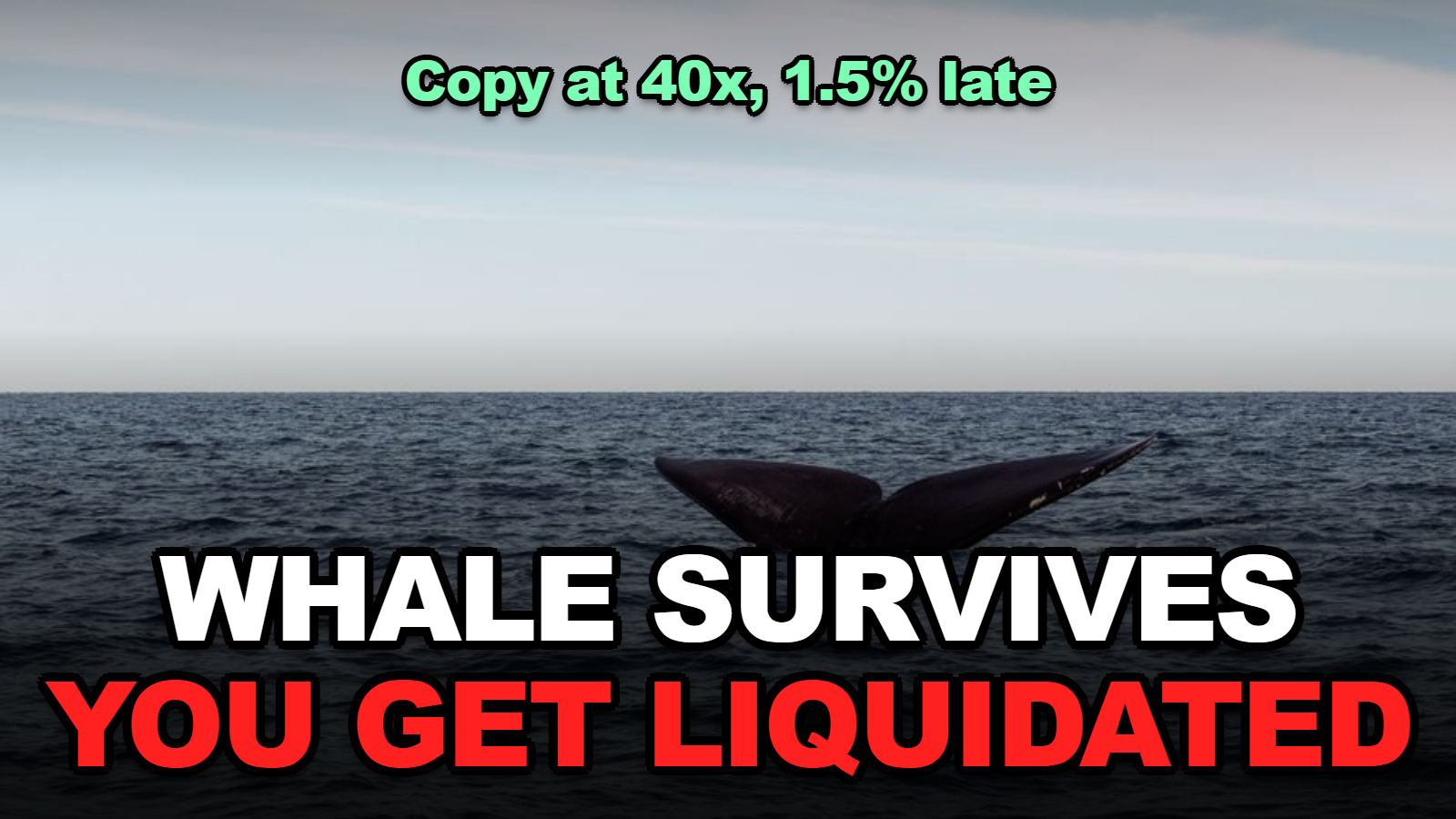
Short answer: A whale’s position tells you direction, not size. If you copy it late and at higher leverage, your liquidation price can sit above the whale’s own entry. In the worked example, a 40x copy opened 1.5% higher is liquidated about 1.27% lower. A small dip back to the whale’s price is enough. Size your copy from a stop you choose, not from the whale’s leverage.
Seeing a large account open a long feels like a tip. It’s really just a data point with a timestamp.
FuturesAI’s Whale Tracker shows Hyperliquid whale positions next to Korean institutional filings and Buffett and Burry’s 13F holdings. This page works out what happens when you copy one of those crypto positions a little late. Every trade below is invented to show the arithmetic.
Not investment advice. Leveraged futures can lose your full principal. The whale, prices and trades below are hypothetical.
Jump to a Part
- What does a whale position actually tell you?
- How does Hyperliquid calculate a liquidation price?
- What happens if you copy the trade 1.5% higher?
- How big should a copied position be?
- Does cross margin change the liquidation price?
- A five-step check before you copy
What does a whale position actually tell you?
A whale position on a tracker tells you the asset, the direction and roughly where a large account got in, but it does not tell you that account’s total equity, its hedges elsewhere, or where it plans to exit.
That gap is the whole problem. A fund with a big cross-margin account can hold a position that looks like 3x and ride a 20% drop. Your account isn’t that account.
When I checked the Whale Tracker page, I noticed that its filing-based sections carry their own warning. Korean 5% and insider reports are filed within 5 business days of the event and may differ from real-time holdings. On-chain positions are faster, but the same rule applies. You’re always looking at the past.
How does Hyperliquid calculate a liquidation price?
Hyperliquid liquidates a position when account equity falls below the maintenance margin, which its documentation sets at half of the initial margin at max leverage, from 1.25% for 40x-max assets up to 16.7% for 3x-max assets.
The Hyperliquid liquidations page publishes the exact formula:
liq_price = price − side × margin_available / position_size / (1 − l × side)
Here l is one over the maintenance leverage, side is 1 for a long, and for an isolated position the margin available is the isolated margin minus the maintenance margin required.
For an isolated long, that simplifies to: entry price minus margin per coin, divided by (1 − 0.0125) on a 40x-max asset. That’s what every number in the next table uses.
One honest caveat. The same page says liquidations use the mark price, which can differ from the book price in fast markets. Treat these as estimates, the way the exchange itself does.
What happens if you copy the trade 1.5% higher?
A copied long opened at a hypothetical $101,500 on a 40x-max asset is liquidated at about $100,215 with 40x isolated leverage, which is above the whale’s $100,000 entry, so an ordinary pullback to the whale’s price closes the copy.
The setup: a whale opens a long at $100,000. You see it later and buy at $101,500. The whale’s position, at an assumed 3x isolated, would liquidate near $67,511.
| Your leverage (isolated) | Your liquidation price | Distance from your entry | If price dips back to $100,000 |
|---|---|---|---|
| 3x isolated | $68,523 | -32.49% | Survives |
| 10x isolated | $92,506 | -8.86% | Survives |
| 20x isolated | $97,646 | -3.80% | Survives |
| 40x isolated | $100,215 | -1.27% | Liquidated |
Same direction as the whale. Same asset. The 40x copy is gone before the whale even feels the dip.
When I compared the 20x and 40x rows, I found that doubling leverage moved the liquidation price from 3.80% below entry to 1.27% below. Leverage doesn’t scale risk evenly. Near the top, it eats the cushion fast.
How big should a copied position be?
A copied position should be sized from the loss you accept at your own stop, so position size equals your maximum loss divided by the percentage distance from your entry to your stop.
Say you have $1,000 in the account and you’ll lose at most $100 on this idea. You buy at $101,500. Pick the stop first, then the size falls out:
| Stop price | Distance from $101,500 | Position size for a $100 loss | Implied leverage on $1,000 |
|---|---|---|---|
| Whale’s entry, $100,000 | 1.48% | $6,767 | 6.8x |
| $99,000 | 2.46% | $4,060 | 4.1x |
| $97,000 | 4.43% | $2,256 | 2.3x |
Notice what that does. With the stop at the whale’s entry, the right size works out to about 6.8x on this account, and the liquidation price at that leverage sits well below the stop. The stop gets hit first, which is the point.
Fees and slippage still come off that $100. Our FuturesAI Strategy Kit: How to Add Real Fees to a Backtest shows how to price those in before you trust any number.
Does cross margin change the liquidation price?
On Hyperliquid, the liquidation price of a cross-margin position does not depend on the leverage you set, because, according to its liquidation documentation, a cross position at lower leverage simply uses more collateral from the shared account.
So the isolated table above is the clean case. In cross mode, your whole account value backs the copy, and other open positions move your liquidation price too. The Hyperliquid margining page says cross positions are liquidated when account value falls below the maintenance margin times total open notional.
That can feel safer. It also means one bad copy can drag down positions that had nothing to do with it. Our explainer Isolated Margin vs Cross Margin: The 2026 Liquidation Risk walks through that trade-off.
And if a position does hit a backstop liquidation, Hyperliquid’s docs say the maintenance margin isn’t returned. Hyperliquid Backstop Liquidation: The Margin You Lose works out what that costs.
A five-step check before you copy
- Write down the whale’s entry and your entry. The gap between them is risk you’re taking that the whale isn’t.
- Pick your stop before your size. Somewhere you’d admit the idea is wrong.
- Size from the stop. Maximum loss divided by stop distance.
- Check the liquidation price. It must sit beyond your stop, with room to spare.
- Price in fees. Entry and exit both pay. Payback rates differ by exchange.
Most people do step 3 last, or never. That’s usually where the account goes.
If you’re tempted to copy several whales in a row, our look at FuturesAI Hit Rate: How Long a Losing Streak Gets is a useful reality check on streaks.
Tips
- Use isolated margin for a copy trade so one idea can’t drain the whole account.
- Treat a whale’s entry as a reference level for your stop, not as a promise.
- Re-check the liquidation price after adding to a position; adding raises your average entry.
Warnings
- Not investment advice. Leveraged futures can lose your full principal.
- Liquidation prices here are estimates from Hyperliquid’s published formula; mark price, funding and margin tiers can move the real number.
- Whale data is a record of what happened, not a forecast.
FAQ
Can I see Hyperliquid whale positions on FuturesAI?
Yes. FuturesAI’s Whale Tracker page lists Hyperliquid whale positions in its crypto section, alongside Korean institutional filings and US 13F filings. It shows what large accounts hold, not the size of their total account or their exit plan.
Why did my copied trade get liquidated when the whale’s did not?
Usually because you entered later at a worse price with higher leverage. In the worked example, a 40x long opened at $101,500 is liquidated near $100,215, before price even returns to the whale’s $100,000 entry.
What maintenance margin does Hyperliquid use?
Hyperliquid’s documentation says maintenance margin is half of the initial margin at max leverage, so it ranges from 1.25% for 40x max leverage assets to 16.7% for 3x max leverage assets.
Sources
- Hyperliquid Docs: Liquidations (maintenance margin and liquidation price formula)
- Hyperliquid Docs: Margining (cross and isolated margin)
- FuturesAI Whale Tracker (checked October 28, 2026)
Next time a whale alert pops up, open a calculator before you open a position. Stop, then size, then leverage.
Fact-checked against Hyperliquid documentation and FuturesAI’s live pages as of October 28, 2026. Worked examples are hypothetical. Not investment advice; leveraged trading can lose your full principal.
🔗 Related guides