FuturesAI Payback: Work Out What a Grid Bot Pays in Fees
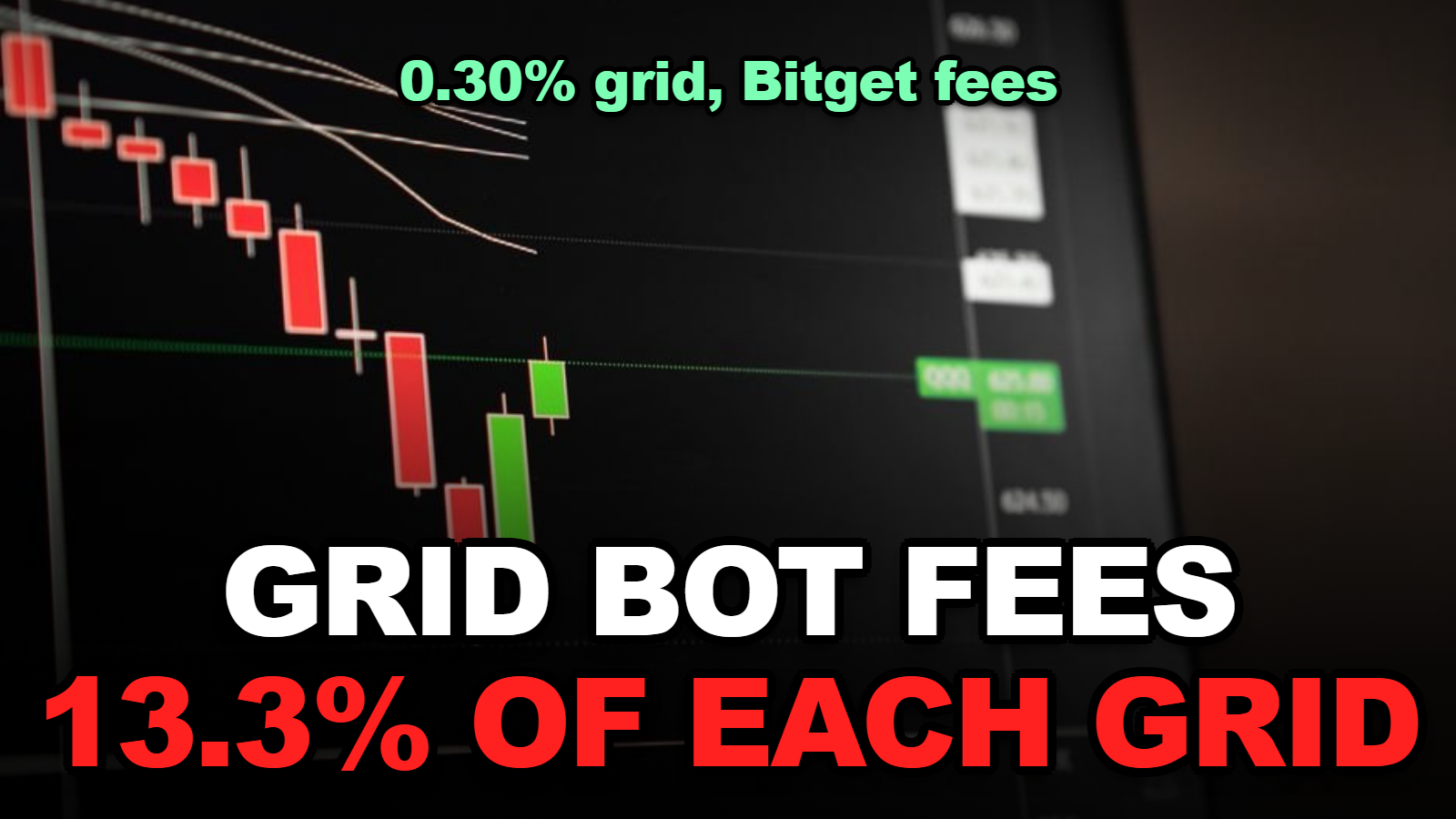
Short answer: A grid bot pays a fee on every fill. On Bitget there’s no extra bot charge. Each buy and each sell pays the normal futures fee. Tight grids feel the fee most. At 0.30% spacing, the standard limit fee eats 13.3% of each grid’s gross. With FuturesAI’s discount and payback that drops to 3.3%. Payback builds slowly, though. Withdrawals start at 50 USDT.
Grid bots trade a lot. That’s the point of them: buy a little lower, sell a little higher, over and over inside a range. Every one of those fills is a fee.
So the fee rate matters more for a grid than for almost any other style. FuturesAI’s payback page lists Bitget at a 0.02% limit fee and 0.06% market fee, falling to 0.005% and 0.015% after the discount and payback. Below is what that does to a grid, fill by fill and month by month.
Not investment advice. Leveraged futures, including grid bots, can lose your full principal. Fee savings don’t protect a grid from a price move outside its range.
Jump to a Section
- Does a grid bot pay more fees than manual trading?
- How much of each grid does the fee take?
- How much payback does a month of grid volume earn?
- What do the start and stop orders cost?
- Can a busy grid lose its payback?
- Five numbers to write down before you start
Does a grid bot pay more fees than manual trading?
A Bitget futures grid bot pays the same fee rates as manual futures trading, with no extra bot charge, according to Bitget’s Futures Grid FAQ; it simply trades far more often, so the total bill is larger.
Bitget’s futures grid app guide adds that standard futures fees apply to each buy or sell order executed within the grid. More grids mean smaller intervals and, in Bitget’s words, may result in more trades.
When I checked the FAQ, I noticed that it answers “Can transaction fees exceed grid profits?” with a no: the bot only pairs orders when the price gap covers fees. That’s true per grid. It says nothing about the position itself losing value when price leaves the range.
How much of each grid does the fee take?
At Bitget’s standard 0.02% limit fee, one completed grid (a buy fill plus a sell fill) costs 0.04% of the order size, which is 13.3% of the gross on 0.30% spacing and 4% on 1% spacing.
The table assumes both fills are charged at the limit (maker) rate, which is the usual case for resting grid orders. The FuturesAI column uses the 0.005% effective limit fee from its Bitget page, read October 28, 2026.
| Grid spacing | Gross per completed grid | Standard fees (0.04%) | Fee share of gross | Via FuturesAI (0.01%) | Fee share of gross |
|---|---|---|---|---|---|
| 0.30% | 0.30% | 0.04% → 0.26% left | 13.3% | 0.01% → 0.29% left | 3.3% |
| 0.50% | 0.50% | 0.04% → 0.46% left | 8.0% | 0.01% → 0.49% left | 2.0% |
| 1.00% | 1.00% | 0.04% → 0.96% left | 4.0% | 0.01% → 0.99% left | 1.0% |
When I compared the rows, I found that the fee share scales almost exactly with how tight the grid is. Halve the spacing and the fee’s slice of each grid roughly doubles.
That’s why tight grids and cheap fees go together. A 0.30% grid on standard fees gives up about one grid in every seven and a half to fees.

How much payback does a month of grid volume earn?
A Bitget grid trading $120,000 of monthly volume through a FuturesAI-linked account pays $6 in fees instead of $24, and $6 of that saving arrives as payback credited to FuturesAI while the other $12 is a discount taken at the exchange.
The split comes from how FuturesAI’s Bitget page describes it. Trades carry the exchange’s standard fee with a fixed 50% discount, so 0.02% becomes 0.01%. Then 50% of that comes back as payback, leaving 0.005%. Volume here counts both sides of every grid. For scale, $120,000 is about 300 completed grids a month with $200 orders.
| Monthly volume (all fills) | Standard 0.02% | After 50% discount | Payback credited (0.005%) | Months to reach 50 USDT |
|---|---|---|---|---|
| $50,000 | $10.00 | $5.00 | $2.50 | 20 |
| $120,000 | $24.00 | $12.00 | $6.00 | 8.3 |
| $300,000 | $60.00 | $30.00 | $15.00 | 3.3 |
| $1,000,000 | $200.00 | $100.00 | $50.00 | 1 |
Here’s where people get tripped up. The discount works from the first trade, but the payback sits in your FuturesAI balance until it reaches the 50 USDT withdrawal minimum. A small grid can take well over a year to get there.
For the full-year version across different styles, see FuturesAI Payback: Work Out a Year by Trading Style.
What do the start and stop orders cost?
When starting or stopping a futures grid fills a market order, that fill pays Bitget’s 0.06% market fee, or 0.015% effective through FuturesAI, instead of the limit rate.
| Market fill size | Standard 0.06% | Via FuturesAI 0.015% | Difference |
|---|---|---|---|
| $1,000 | $0.60 | $0.15 | $0.45 |
| $5,000 | $3.00 | $0.75 | $2.25 |
Small numbers. But a bot you stop and restart every few days pays them every time. Bitget’s FAQ says cancelling a grid closes all open positions at the current market price.
Can a busy grid lose its payback?
A grid bot can lose FuturesAI payback if the exchange stops commissions on the account: FuturesAI’s Bitget page says that when an exchange suspends a trader or UID for high-frequency rule violations such as click farming or wash trading, FuturesAI applies the same suspension.
An ordinary grid isn’t wash trading. Still, a very tight grid on a thin pair can produce hundreds of fills a day, and that’s the activity an exchange’s risk team reviews. Check Bitget’s own rules before you push spacing to the minimum.
Two more conditions from the same page are worth knowing:
- Exchange deposit gifts and bonuses must be used up before any payback is paid.
- Only Bitget accounts opened within 7 days that never used another referral code can be linked.
If payback stops showing up, our checklist for Futures Fee Rebate Not Received? 4 Causes, in Order (2026) walks through the usual causes in order.
Five numbers to write down before you start
- Grid spacing as a percentage.
- Order size per grid.
- Expected completed grids per month. Be conservative.
- Your fee per round trip: 0.04% standard or 0.01% through the FuturesAI Bitget rate.
- The price at which the position would be liquidated if the market leaves the range.
Multiply 2 × 3 × 2 for monthly volume. Then use the tables above. The fifth number matters more than the other four combined. Our guide to FuturesAI Strategy Kit: How to Add Real Fees to a Backtest shows how to test a setup with real fees before going live.
Tips
- Prefer wider spacing if your fee is the standard rate. A 1% grid gives up 4% of gross; a 0.30% grid gives up 13.3%.
- Count both fills when you estimate volume. One completed grid is two trades.
- Confirm on FuturesAI that your Bitget UID is linked before the bot starts.
- Avoid stopping and restarting the bot often. Each stop closes positions at market, and market fills pay the higher rate.
Warnings
- A grid can show many profitable grids while the open position is deep in loss. Fee savings don’t change that.
- Leveraged futures can lose your full principal. Nothing here is investment advice.
- Fee rates and payback terms change. Figures are from Bitget’s help centre and FuturesAI’s Bitget page as of October 28, 2026.
Bitget’s fee discount and payback stacking is covered in more depth in Bitget Fee Discount and Payback Stacked (2026).
FAQ
Does Bitget charge extra for running a futures grid bot?
No. Bitget’s Futures Grid FAQ says futures grid bots follow the same fee structure as regular futures trading, with no extra charge for using a bot. Each executed buy or sell order inside the grid pays the standard futures fee.
How small can grid spacing be before fees matter?
Fees take a bigger share as spacing narrows. At Bitget’s 0.02% limit rate, a round trip costs 0.04%, which is 13.3% of the gross on a 0.30% grid and 4% on a 1% grid. With the FuturesAI discount and payback the round trip drops to 0.01%.
When can I withdraw grid bot payback from FuturesAI?
FuturesAI’s Bitget page says payback is credited to your FuturesAI balance once a day and withdrawn as USDT with a 50 USDT minimum. At $120,000 of monthly grid volume, Bitget payback of 0.005% comes to about $6 a month, so reaching 50 USDT takes a little over eight months.
Sources
- Bitget Support: Futures Grid FAQ
- Bitget Support: Futures Grid on Bitget, Mobile App Guide
- FuturesAI: Bitget payback policy and fee table (read October 28, 2026)
Run the five numbers once. If the fee share comes out above 10% of gross per grid, widen the spacing or lower the fee before you start.
Fact-checked against Bitget’s help centre and FuturesAI’s public payback pages as of October 28, 2026. Not investment advice; leveraged trading can lose your full principal.
🔗 Related guides