Hyperliquid Funding Is Paid Hourly: What 0.01% Really Costs
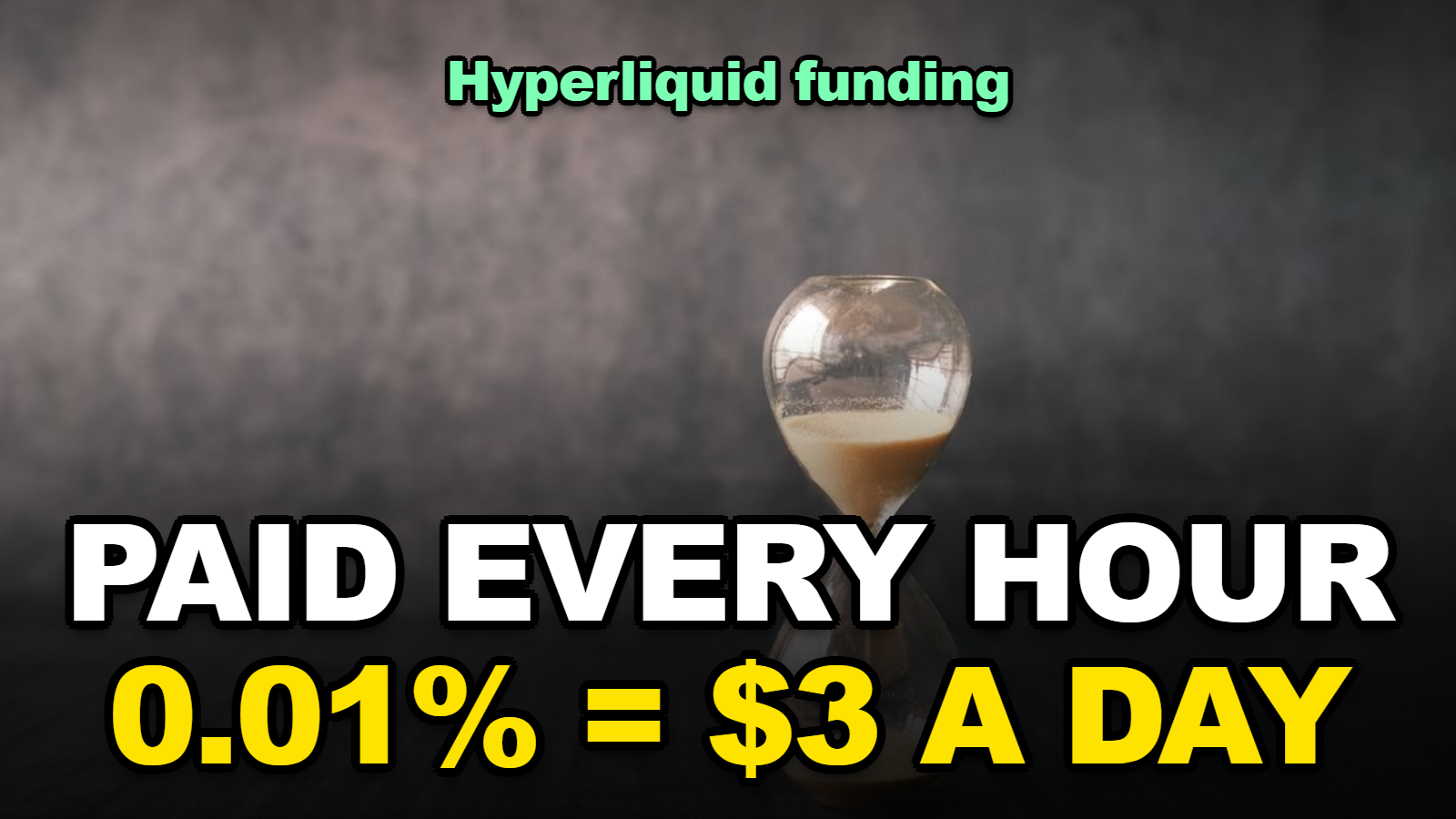
Short answer: Hyperliquid computes funding as an 8-hour rate but pays one eighth of it every hour. The baseline is 0.01% per 8 hours, which is 0.00125% per hour. On a $10,000 position that is $0.125 an hour, $3 a day and $21 a week. The hourly cap is 4%, which on the same position is $400 in a single hour. Compare the rate and the interval label before you compare exchanges.
A funding number with no interval is half a number. 0.01% per hour and 0.01% per 8 hours differ by a factor of eight, and the first one costs a $10,000 long about $8,760 a year while the second costs about $1,095.
Hyperliquid’s documentation is clear about its own mechanics. Most of the confusion comes from carrying habits over from venues that settle every 8 hours.
Educational content, not trading advice. Perpetual futures are leveraged products and can lose more than expected. Figures come from Hyperliquid’s Funding documentation (page last updated about six months before October 18, 2026, which I read that day); worked dollar amounts are my own arithmetic on a $10,000 notional.
What This Covers
- How does Hyperliquid actually charge funding?
- What does 0.01% cost on a $10,000 position?
- Why can the premium push the rate far above 0.01%?
- What does the 4% hourly cap mean in dollars?
- How should you price a position you hold for days?
- What Trips People Up
- Tips
- Warnings
- FAQ
- Sources
How does Hyperliquid actually charge funding?
Hyperliquid charges funding every hour, and the amount is one eighth of an 8-hour funding rate, according to its Funding documentation.
The docs say the rate formula applies to an 8-hour rate, but funding is paid every hour at one eighth of the computed rate. The premium is sampled every 5 seconds and averaged over the hour. Funding is peer to peer, so the exchange collects nothing on the payment itself. Longs pay shorts when the contract trades above the oracle price, and shorts pay longs when it trades below.
One detail changes your arithmetic. The payment uses the spot oracle price to size the position, not the mark price: position size times oracle price times funding rate.
What does 0.01% cost on a $10,000 position?
On Hyperliquid, a funding rate of 0.01% per 8 hours costs a $10,000 position $0.125 per hour, $3.00 per day and $21.00 per week, because the hourly payment is 0.00125% of notional.
The 0.01% is not random. Hyperliquid states the interest rate component is fixed at 0.01% every 8 hours to stay consistent with centralized exchanges, which it says is 11.6% APR paid to the short side. I ran that myself: 0.00125% compounded hourly over 8,760 hours gives 11.57%, and simple interest gives 10.95%, so the docs’ figure is the compounded one.
| 8-hour rate | Hourly rate | Per hour on $10,000 | Per day | Per week |
|---|---|---|---|---|
| 0.01% (baseline) | 0.00125% | $0.125 | $3.00 | $21.00 |
| 0.05% | 0.00625% | $0.625 | $15.00 | $105.00 |
| 0.10% | 0.0125% | $1.25 | $30.00 | $210.00 |
| 0.95% (docs example) | 0.11875% | $11.875 | $285.00 | $1,995.00 |
8-hour rates from Hyperliquid’s Funding page and my own conversion at one eighth per hour. Dollar amounts assume a constant rate on a $10,000 notional at the oracle price.
When I compared the rows, I noticed that the baseline row is cheap enough to ignore for a day trade. A position held 36 hours at the baseline pays about $4.50. The expensive rows are the ones where the premium takes over.

Why can the premium push the rate far above 0.01%?
Hyperliquid’s funding rate equals the average premium plus the interest rate component clamped to a band of plus or minus 0.05% around the premium, so when the contract trades far from the oracle price the rate follows the premium almost one for one.
The documented formula is Funding Rate = Average Premium Index + clamp(interest rate minus premium index, -0.0005, 0.0005). The premium itself is the impact price difference divided by the oracle price. In the docs’ worked example the contract’s impact bid is $10,100 against a $10,000 spot price. That is a 1% premium. The clamp limits the interest correction to minus 0.05%, so the funding rate comes out at 0.95%.
Read that 0.95% as an 8-hour rate. Paid hourly it is 0.11875% per hour. On $10,000 that is $11.875 an hour, which is $285 for a day.
This is the line most people miss. The baseline is small, but nothing stops the number from being 100 times the baseline when the contract runs rich.
What does the 4% hourly cap mean in dollars?
Hyperliquid caps funding at 4% per hour for every asset, so the maximum a $10,000 position can pay in one hour is $400, and the docs call this much less aggressive than the caps on centralized exchanges.
The docs also say the funding cap and the funding interval do not depend on the asset. So a thin, volatile market and a large one share the same ceiling. Hitting it for a full day would cost $9,600 on a $10,000 notional, which is more than the position itself. That is a stress case, not a forecast. It matters because it shows that funding risk on a leveraged position is not always small.
| Funding condition | Rate paid per hour | Cost on $10,000 for one hour | For 24 hours |
|---|---|---|---|
| Baseline | 0.00125% | $0.125 | $3.00 |
| Docs example premium | 0.11875% | $11.875 | $285.00 |
| Documented cap | 4% | $400 | $9,600 |
How should you price a position you hold for days?
To price a multi-day Hyperliquid position, multiply the current hourly rate by your notional and the hours you expect to hold, then rerun the number each day because the rate resets every hour.
- Read the current funding rate on the contract page and confirm the interval label.
- Convert it to an hourly rate if it is shown as an 8-hour rate (divide by 8).
- Multiply by your notional at the oracle price and by the planned hours.
- Add a stress line at five times the current rate.
- Compare that total with the profit you are aiming for.
If the stress line already eats your target, the trade is too slow for a perpetual. A shorter hold or a spot position may fit better.
I found that the number most readers get wrong is the stress case, not the average. They price the quiet hour and hold through the loud one.
What Trips People Up
- Comparing venues by the headline percent. Put every rate on the same interval first.
- Reading the funding rate as annual. The 11.6% APR is only the baseline interest piece, not a promise of what you pay.
- Forgetting funding moves liquidation price. Hyperliquid’s liquidation docs say funding payments can change the actual liquidation price from the one shown.
- Assuming mark price sets the payment. The docs use the oracle price.
Skip this check and the cost shows up later, as a position that bleeds for no obvious reason.
Tips
- ✅ Write the interval next to every rate you note down: 8h or 1h.
- ✅ Divide any 8-hour rate by 8 before comparing it with Hyperliquid’s hourly payment.
- ✅ Check whether you are long or short. Only the paying side loses money to funding.
- ✅ Reprice open positions once a day if you hold longer than a day.
Warnings
- Dollar figures here assume a constant rate. Real funding changes every hour.
- I used a $10,000 notional, not margin. Your own margin is smaller, but the payment is on notional.
- Leverage can lose your whole margin quickly. This is not trading advice.
FAQ
Is Hyperliquid funding paid every 8 hours or every hour?
Every hour. Hyperliquid’s Funding documentation says the rate formula is defined as an 8-hour rate, but funding is paid hourly at one eighth of the computed rate.
How much does a 0.01% funding rate cost on a $10,000 position?
At 0.01% per 8 hours, which is 0.00125% per hour, a $10,000 position pays about $0.125 an hour, $3 a day and $21 a week. The payment is calculated on notional at the oracle price.
What is the maximum Hyperliquid funding rate?
Hyperliquid’s documentation says funding is capped at 4% per hour. On a $10,000 position that is a maximum of $400 in one hour, and the cap does not vary by asset.
Sources
🔗 Related guides
Fact-checked against Hyperliquid’s Funding and Liquidations documentation as read on October 18, 2026. Dollar examples are our own arithmetic. Not trading advice.