
Q3 2026 Estimated Tax Deadline: How Much Freelancers Actually Owe by September 15
Quick answer: Q3 2026 estimated tax payments, covering income from June through August, are due September 15, 2026. You only have to make this payment if you’ll owe at least $1,000 for the year after subtracting withholding. The safest number to send is 25% of last year’s total tax bill (or 27.5% if your prior-year income was over $150,000) — matching that “safe harbor” figure protects you from a penalty even if you underestimate this year’s income. Miss it, and the IRS charges 7% annual interest, compounded daily, on the shortfall.
Freelancers who set aside money for taxes all summer are now staring down the September 15 deadline, and the actual math trips up more people than the deadline date does.
This isn’t about your April filing — it’s a payment now, based on income you already earned between June and August, and the IRS doesn’t wait for your 1099s to show up before charging interest on a missed quarter.
Where to Start
- Do You Actually Owe a Q3 Payment?
- How Do You Calculate the Safe Harbor Number?
- How Do You Actually Send the Payment by September 15?
- What Happens If You Miss the Deadline?
- Safe Harbor vs Actual-Income Method: Which Costs Less?
Do You Actually Owe a Q3 Payment?
You owe a Q3 estimated payment if you expect to owe at least $1,000 in federal tax for 2026 after subtracting withholding and refundable credits — that $1,000 threshold, not your total income, is what actually triggers the requirement.
Most side hustlers cross it faster than they expect. Self-employment tax alone runs 15.3% on net freelance earnings, so even a moderate side income on top of a W-2 job can push you past $1,000 owed well before your standard deduction would otherwise wipe out a small side gig’s tax bill.
How Do You Calculate the Safe Harbor Number?
The safe harbor number is either 100% or 110% of last year’s total tax, split into four equal payments — pay that amount on schedule and the IRS can’t penalize you no matter how much you actually owe when you file.
Find last year’s total tax
Pull line 24 from your 2025 Form 1040 — that’s your total tax, not your refund or balance due. This is the number the entire safe harbor calculation is built on, so use the filed return, not a rough guess from memory.
Check which percentage applies to you
If your 2025 adjusted gross income was $150,000 or less ($75,000 if married filing separately), you need to pay 100% of that total tax across the year. Above that AGI threshold, the requirement rises to 110%.

Divide by four and compare to what you’ve already paid
Take that 100% or 110% figure, divide it by four, and check it against what you already sent in April, June, and now September. If you’ve been paying an even quarter each time, Q3 is simply the third of those four equal payments.
Switch to the actual-income method only if this year is genuinely lighter
When I checked the IRS’s own Form 1040-ES worksheet, the actual-income calculation asks for projected annual income, half of your self-employment tax deduction, and your standard deduction before it lands on a number — it’s more accurate for a slow year, but it takes real bookkeeping to trust the input.
How Do You Actually Send the Payment by September 15?
IRS Direct Pay is the fastest free option — it moves money straight from your bank account and gives you a confirmation number the same day, with no enrollment step required.
Use Direct Pay for a same-day bank transfer
Go to the IRS payments page, select 1040-ES as the reason for payment, choose the correct tax year, and confirm with your prior-year AGI for identity verification. Save the confirmation number — it’s your only proof if the payment gets lost in processing.
Enroll in EFTPS if you’ll be paying quarterly long-term
EFTPS takes a few business days to activate because the IRS mails a PIN to your address on file, so it’s not a same-day option if you’re starting from scratch this quarter. Worth setting up anyway if you expect to keep making these payments.
Mail a check only as a last resort
A mailed 1040-ES voucher has to be postmarked by September 15, not received by then — cutting it close with mail risk on a hard deadline is the one mistake that’s entirely avoidable.
What Happens If You Miss the Deadline?
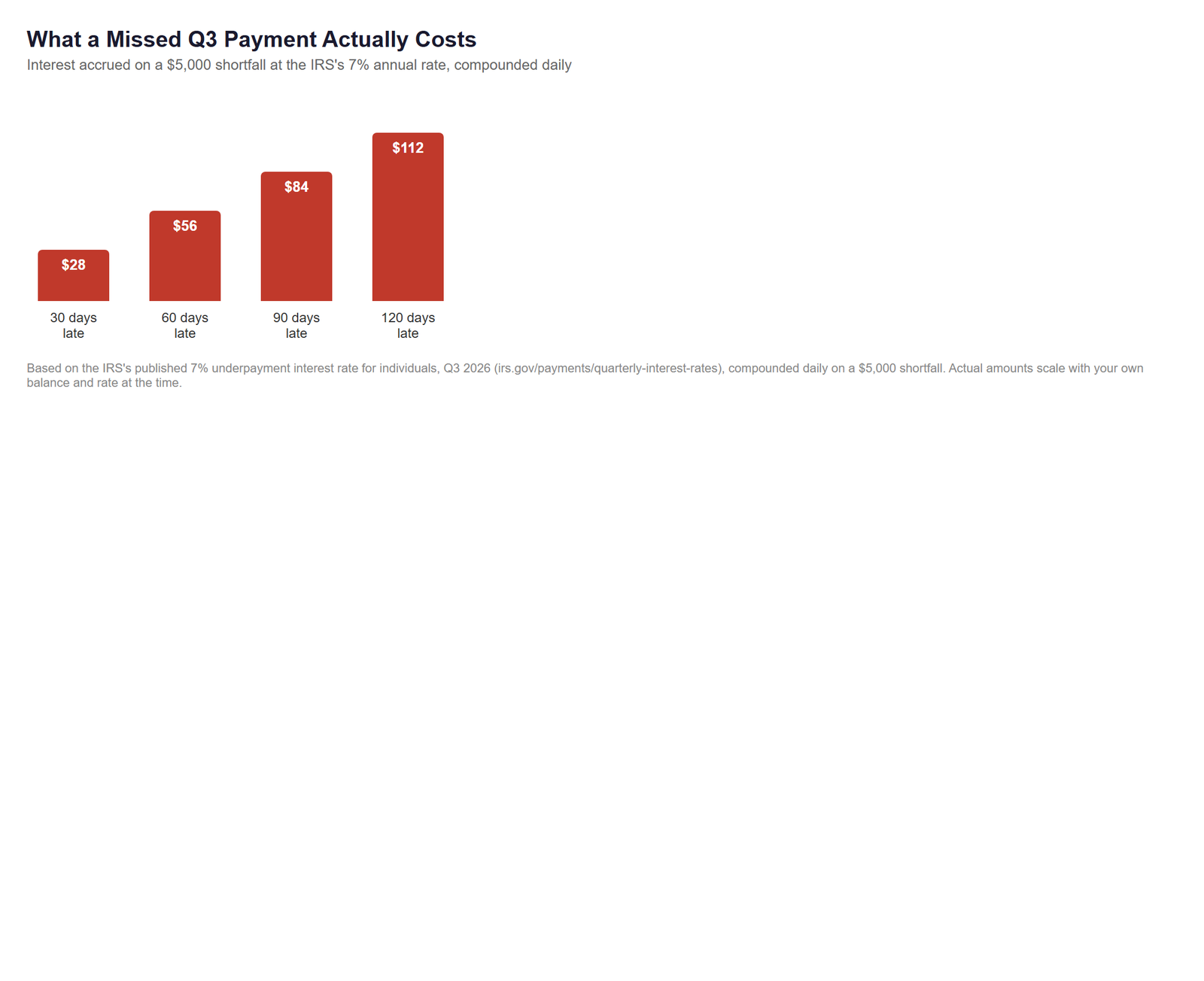
Missing September 15 doesn’t erase the obligation — it just starts the interest clock, and the IRS charges 7% annually, compounded daily, on individual underpayments for the quarter beginning July 1, 2026.
Reading the safe-harbor rule closely, I found that the penalty calculation doesn’t care why the payment was late — a forgotten deadline and a genuine cash-flow problem accrue interest the same way. Paying even part of what you owe on time reduces the balance that interest compounds against, so a partial payment by the 15th still beats paying the full amount two weeks late.
This part trips a lot of people up: catching up in October doesn’t just mean paying what you missed. It means paying what you missed plus the daily interest that’s accrued since the 15th, and that interest keeps compounding until the balance clears.
Safe Harbor vs Actual-Income Method: Which Costs Less?
The right method depends entirely on whether this year’s income is higher, lower, or about the same as last year’s — there’s no single answer that works for every freelancer.
| Situation | Better Method | Why |
|---|---|---|
| Income about the same as last year | Safe harbor (100%/110% of prior year) | Simplest math, zero penalty risk, no need to track this year’s numbers closely |
| Income significantly higher this year | Safe harbor | You still avoid penalties paying last year’s lower number, even though you’ll owe more at filing |
| Income significantly lower this year | Actual-income method | Paying last year’s higher number means overpaying and waiting for a refund |
| Highly seasonal or lumpy income | Annualized installment method | Ties each payment to income actually earned in that period, not a flat quarter |
Third-quarter 2026 estimated tax payments covering June through August income are due September 15, 2026, according to the IRS’s own Form 1040-ES instructions, and that filing deadline doesn’t shift based on which calculation method you use to get there.
As of July 2026, the IRS charges a 7% annual underpayment interest rate, compounded daily, on estimated tax shortfalls for individual taxpayers, according to the IRS’s quarterly interest rate schedule — a rate that resets every quarter, so a number you saw earlier this year may already be out of date.
Fast Checks Before You Pay
- ✅ Confirm your $1,000 threshold status before assuming you owe nothing this quarter.
- ✅ Pull line 24 from last year’s actual Form 1040, not an estimate from memory.
- ✅ Use Direct Pay if you’re paying this close to the 15th — it’s the only same-day option.
- ✅ Save every confirmation number in one place, not just your email inbox.
The Fine-Print Problems
Don’t assume a W-2 job’s withholding automatically covers your side income — withholding from an employer only applies to that paycheck, not to freelance income earned separately.
Don’t wait until your 1099s arrive to start this calculation. The Q3 deadline is based on income already earned through August, and 1099s from clients or platforms often don’t show up until January — long after this payment is due.
FAQ
Do I still owe Q3 estimated tax if my side hustle only made a small profit?
Only if your total expected federal tax for the year, across all income sources, hits $1,000 or more after withholding — a small side profit alone often doesn’t trigger it, but combined with W-2 withholding that’s already too low, it can.
Can I skip Q3 and just pay everything when I file in April?
No — skipping a quarter doesn’t defer the payment, it triggers interest on that specific quarter’s shortfall starting from its own due date, even if you pay your full annual balance by the April filing deadline.
Does paying by credit card instead of Direct Pay avoid the interest issue?
No — a credit card payment made after September 15 is still a late payment for IRS purposes and accrues the same 7% underpayment interest; card processors also charge their own convenience fee on top.
This is general tax information, not personalized tax advice — a CPA or enrolled agent can confirm how these rules apply to your specific situation.
Sources
- IRS — Form 1040-ES, Estimated Tax for Individuals
- IRS — Estimated Tax FAQ
- IRS — Quarterly Interest Rates
Fact-checked based on 3 public IRS sources as of August 27, 2026.