FuturesAI Payback: Smallest Profit Target That Beats Fees
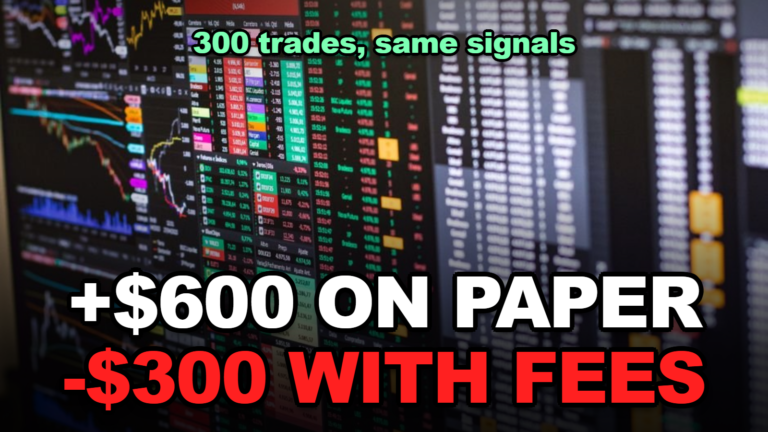
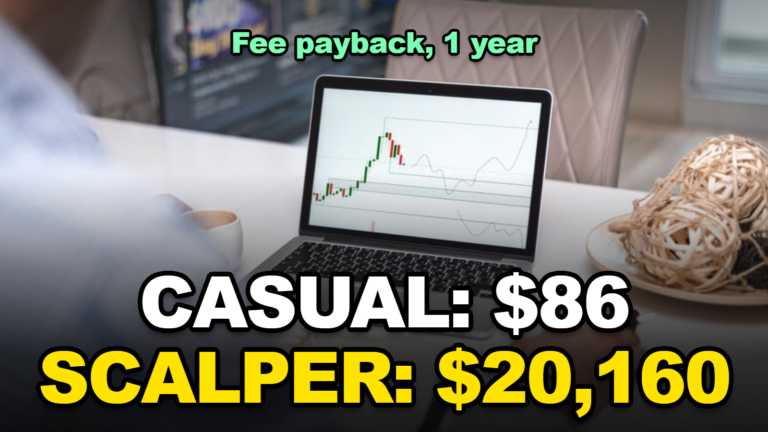
Scalpers pick targets by feel. A 0.3% move sounds like a win until you subtract what the exchange keeps.
This is general information, not investment advice. Futures trading uses leverage and can lose your entire principal. Nothing here promises a profit.
Contents
- How do you work out the smallest target that beats fees?
- What does a 0.5% target keep after market-order fees?
- How much smaller can the target get with limit orders?
- What does this calculation leave out?
- How do you pick a target on your own exchange?
- Quick Rules
How do you work out the smallest target that beats fees?
The smallest profit target worth taking is the round-trip fee divided by the share of profit you are willing to hand to the exchange. A round trip is one entry plus one exit, so it is two fees, each charged on the notional position size.
The fee inputs come from the payback page at futuresai.io/payback. As listed there, the figures in parentheses are effective fees after fee discounts and payback are both applied. When I checked the page, the taker effective fees were: Bybit 0.044%, Bitget 0.015%, OKX 0.04%, Gate 0.015%, Binance 0.045% and Toobit 0.027%.
Rule used here: target = round-trip fee / 0.10 when you accept a 10% fee share. Double the fee, double the minimum target.
| Exchange | Taker, effective (one side) | Round trip (x2) | Smallest target at 10% fee share | At 20% fee share |
|---|---|---|---|---|
| Binance | 0.045% | 0.090% | 0.90% | 0.45% |
| Bybit | 0.044% | 0.088% | 0.88% | 0.44% |
| OKX | 0.04% | 0.080% | 0.80% | 0.40% |
| Toobit | 0.027% | 0.054% | 0.54% | 0.27% |
| Bitget | 0.015% | 0.030% | 0.30% | 0.15% |
| Gate | 0.015% | 0.030% | 0.30% | 0.15% |
Bitget and Gate tie on the taker side. Notice the spread: the same trade needs a target three times larger on Binance than on Gate.
What does a 0.5% target keep after market-order fees?
On a $10,000 notional position with a 0.5% target, the gross profit is $50.00, and market-order round-trip fees at the effective rates above take between $3.00 and $9.00 of it. The exchange you use decides whether you keep 82% or 94% of the gross.
| Exchange | Round-trip fee on $10,000 | Fee as share of $50 gross | Left after fees |
|---|---|---|---|
| Binance | $9.00 | 18.0% | $41.00 |
| Bybit | $8.80 | 17.6% | $41.20 |
| OKX | $8.00 | 16.0% | $42.00 |
| Toobit | $5.40 | 10.8% | $44.60 |
| Bitget | $3.00 | 6.0% | $47.00 |
| Gate | $3.00 | 6.0% | $47.00 |

Those are the winners. A losing trade pays the same fees on top of its loss, which is why the fee share only looks small when the trade works.
How much smaller can the target get with limit orders?
With limit orders filling as maker on both sides, the listed effective maker fees make the smallest 10%-fee-share target between 0.10% and 0.36% of notional. The page lists maker fees of 0.016% for Bybit and OKX, 0.005% for Bitget, 0.006% for Gate, 0.018% for Binance and 0.009% for Toobit, all effective.
| Exchange | Maker, effective | Round trip | Smallest target at 10% fee share |
|---|---|---|---|
| Binance | 0.018% | 0.036% | 0.36% |
| Bybit | 0.016% | 0.032% | 0.32% |
| OKX | 0.016% | 0.032% | 0.32% |
| Toobit | 0.009% | 0.018% | 0.18% |
| Gate | 0.006% | 0.012% | 0.12% |
| Bitget | 0.005% | 0.010% | 0.10% |
Honestly, that is the whole case for limit entries on small targets. It only helps if the order actually fills.
What does this calculation leave out?
This math ignores slippage, funding payments and unfilled limit orders, so real costs on any given trade are higher than the table shows. A market order in a thin book can cost more in slippage than the fee itself.
It also assumes payback arrives. The page defines the bracketed figures as effective after payback, so a missing or delayed payback puts you back at the headline rate: 0.055% for Bybit’s taker, 0.05% for Binance’s and 0.06% for Bitget’s. For the causes of a missing payout, see our guide on Futures Fee Rebate Not Received? 4 Causes, in Order (2026).
When I compared the headline and effective columns, I noticed that Bitget’s taker fee falls from 0.06% to 0.015%, a drop of 75%. The listed 50% payback alone would not do that, so a fee discount is also in play there. I did not verify the discount’s conditions, so check them on the exchange itself.
How do you pick a target on your own exchange?
Take your own effective taker or maker fee, double it, and divide by the fee share you accept. That number is the floor for your profit target, and any plan with a smaller target needs another reason to exist.
For a ranking of the same exchanges by cost per $1 million of volume, read FuturesAI Payback: Rank 8 Exchanges by Cost per $1M. For limit versus market pricing, there is FuturesAI Payback: How to Price Limit vs Market Orders.
Quick Rules
- Use effective fees only if your payback is actually paid.
- Double the one-side fee for the round trip.
- Divide by 0.10 to find the 10% fee-share target.
- Add your own slippage estimate on top.
- Skip any target smaller than the floor you calculated.
FAQ
Why double the fee for a round trip?
Because you pay the fee once when you open the position and once when you close it, each on the notional size. Two fills means two fees.
Does leverage change the minimum profit target?
Not as a percentage of notional. Leverage changes the margin you post and the size of your gain or loss against it, but exchange fees are charged on notional, so the percentage target floor is the same.
What fee share should I accept?
That is a personal limit, not a rule. The 10% and 20% rows show two examples. A lower share needs a larger target on the same exchange.
Sources
Not investment advice. Fee rates change, so confirm current figures with each exchange before trading.
Fact-checked based on public sources as of November 13, 2026.