What a 3x Leveraged ETF Lost in the Nasdaq’s Worst Week
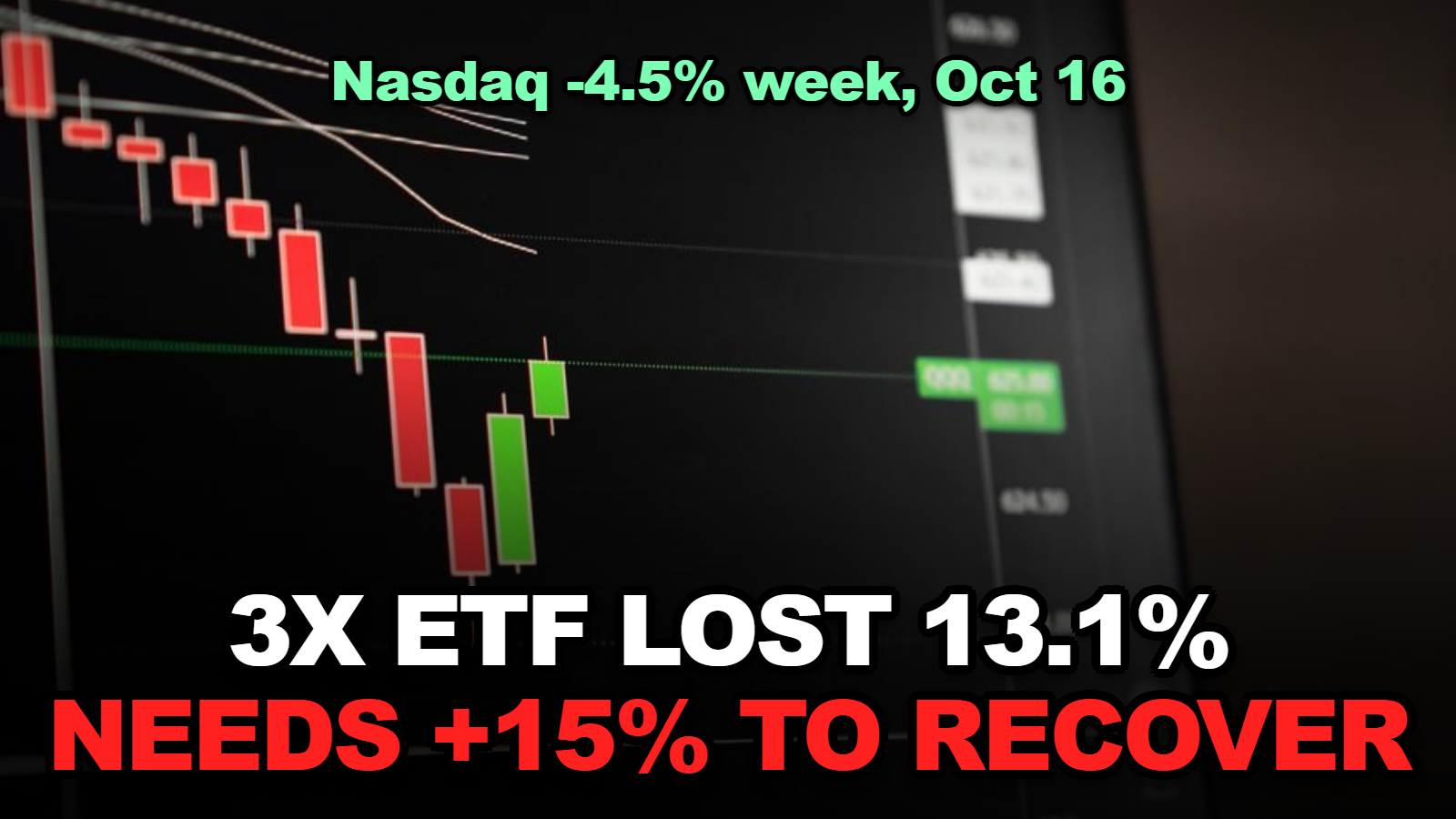
Short answer: The Nasdaq composite fell 4.5% between the October 9 and October 16, 2026 closes. A 3x leveraged ETF that reset perfectly every day would have lost about 13.1% over the same five sessions, not 13.4%. That gap is small because the week trended one way. The real damage is what comes next. The index needs a 4.7% rebound to get back to even. The 3x holder needs 15.1%. Even if the Nasdaq recovered its whole loss in a single session, the 3x position would still be about 0.9% short.
Friday’s 2.1% drop on the Nasdaq composite closed out the index’s worst week since June, and it also closed out a brutal week for anyone holding a 3x leveraged ETF through it. The number that matters for those holders is not 4.5%. It is the path the index took to get there, because a daily-reset fund compounds each day’s move separately.
I rebuilt that path from the Associated Press closing tables for each session, then ran $10,000 through a hypothetical fund that delivers exactly three times the index’s daily move. Here is what came out.
Not investment advice. Index closes are from Associated Press daily market tables as published by ABC News and La Nación. The 3x figures are a model of a fund that hits its daily target exactly, before fees. Real funds such as TQQQ track the Nasdaq-100, not the composite, charge an expense ratio and will not match these figures.
What This Covers
- How much did the Nasdaq actually fall this week?
- What does a 3x leveraged ETF do on a day like Friday?
- Five Sessions, Two Accounts: the Day-by-Day Ledger
- Why did the 3x fund lose less than three times the index?
- How much does the Nasdaq need to recover before a 3x holder is whole?
- When does the daily reset actually hurt you?
- Should you hold a 3x ETF through earnings week?
- Tips
- Warnings
- FAQ
- Sources
How much did the Nasdaq actually fall this week?
The Nasdaq composite fell 1,226.14 points, or 4.5%, over the week ending October 16, 2026, closing at 26,140.03 after a 2.1% drop on Friday alone, according to the Associated Press market table published by ABC News.
The S&P 500 lost 1.9% over the same five days. The Dow actually gained 0.7%. The Russell 2000 fell 3%.
Two of the five sessions did almost all of the work. Wednesday, October 14 took 1.9% off the Nasdaq after the September inflation report came in hot. Friday took another 2.1% as chip and AI stocks sold off. Monday and Tuesday were small declines. Thursday was a 0.1% gain that barely registered.
Year to date the Nasdaq is still up 12.5%. On Monday morning it had been up 17.2%.
What does a 3x leveraged ETF do on a day like Friday?
A 3x leveraged ETF such as ProShares UltraPro QQQ (TQQQ) seeks “daily investment results, before fees and expenses, that correspond to three times (3x) the daily performance” of its index, according to the ProShares fund page, and the key word in that sentence is daily.
On Friday the Nasdaq composite fell 2.145%. A perfect 3x fund on that index would have fallen 6.435%. Then at the close it resets. Saturday morning its exposure is 3x of whatever it is now worth, not 3x of what you originally invested.
That reset is the whole story. It is why the SEC’s Office of Investor Education and Advocacy says in its investor bulletin on leveraged and inverse ETFs, updated August 29, 2023, that these products are designed to achieve their stated objectives on a daily basis and that performance over longer periods can differ significantly from the stated daily objective.
Most people buying a 3x fund have read that sentence. Far fewer have seen what it looks like in dollars over an actual week.
Five Sessions, Two Accounts: the Day-by-Day Ledger
Start with $10,000 in each account at the October 9 close. The index account simply tracks the Nasdaq composite. The 3x account earns exactly three times each day’s percentage move and resets at every close.
| Session | Nasdaq close | Index move | 3x move | $10,000 at 1x | $10,000 at 3x |
|---|---|---|---|---|---|
| Fri Oct 9 (start) | 27,366.17 | — | — | $10,000.00 | $10,000.00 |
| Mon Oct 12 | 27,245.90 | −0.44% | −1.32% | $9,956.05 | $9,868.15 |
| Tue Oct 13 | 27,204.38 | −0.15% | −0.46% | $9,940.88 | $9,823.04 |
| Wed Oct 14 | 26,692.87 | −1.88% | −5.64% | $9,753.97 | $9,268.95 |
| Thu Oct 15 | 26,713.03 | +0.08% | +0.23% | $9,761.33 | $9,289.95 |
| Fri Oct 16 | 26,140.03 | −2.15% | −6.44% | $9,551.95 | $8,692.14 |
| Week | −1,226.14 | −4.48% | −13.08% | −$448.05 | −$1,307.86 |
Closes from AP market tables (ABC News, October 14 and 16; La Nación, October 12). Daily percentages computed from the closes, so they differ slightly from the rounded figures in the wire stories. 3x column assumes a perfect daily 3x fund with no fees.
The 3x account ended the week at $8,692.14. That is a 13.08% loss. Three times the index’s 4.48% would have been 13.44%, or $8,656. The compounding path came out $36 better than the naive multiplication.

Why did the 3x fund lose less than three times the index?
A 3x daily-reset fund loses slightly less than three times the index in a week where the index falls on most days, because each day’s 3x loss is applied to a smaller balance than the day before. Wednesday’s 5.64% hit landed on $9,823, not on $10,000. Friday’s 6.44% hit landed on $9,290.
When I compared the two columns day by day, I noticed that the gap only opens on the big down days. Monday and Tuesday were too small to matter. Wednesday and Friday created almost the entire $36 difference.
This is the part that fools people. In a one-directional week, compounding looks like a friend. It shaved a little off the loss. The same mechanism turns hostile the moment the index starts bouncing, which is what the next two sections are about.
How much does the Nasdaq need to recover before a 3x holder is whole?
After a 4.48% drop the Nasdaq composite needs to rise 4.69% to return to its October 9 close of 27,366.17, while a 3x fund that fell 13.08% needs to rise 15.05% to return to $10,000.
Now run the best case for the leveraged holder. Suppose the Nasdaq recovers the entire 4.69% in a single session on Monday. The 3x fund would gain 14.07% that day, taking $8,692.14 to about $9,915. The index is back to even. The 3x holder is still down roughly 0.85%, or about $85 on $10,000.
Spread that same recovery across several up-and-down sessions and the shortfall grows. The daily reset means the fund needs the index to overshoot its old high before the fund itself gets back to even.
Honestly, that one paragraph is the only thing you need to remember about these products.
When does the daily reset actually hurt you?
Daily-reset leveraged ETFs lose the most ground, relative to simple multiplication, when the index moves sharply in one direction and then reverses, because the fund gains on a smaller base after a loss and loses on a larger base after a gain.
A clean two-day example shows it. The index falls 5% on day one and rises 5.26% on day two, which puts it exactly back where it started.
| Scenario | Day 1 | Day 2 | Index result | Perfect 3x result |
|---|---|---|---|---|
| Round trip | −5.00% | +5.26% | 0.00% | −1.58% |
| Round trip, larger | −10.00% | +11.11% | 0.00% | −6.67% |
| Straight down (this week) | five sessions | — | −4.48% | −13.08% (vs −13.44% naive) |
The index is flat in the first two rows. The 3x fund is not. A 10% dip and full recovery costs a perfect 3x fund 6.67% of its value with the index having gone nowhere.
You will probably notice that this week’s chip-stock selloff has been one-directional so far. If it stays that way, compounding keeps being mildly helpful. The first sharp bounce flips the sign.
Should you hold a 3x ETF through earnings week?
Holding a 3x leveraged ETF through a week of large single-stock earnings reactions exposes the position to exactly the whipsaw pattern in which daily resets cost the most, and the week of October 19, 2026 is dense with third-quarter reports, alongside a chip sector that the Associated Press described on Friday as pulling back further on worries about how long the AI buildout frenzy will last, with Micron down 5.6% and Intel down 5.8% that day.
The ProShares page itself puts it bluntly. For any holding period other than a day, your return may be higher or lower than the daily target, and smaller index gains or losses combined with higher volatility contribute to returns worse than the daily target. Volatility is the enemy. A week of 2% swings in both directions is the worst environment for these funds, even if the index finishes roughly flat.
The decision splits three ways.
- You bought it as a one-day or two-day trade. Then the product is doing what it says. Set your exit before the open and treat each day as a new position, because the fund does.
- You bought it as a cheaper way to be “really long” the Nasdaq. Then this week’s math is the warning. You now need a 15% move to get even where an index holder needs 4.7%. A 2x fund on the same path would have lost 8.84%, and a plain index fund 4.48%.
- You are down and want to “wait for it to come back.” Waiting is the one strategy these funds punish. Every choppy session you hold costs decay even if the index ends the month unchanged.
The expense ratio is the least of your problems here. TQQQ’s net expense ratio is 0.78% per year, with a gross figure of 0.94% before a fee waiver that the fund page lists as running through September 30, 2026. One bad whipsaw week costs more than a decade of that fee.
Tips
- ✅ Write down the index level that gets you back to even before you buy. For a 3x fund it is not the same level as the index’s own break-even.
- ✅ Track your fund’s actual NAV against the index’s daily move for a week. The gap you see is the reset at work, and it is bigger in volatile weeks.
- ✅ If you want leverage over months, compare the cost of a 3x fund’s decay against a margin loan or a long-dated call option. Decay is a cost even though it never appears on a statement as a fee.
- ✅ Check which index your fund tracks. TQQQ follows the Nasdaq-100, which moved differently from the Nasdaq composite used here.
- ✅ Reread the SEC bulletin linked above once a year. It has not changed since 2023 and the lesson has not either.
Warnings
- The 3x figures here are a model of a perfect daily 3x fund with no fees, swaps costs or tracking error. Real funds will differ, sometimes by a lot.
- Daily percentages were computed from the AP closing levels, so they differ slightly from the rounded one-decimal figures printed in the wire stories.
- Leveraged ETFs can lose most of their value in a sustained decline. A 3x fund does not go to zero on a 33% index drop in one day only because of circuit breakers, but a 3x fund can fall 90% over a bad quarter while the index falls 40%.
- None of this is investment advice. Tax consequences of selling a losing position differ by account type and jurisdiction.
FAQ
Does a 3x ETF always lose more than three times the index over a week?
No. In a week where the index falls on most days, as it did from October 12 to 16, 2026, the compounded loss is slightly smaller than three times the index loss. The fund loses more than three times the index when the index whipsaws, because gains are earned on a shrunken base and losses hit an enlarged one.
Why does my 3x fund still show a loss when the index is back to its old level?
Because the fund resets its 3x exposure every day. After a decline the fund needs a larger percentage gain than the index to recover, so an index that returns exactly to its starting level leaves the fund below its starting value. The shortfall grows with the size and number of the swings in between.
Is a 2x fund safe to hold for a few weeks?
A 2x fund has the same daily-reset structure and the same volatility decay, only smaller. Over the October 12 to 16 path a perfect 2x fund on the Nasdaq composite would have lost 8.84% versus 4.48% for the index. It is less violent than 3x, not a different kind of product.
Sources
- Associated Press via ABC News — How major US stock indexes fared Friday 10/16/2026
- Associated Press via ABC News — How major US stock indexes fared Wednesday 10/14/2026
- Associated Press via La Nación — How major US stock indexes fared Monday 10/12/2026
- SEC Office of Investor Education and Advocacy — Updated Investor Bulletin: Leveraged and Inverse ETFs (August 29, 2023)
- ProShares — UltraPro QQQ (TQQQ) fund page, data as of October 16, 2026
🔗 Related guides
Fact-checked against Associated Press closing tables for October 12 to 16, 2026, the SEC investor bulletin on leveraged and inverse ETFs and the ProShares TQQQ fund page as of October 17, 2026. The 3x and 2x figures are our own compounding model, not fund results. This is not investment advice.